By Jeannie Campbell MBE
The Glasgow Uist and Barra Association’s Piping Competition took place in The National Piping Centre’s Otago Street venue on Saturday, 7th March, 2026. With eleven pipers taking part there were eleven different marches played. Some of these have been covered in previous articles but others have not. It is interesting to note that three of the tunes were composed by PM Donald MacLeod, two by John MacColl and one and a half by G S McLennan. Donald MacLeod’s tunes are becoming more and more popular in recent years. This is probably due to the Donald MacLeod Memorial competition, established in 1994, which requires pipers to include tunes by Donald MacLeod in their selections. Consequently these tunes are being played and heard more frequently. The strathspeys and reels played also give evidence of the growing popularity of Donald MacLeod’s music.
Calum Brown
Braes of Castle Grant by Duncan MacDonald

Castle Grant stands a mile north of Grantown-on-Spey and dates from the 15th century. It was originally named Freuchie Castle but was re-named Castle Grant in 1694. The surrounding area is known as the Braes of Castle Grant. The title Earl of Seafield was created in 1701 for an Ogilvy of the same family as the Earls of Airlie. The male line died out in 1811 on the death of the 4th Earl of Seafield and the title passed to Sir Lewis Alexander Grant of Grant whose grandmother was a daughter of the 2nd Earl. Cullen House was the Ogilvy family seat. The Grant family seat was Castle Grant. The Grant Earls of Seafield seem to have lived mainly at Cullen House while still retaining their properties at Castle Grant. Sir Lewis, born 1767, became the 5th Earl. He died unmarried in 1840 and his brother Colonel Francis William Grant became the 6th Earl. He died in 1853 and was succeeded by his son John, born 1814 who became 7th Earl. The Earl’s brother James born 1817, later the 9th Earl was probably the Hon. James Grant who judged at the Northern Meeting in 1869 and their brother Lewis, born 1820, was the Hon. Lewis Grant who judged in 1852, 1855, 1859, 1860 and 1862. The Earl of Seafield was a judge in 1859. The 7th Earl died in 1881 and was succeeded by his son Ian, the 8th Earl, born in 1851, who died unmarried in 1884. His uncle James then became the 9th Earl. He died in 1888. His son Francis the 10th Earl died in December 1888 only six months after his father’s death. His son Captain Sir James Ogilvie Grant 11th Earl of Seafield, born 1876, was in action at Ypres in 1915 in temporary command of the 5th Camerons when he was severely wounded. He died on 12th November 1915 aged 39 from the wounds received in action. Pipe Major William MacLean, Cameron Highlanders composed the piobaireachd Lament for the Earl of Seafield for him.

•Duncan MacDonald was born in 1830 at Balmacaan, son of Alexander McDonald and Mary Chisholm. Duncan’s brother Alexander was piper to MacPherson of Glentruim then piper to the Earl of Fife. He was father of John MacDonald Inverness, and Andrew MacDonald. Duncan’s brother William was Piper to the Prince of Wales and composer of Leaving Glenurquhart. Duncan was taught by Duncan MacKay piper to Duke of Leeds and Donald Cameron. Duncan was Piper to the Earl of Seafield but was probably employed at Castle Grant or on the estate there, as Andrew Gordon was the piper at Cullen House. Although the tune composed by Duncan MacDonald had only two parts the published tune in G S McLennan’s collection has third and fourth parts by G S McLennan and this is what is usually played. Another version in the John MacColl collection has third and fourth parts by John MacColl and for those wanting something different these parts would be well worth playing.
Connor Sinclair
John McColl’s March to Kilbowie Cottage by William Lawrie.
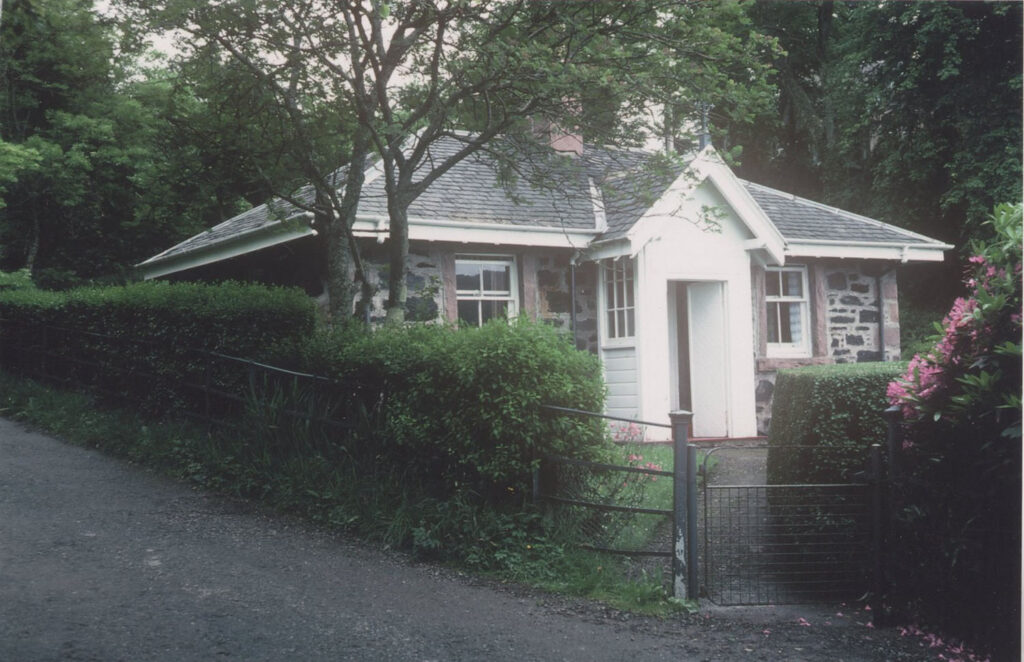
John MacColl and his wife lived in Oban when they were first married in 1894, then moved to Kilbowie Cottage where they lived until moving to Glasgow in 1908.
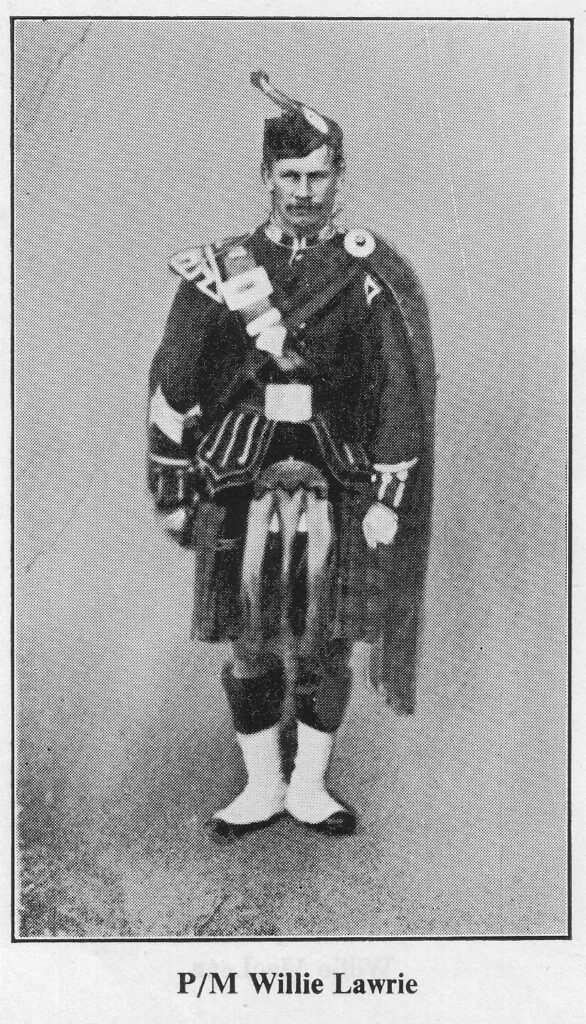
•William Lawrie, was born at West Laroch, Ballachulish in May 1881. Willie had his first piping lessons from his father before joining the 8th Argylls TA in order to improve his playing. Willie worked in the slate quarry at Ballachulish and in later years his widow told of Willie coming home with tunes written on pieces of slate. Willie would visit John MacColl at Kilbowie Cottage for further tuition and after John moved to Glasgow he would visit him there. In 1910 Willie won the Gold Medals at both the Argyllshire Gathering and the Northern Meeting and followed this with a Clasp at the Northern Meeting in 1911. When the war came in 1914 Willie went to France as Pipe Major of the Argyll and Sutherland Highlanders but his health failed in 1916 and he was invalided back to a hospital in Oxford where he died in November of that year at the age of 35.
Jamie Forrester
Jimmy Young by Donald S Ramsay
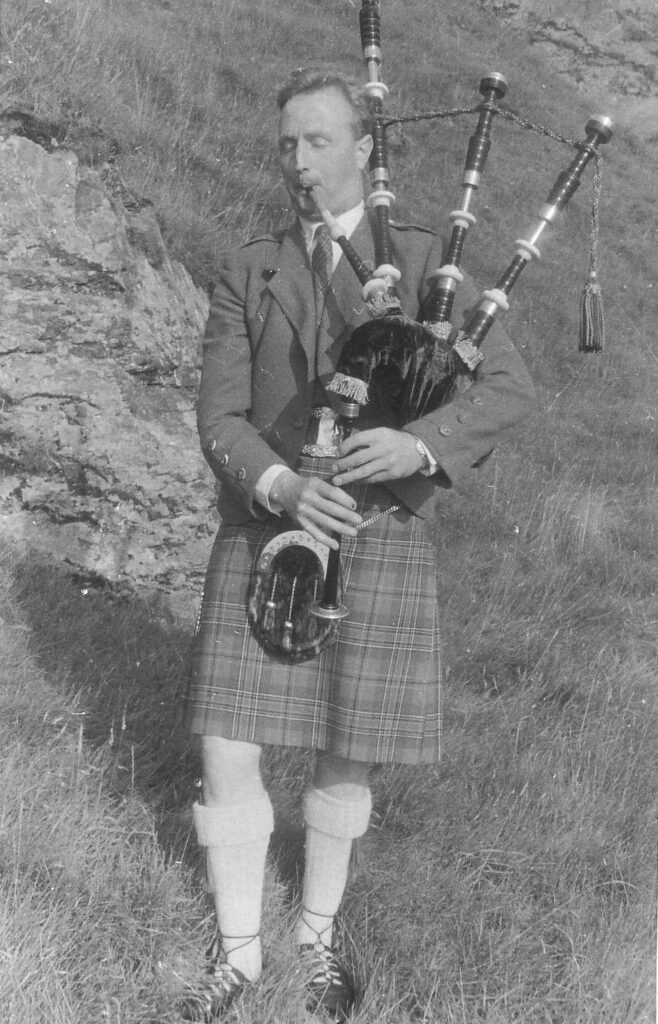
James Young was born on 10th January 1929. His father John and uncles William and James were pipers and Jimmy was taught from the age of nine by his father and his uncle PM William Young who had served as PM of the HLI during the First World War. Jimmy did his National Service with The Royal Scots and afterwards worked as an engineer with British Rail before joining National Cash Register in Edinburgh. Later he worked as a jukebox engineer. During the 1950s Jimmy played with the Edinburgh Police Pipe Band under PM Donald Shaw Ramsay who composed the march Jimmy Young for him. In October 1961 he left Scotland for the USA. A motel chain there had as its insignia a Scots piper complete with red hair and beard and named by them ‘The Wee Scots King.’ The firm wanted a real Scottish piper to promote the business and Jimmy had beaten seven other applicants for the position. Jimmy returned to Scotland 18 months later, married May in her home town of Stornoway and settled there briefly before moving to Perth where he worked as an insurance salesman. In 1965 Jimmy and May moved to South Africa where Jimmy had taken a job in the accounts office of a mining company. During his time in South Africa he won the 100 guineas solo championship in 1965 and 1967 and was Pipe Major of the 1st Battalion Transvaal Scottish. After three and a half years the family returned to Scotland, settled in Cumbernauld and Jimmy resumed his career with NCR in Stirling until his retirement in the mid 1990s. From 1971 to 1974 he was Pipe Major of the 153 (Highland) Regiment Royal Corps of Transport. He won the Strathspey and Reel at the Northern Meeting in 1957 and the March in 1961. Although he never won the Gold Medal he was placed second on four occasions. He was a prolific prize winner at other contests and was known for his smart turnout and immaculate appearance. On his retirement from competition he was greatly in demand as a judge and as a teacher. In 1996 he joined the teaching staff at the College of Piping. In July 2005 Jimmy was teaching as usual and was in the middle of a lesson when he had a bad turn. An ambulance was called and Jimmy was taken to the Western Infirmary where he had another more severe stroke two days later. Eventually he was able to leave hospital and return home but he was not well enough again to return to the College. Jimmy died on 8th March 2017 aged 88.
•Donald Shaw Ramsay was born in 1919 at Muiravonside and taught by Alex Forrest from age 8 and later by William Ross. From 1937 to 1939 he was PM of the Craigend pipe band in Falkirk then from 1939 to 1946 he was PM 10th HLI. He was Piper to Duke of Hamilton 1946-7 then in 1947 he joined the Edinburgh Police and was PM 1949 to 1958. He was shot and injured on police duty in 1957. At the Argyllshire gathering he won the March in 1955. He spent two years in San Francisco 1963-65 then was PM Invergordon Distillery pipe band 1965 to 1967. He died in Falkirk in 1998.
Ben Duncan
Lonach Gathering by William Grant
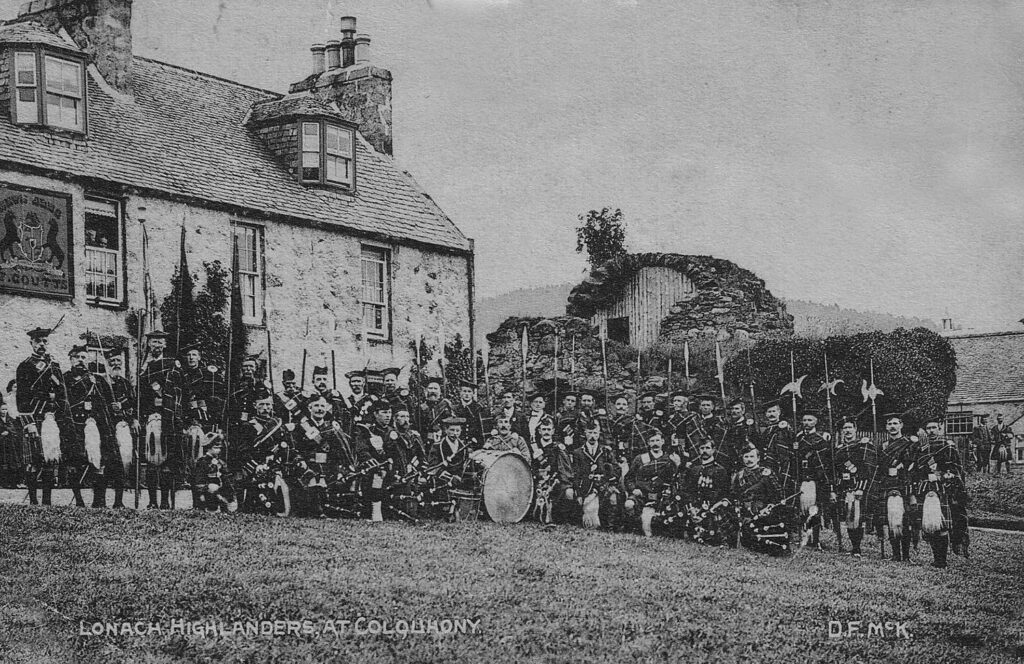
The Lonach Highland and Friendly Society was founded in 1823 by Sir Charles Forbes of Newe and Edinglassie 1st Baronet (1773-1849), with a commitment to the preservation of Highland garb and the promotion of social and friendly feelings among the inhabitants of the district. The current patron is Sir James Forbes, 8th Baronet. Lonach is noted for the march of the Lonach Highlanders. This would start early in the morning and go round the district, pausing at various places where refreshments would be provided. The date of the first gathering is unclear. The 1935 Gathering was reported as the centenary and the 2023 Gathering as the 180th.
The first newspaper account was in 1845 when in September that year papers said ‘Lonach Gathering. The annual meeting of the Lonach Highland and Friendly Society took place on the 15th inst. From the increasing prosperity of this excellent and benevolent institution, and the anxious preparation that had been made for the Games, an unusual interest was excited throughout the Strath in the proceedings of the day. The weather proving all that could be wished, people from all quarters crowded to the arena where the games were to be contested. Lonach the slogan of the Strathdon men, was raised at an early hour, and the trysting place, the Brig of Ernan, at the foot of Lonach was soon thronged with the members. At the summons of the bagpipe the Highlanders fell in, and having, in procession, paid their usual visits, the sports of the day commenced. The competitors for the different games were numerous, each of which, in the true Highland spirit of friendly rivalry was keenly contested. The prizes for the best Highland dancing, and the best dancer of Ghillie Callum, especially interested the numerous assemblage of spectators.’ The results of the athletic and dancing events followed but there was no mention of a piping competition.
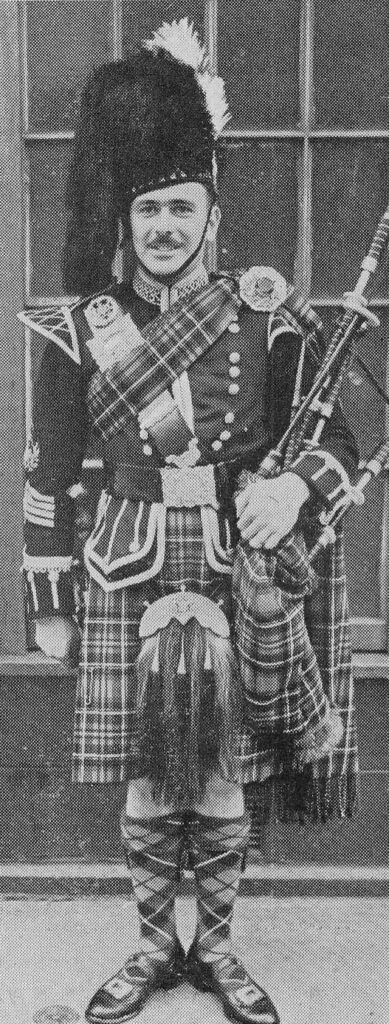
•Pipe Major William Grant was born in 1888. He joined the 2nd Battalion Scots Guards in 1908. He was wounded during the first Battle of Ypres in 1914. He lost an eye and carried pieces of unrecovered ammunition in his body for the rest of his life. After recovery from his wounds, he served the Royal Household in Windsor, before returning north, eventually settling in Strathdon in 1930. Grant was employed on the Candacraig estate and soon became Pipe Major of the Lonach Pipe Band. He was a well respected teacher. He died in 1963.
Steven Leask
Mrs Duncan MacFadyen by Donald MacLeod
Mrs Duncan MacFadyen was Effie or Euphemia Beaton before her marriage in 1924 to Duncan MacFadyen. Her death was reported as follows in the Piping Times July 1988. ‘Last month the Highland and the piping community in Glasgow was saddened to hear of the death of Mrs Duncan MacFadyen, mother of the famous piping brothers. A native of Mull she had come to Glasgow where she played a prominent part in the Highland community there. Four of her sons became professional pipers and three of them – John, Duncan and Iain – won Gold Medals at both Oban and Inverness. She was 86 years of age and had survived her husband by two decades. On a bright sunny afternoon she was laid to rest beside her husband in Craigton Cemetery, attended by a very large crowd of relatives and friends.’
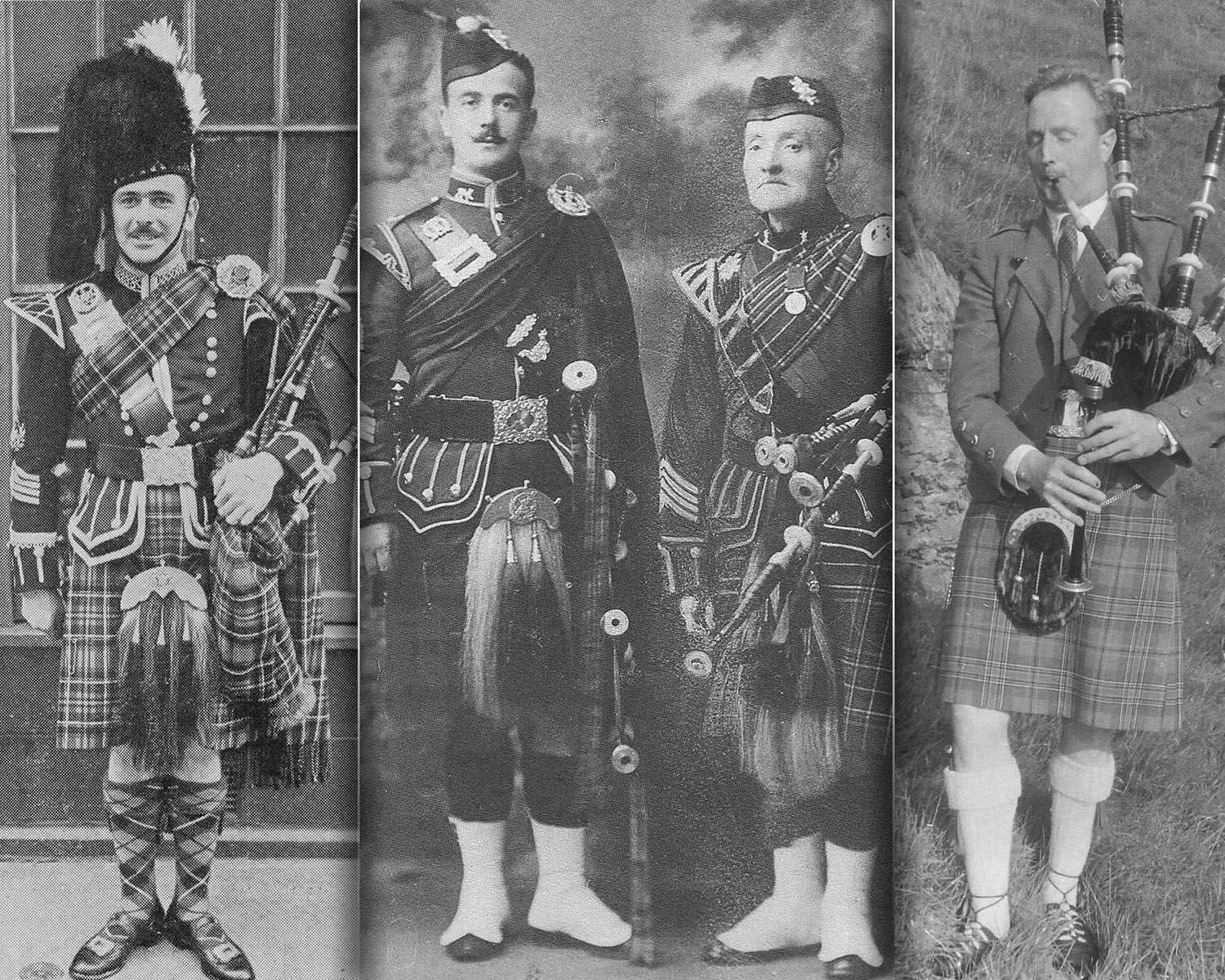
•Donald MacLeod was born in Stornoway, Lewis in 1916. His first teachers were his father and John Morrison Assynt House, followed by William Ross and then John MacDonald, Inverness for 25 years. He joined the Seaforth Highlanders in 1937 and was Pipe Major 1941-63, at the Depot 1941-42 then 7th Seaforth 1942-46. He was captured with 51st Highland Division but escaped and rejoined the regiment. He was with the 9th Training Batt 1946-47 then Instructor Highland Brigade and Depot 1948-57 and Highland Brigade and Junior Soldiers wing 1957-62. After his retirement from the army he settled in Glasgow and became a partner in Grainger and Campbell Bagpipe Makers. At the Northern Meeting he won the March in 1947, the Strathspey and reel in 1949, the Gold Medal in 1947, the Clasp eight times in 1948, 1949, 1952, 1955, 1959, 1961, 1962, 1964 and the Former Winners in 1950, 1952, 1953, 1954, 1955 and 1959. At the Argyllshire Gathering he won the Gold Medal in 1954, the Open in 1953, 1957, 1961, the March in 1959, the Strathspey and Reel in 1957 and the Former Winners in 1959 and 1961. He won the Jig at the Northern Meeting ten times, six of them with his own compositions. He made many recordings and published six books of mainly light music, containing many of his own compositions and one book of his own piobaireachd compositions. He died in Glasgow in 1982.

Sandy Cameron
PM John Stewart by G S McLennan.
PM John Stewart was an uncle of G S McLennan and the subject of this march composed by him. John Stewart was born in about 1842, son of John Stewart, a blacksmith and Clarinda Sword who married in Dundee in1838. His sister Elizabeth married police constable John McLennan in Dundee on 25th February 1870. They were the parents of Pipe Major G S McLennan, Gordon Highlanders, who composed the March PM John Stewart for his uncle. Clarinda Sword, widow of John Stewart, blacksmith, aged 72 died at 20 Panmure Street, Dundee, on 24th December 1886.
John Stewart served with the 3rd Dundee Highland Volunteer Battalion, Black Watch. At this time the Volunteers band was led by PM Donald Bain.
In 1879 John Stewart was the founding Pipe Major of one of the early civilian pipe bands. The first mention of the band is in small advertisements which appeared in the local papers towards the end of November 1879, ‘Dundee Highland Pipe Band. Patronage – The Dundee Celtic Club. Practice – Monday and Wednesday evenings, Lower Anteroom, Cutlers’ Hall, 138 Murraygate. Pipe Major John Stewart. Corporal Murdoch McKinnon.’ Another report was published by the Dundee People’s Journal on 20th December 1879, ‘Formation of a New Pipe Band. Dundee. A number of pipers in Dundee have formed themselves into a band under the patronage of the Celtic Club, with the view of increasing the interest in Scottish Highland bagpipe music. The band consists of nineteen members. Pipe-Major John Stewart has been appointed leader, and they paraded several of the principal streets of the town on Saturday afternoon playing a number of favourite airs. Considerable expense will necessarily incurred in providing uniforms and instruments and it is to be hoped that the lovers of the national music will assist the promoters in carrying out their object.’ More advertisements followed, mainly concerning fund raising concerts and prize draws. In 1894-95 the Post Office Directory included the information that ‘Dundee Pipe Band meets in Cutlers Hall Tuesdays and Fridays Pipe Major J Stewart 62 Commercial St.’
In 1895 John Stewart became the Pipe Major of the Dundee Volunteers after the death of Donald Bain. He was appointed PM of the Battalion and was awarded the Volunteer long service medal in 1902. He died on 25th October 1913. He was unmarried and his occupation was iron moulder. A report of his funeral was published in the Dundee Courier on 30th October; ‘Well-Known Dundee Piper Laid to Rest—Impressive scenes were witnessed at the funeral at Dundee yesterday of Mr John Stewart, late pipe-major, V.B.R.H. The funeral was largely attended, a detachment of Territorials being present. On the way to the cemetery Pipers Key and Stewart played The Flowers of the Forest, and at the graveside Major McLennan, a nephew of the deceased, gave a rendering of the pathetic Lochaber No More. Deceased was a well known local piper, and had also taught many who have achieved fame in that line.’
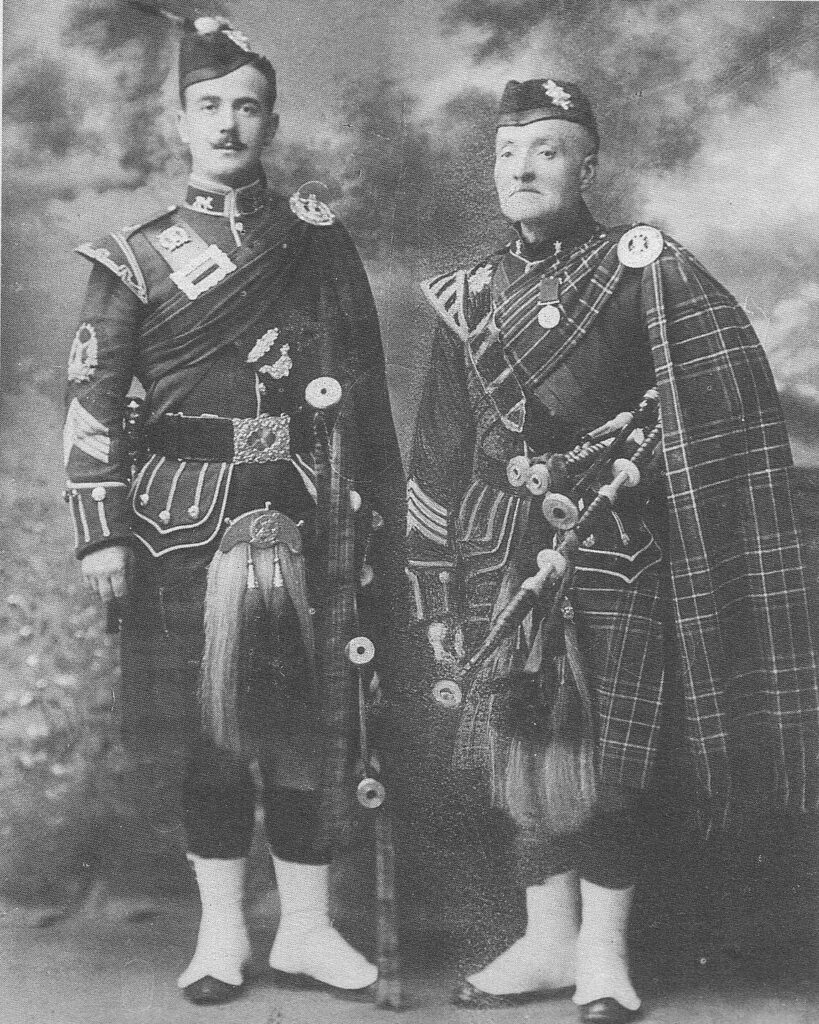
•George Stewart McLennan was born in Edinburgh in 1883. He was a sickly child, unable to walk until the age of four and a half, but began to learn piping from his father when aged four. George had additional tuition from his maternal uncle John Stewart and later had a year of tuition from John MacDougall Gillies. He enlisted in the Gordon Highlanders in 1899 and was appointed Pipe Major in 1905. He served through the First World War and was discharged in 1922, after which he had a bagpipe and reed making business in Aberdeen. At the Northern Meeting he won the March in 1903, the Strathspey and Reel in 1904, the Gold Medal in 1905 and Clasps in 1909, 1920 and 1921. At the Argyllshire Gathering he won the March in 1903, the Strathspey and Reel and the Gold Medal in 1904. He died in Aberdeen in 1929.
Callum Beaumont
Argyllshire Gathering by John MacColl.
The Argyllshire Gathering was founded in 1871 following the wedding of Queen Victoria’s daughter Louise to the Marquess of Lorne, heir to the Duke of Argyll. The tune was composed some time later by John MacColl. The County families still gather every year and on the day of the Highland Games the Chieftain and the members and stewards of the Gathering march from Argyll Square, to the games field led by the competing pipers. The last tune played on entering the field is the Argyllshire Gathering.
•John MacColl was born in 1860 at Kentallen in Duror. In summer 1877 John heard Donald MacPhee play at Bonawe Games, and was inspired to emulate him. He took a job at Bonawe quarry until he had saved enough to take him to Glasgow where he worked with MacPhee and was able to learn from him. By 1879 Donald MacPhee was seriously ill and he died in 1880 so John returned to Argyll. In 1879 he played at the Lorn Ossian Games and in 1880 he played at the Argyllshire Gathering. In 1881 he was Piper to MacDonald of Dunach. John’s future wife Ellen Carruthers was employed as a housemaid at Dunach by 1891 and her sister Maggie was the cook. By 1891 John was able to support himself by competing in piping, dancing and athletics, with some teaching during the winter months when he was employed by the army to teach the TA pipers. In 1908 he returned to Glasgow where he became the manager of R G Lawrie’s bagpipe shop. He won the Gold Medal at the Northern Meeting in 1883 and the Clasp in 1884, 1888 and 1900 and the Strathspeys and Marches in 1882. At the Argyllshire Gathering he won the Confined Strathspey and Reel in 1880, the Confined March in 1881, the Gold Medal in 1881, the March in 1890, the Strathspey and Reel in 1883, the March Championship in 1892, the Strathspey and Reel Championship 1893, the Open equal first 1901 and 1st 1902. He died in Glasgow in 1943.
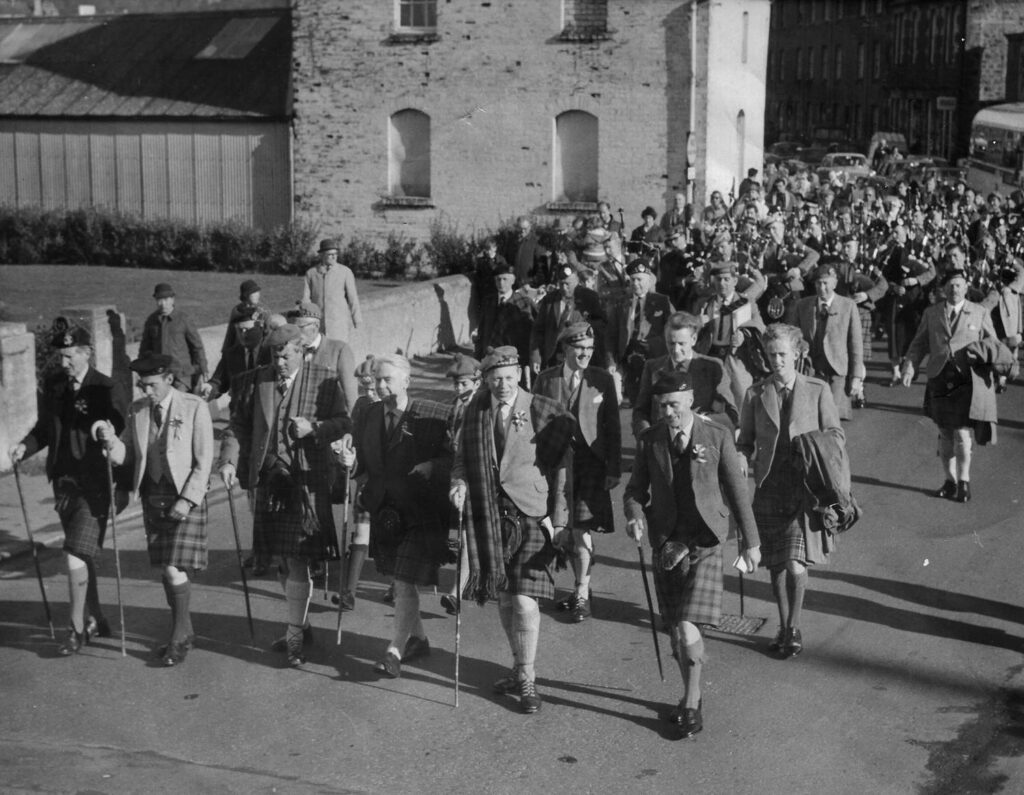
Sarah Muir
Duncan MacColl by Donald MacLeod
While I do not know for certain the identity of Duncan MacColl, a possible candidate would be a well known amateur piper of that name. He was a member of the Piobaireachd Society and the Royal Scottish Pipers’ Society. He judged frequently during the 1950s and 1960s and won many prizes at the RSPS competitions. He was Pipe Major of the RSPS 1949-51. In 1953 the College arranged s recital at the Argyll Hotel in Campbeltown on 21st November with pipers Duncan Johnstone, Seumas MacNeill, Thomas Pearston, John MacFadyen and Duncan MacColl taking part. At Cowal in 1954 the judges for piobaireachd were two representatives of the Piobaireachd Society, Duncan MacColl of Glasgow and Maxwell MacDonald of Largie. He judged at the Uist and Barra, the Scottish Pipers Association, the Highland Pipers’ Society and the Argyllshire Gathering. He may be Duncan MacColl, Pollokshields, who won second prize for piobaireachd at the SPA amateur competition in 1927. The report stated, ‘MacColl played a very difficult tune, but he timed it very correctly and skilfully. He is a very promising player who will be heard of again. His carriage and smart appearance should be taken as an example by other pipers.’
Finlay Johnston
Mrs John MacColl by John MacColl
Mrs John MacColl was the wife of John MacColl, who composed the tune. She was Ellen Carruthers, born in 1863. The Carruthers family were originally from Dumfries and all the children had been born there but by 1881 they were living at the home farm on the Kilberry estate where Ellen’s father John was the farm manager. Ellen’s brother John was an excellent piper. By 1891 Ellen was employed as a housemaid at Dunach, where her elder sister was the cook. A younger sister Jeannie was commemorated in the march Jeannie Carruthers. John and Ellen were married at Dunach in 1894 and set up home at 9 High Street in Oban, where John had been living prior to his marriage. A few years later the family had moved to Kilbowie Cottage and in 1908 they moved to Glasgow. John and Ellen had two sons and two daughters.
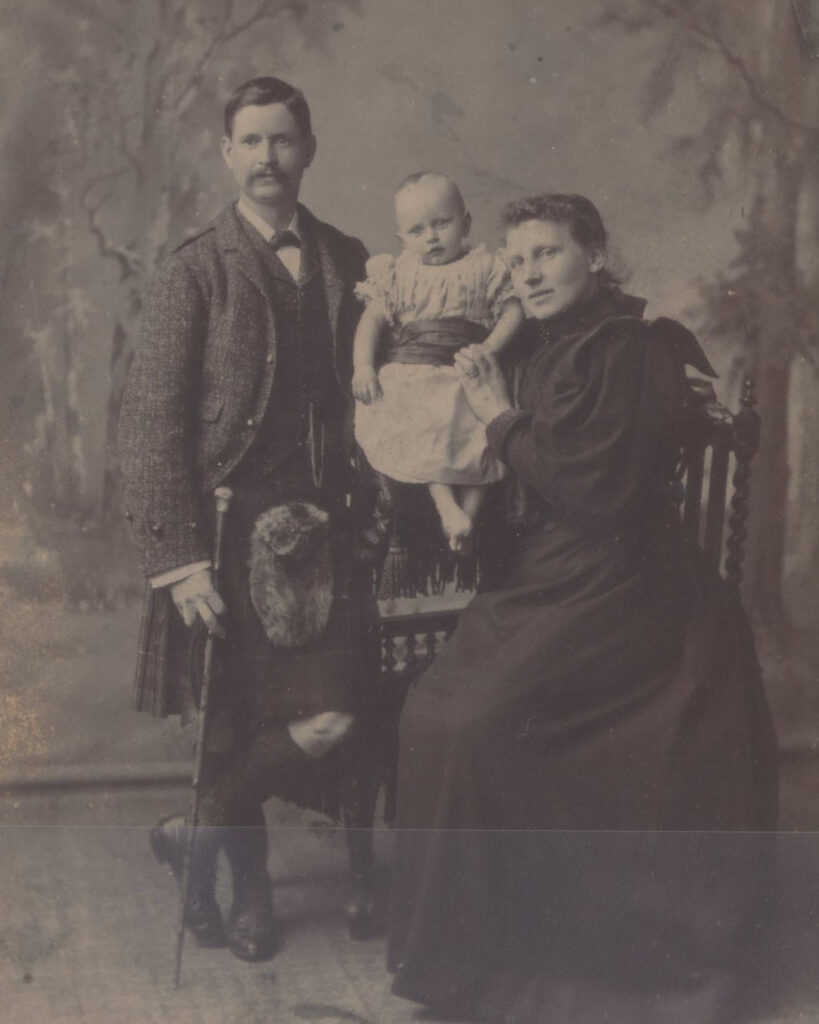
Angus D. MacColl
Ross-shire Volunteers by PM J J Connan
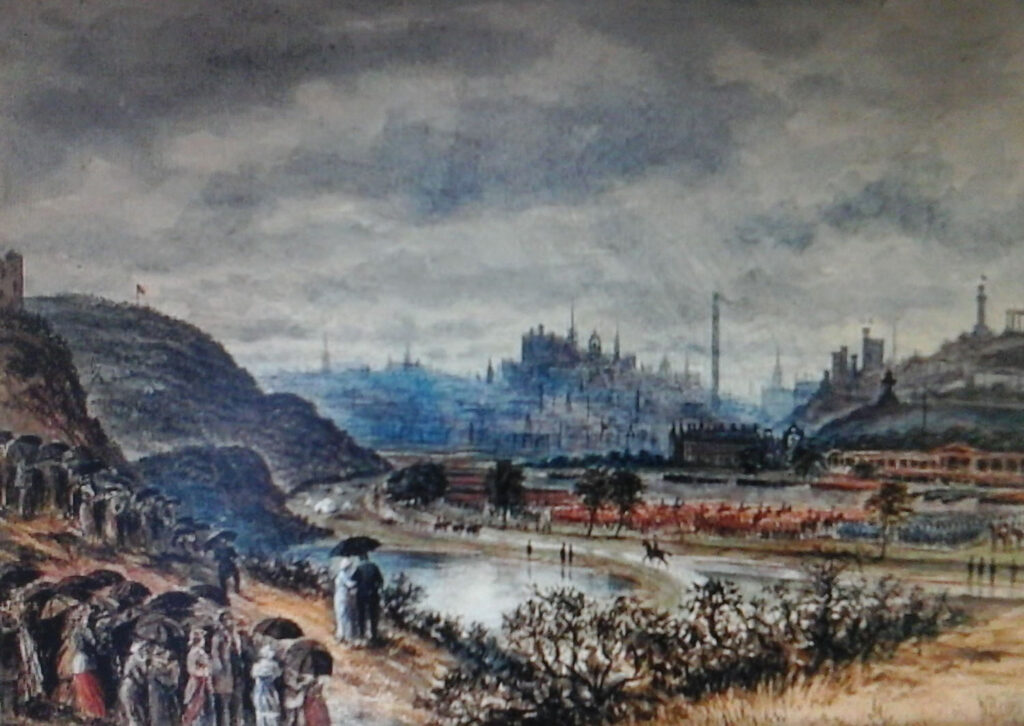
Following the Crimean War it was clear that with half of the British Army stationed around the Empire on garrison duty, it had insufficient forces available to dispatch an effective expeditionary force to a new area of conflict, unless it was to reduce the home own defences. In May 1859 the formation of volunteer rifle corps was authorised under the provisions of the Volunteer Act 1804, which had been used to form local defence forces during the Napoleonic Wars. A review was held in Edinburgh in August 1860 when 300,000 spectators gathered in the Queen’s Park, Edinburgh to see the first Royal Review of over 21,000 Volunteers, who had travelled to Edinburgh to be inspected by the Queen and Prince Albert. From 1872 volunteer units became increasingly integrated with the Regular Army. In 1881 under the Childers Reforms, volunteer corps became volunteer battalions of the new “county” infantry regiments and adopted the volunteer battalion designation and the uniform of their parent regiment. To mark the 1881 reorganisation a Grand Review was held in Queen’s Park in Edinburgh. 40,000 men gathered and it was reputed to be the largest military assembly in Scotland since the Battle of Bannockburn. No sooner had the men assembled in the park than the heavens opened, in a downpour that lasted for the whole day. From forenoon till night rain fell steadily in a drenching downpour and what otherwise could have been a brilliant spectacle was shorn of most of the glory by the ravages of the weather. In a short time the men were wet to the skin. Clad only in red tunic, tartan kilt and glengarry they had little to protect them as they stood for hours in the pelting rain. Had they been on the move, it would not have been so bad, but standing still and letting the rain soak through was torture. The military authorities said they were agreeably surprised at the discipline and bearing of the troops under such conditions. For the men, their ordeal was not over even when they had left the field. Away from home, and with no dry clothes to put on, all they could do was wring out as much water as they could before putting their uniforms back on for the journey home. The “Wet Review”, as it was afterwards known, was responsible for a considerable death toll, due to pneumonia and similar afflictions contracted in the damp conditions. Although no record has been found of those attending, the Ross-shire Volunteers were probably present. As the tune appears in early collections as The Ross-shire Volunteers Farewell to Edinburgh 1881 it is very likely that the name reflects the occasion. One good result of the fiasco was that the equipment of the volunteer regiments was improved. Ronald MacKenzie was PM Ross-shire Volunteers 1879-1893. In 1907 the Territorial and Reserve Forces Act merged the Volunteer Force, the Militia and the Yeomanry to form the Territorial Force in 1908.
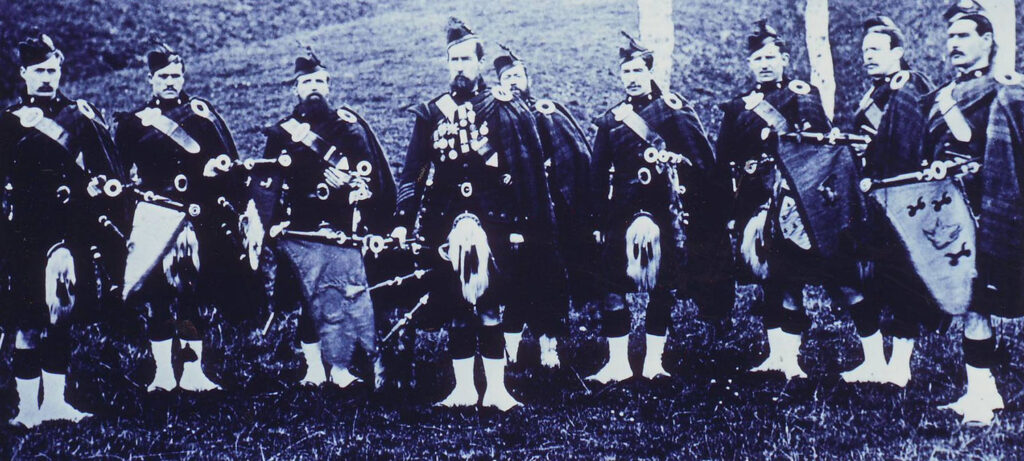
•The composer John James Connan was from a Ross-shire family but was born in London in 1859 and learned his piping under John MacKenzie, Instructor at the Royal Caledonian Asylum. In 1878 he was Piper to Tulloch and from 1879-1881 Piper to John Henry Dickson, Inveran Lodge, Poolewe. He may have been associated with the Ross-shire Volunteers at this time. He won the Northern Meeting Prize Pipe and Former Winners Gold Medal in 1880. In 1882 he was Pipe Major of the Royal Scots. His tune today is better known simply as The Ross-shire Volunteers. John J Connan died in 1915 aged 56.
Brodie Watson-Massey
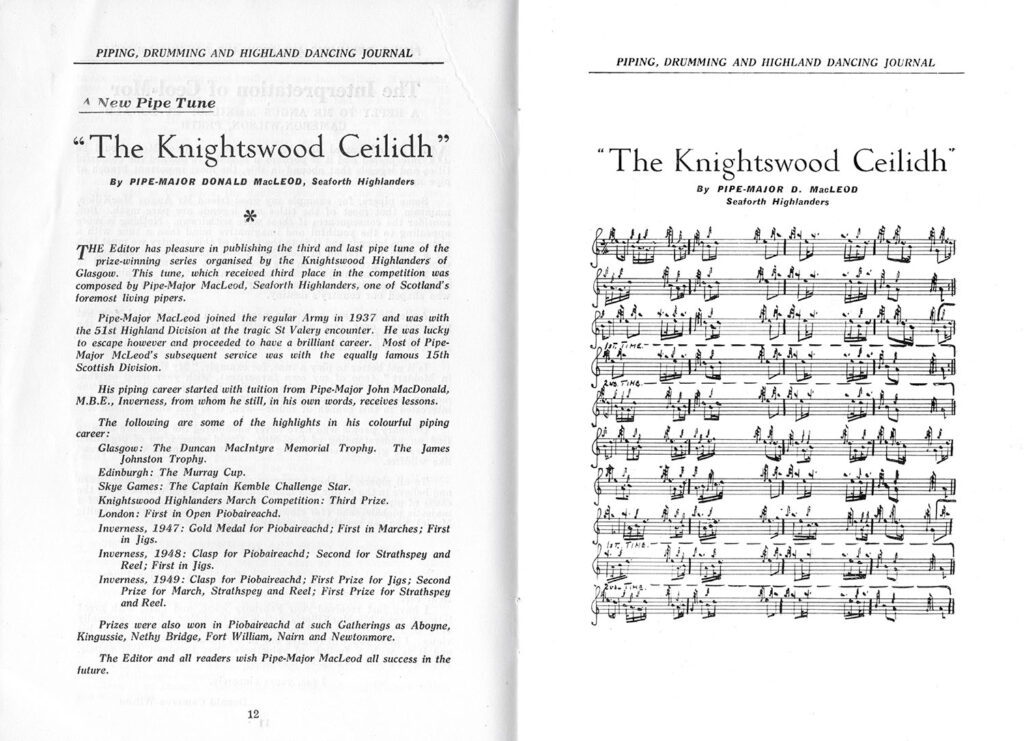
Knightswood Ceilidh by Donald MacLeod
In March 1949 the Piping, Drumming and Highland Dancing Journal reported on what they described as an interesting competition sponsored by the Knightswood and District Highland Association. Pipers were invited to submit tunes of their own composition for which valuable money prizes were offered. In all forty tunes were received by the adjudicating committee and in their opinion the standard of music was exceptionally high. The first prize was awarded to Pipe Major Hector MacLean, Glasgow and his tune was named The Knightswood Highlanders. The editor had been given permission to publish the winning tunes and the first prize tune was published in the Journal in February 1950. John MacLellan’s tune Allan Rowan of Port Appin was placed second and was published in the March edition of the Journal. The third prize winner was Donald MacLeod’s tune which was named The Knightswood Ceilidh. It was published in the April edition of the Journal.