


Come prepared to learn. Come prepared to contribute
The Pipe Bands’ Association of Southern Africa in conjunction with Dr Sandy Geyer is hosting a Leadership Workshop in Johannesburg on Saturday, May 9, 2026 from 2-5pm.
This interactive workshop explores leadership in pipe bands not as a title, but as an identity. Rather than focusing only on “how to lead,” we will explore a deeper question: Is leadership something we do — or something we become? The workshop is tailored towards pipe majors, leading drummers, tutors, committee members and emerging leaders.
To attend, contact the PBASA here, or Dr. Sandy Geyer here.

Workshop Overview
This three-hour interactive session is designed for pipe majors, leading drummers, tutors, committee members and emerging leaders. It combines:
• Leadership theory grounded in lived experience
• Pipe band–specific insight
• Facilitated discussion and reflection
• Scenario-based workshop conversations
• Shared contribution toward global best practice
The aim is not only to strengthen leadership within South African pipe bands — but to capture insights that can be shared with the wider global pipe band community.
Session Structure
- The Essence of Leadership
• What is leadership — really? (History of leadership theory and definition)
• Where does leadership begin?
• The difference between being a leader and doing leadership
• The formation of personal leadership identity
We explore leadership as a being-first, doing-second discipline.
- The Being of Leadership
Self-Awareness
• Understanding personal values
• Communication styles and behavioural preferences
• Why leaders respond differently under pressure
Self-Leadership
• Turning awareness into accountability
• Responsibility versus accountability
• Avoiding ego traps attached to titles
- The Doing of Leadership
• Leadership styles and situational awareness
• Positive influence versus control
• Trust and adaptation
• Why one-style-fits-all leadership fails
- Leadership in Pipe Bands
This section applies the framework directly to pipe band culture: (Recognise these?)
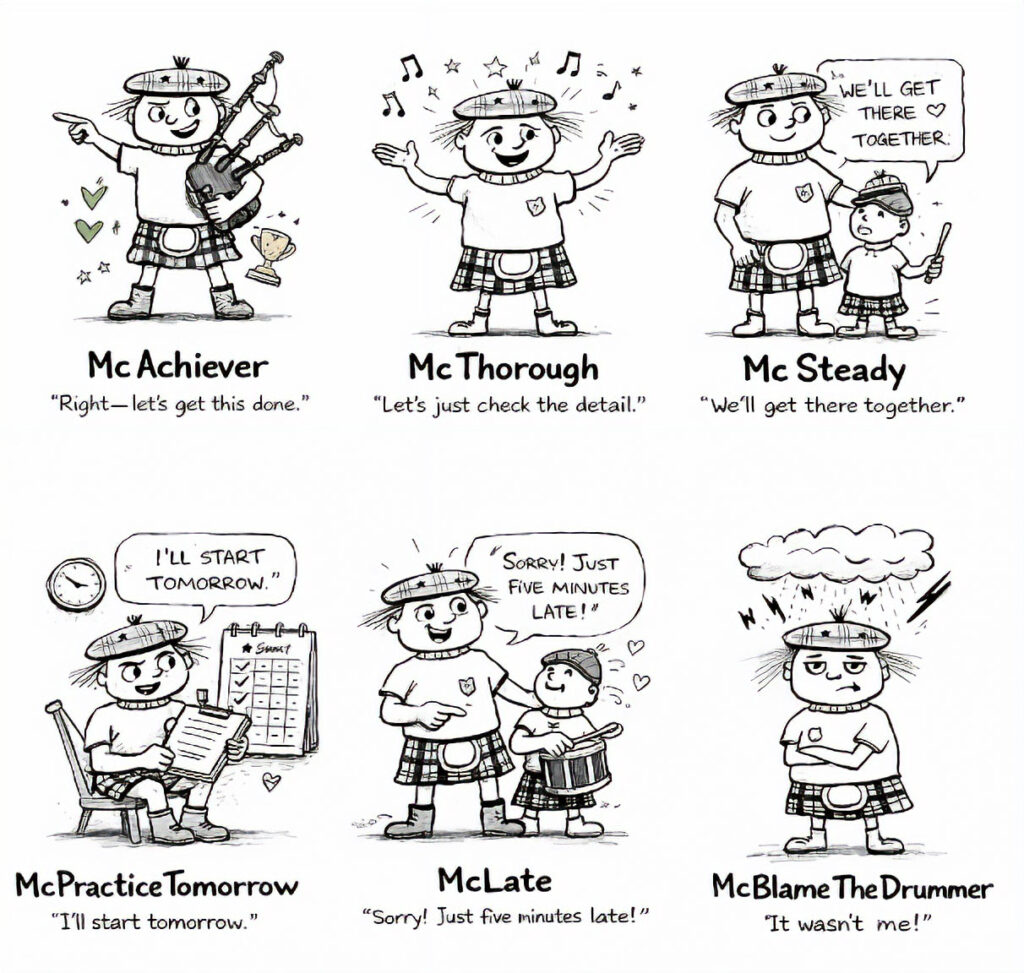
• “MacPersonalities” — recurring leadership patterns within bands
• Bias, gender dynamics and cultural belonging
• Loyalty versus collective good
• The societal trap of titles and unchecked ego
• Scenario workshop: real band situations unpacked collaboratively
- Preparing Future Leaders in Pipe Bands
• How leadership identity forms
• The role of tutors and senior players in shaping future leaders
• Creating succession pathways intentionally
• Avoiding imitation leadership (“just doing it like the last Pipe Major”)
Collective Contribution
Together we will articulate five key leadership messages that the Pipe Bands’ Association of Southern Africa can offer the global pipe band world.
These insights may later be:
• Integrated into a Scotland-facing presentation
• Published as an article in Bagpipe.News
• Shared across global pipe band networks
This workshop is therefore both developmental and contributory.
Presenter Profile

Dr. Sandy Geyer is a South African born leadership researcher, author, pipe band competitor and international speaker whose work centres on identity-based leadership formation.
She is:
• A former pipe major, pipe sergeant and long-standing competitive piper across South Africa and New Zealand
• A leadership educator working across school and organisational systems
• A Doctor of Professional Practice whose research focused on leadership identity formation
• An author and contributor to international pipe band publications
Her work bridges:
• Pipe band culture
• Leadership development
• Gender and bias awareness
• Cultural belonging
• Self-leadership and accountability
She brings both lived pipe band experience and professional leadership research into one integrated framework designed specifically for band environments.
Participant Outcomes
Participants will leave with:
• A clearer understanding of their own leadership identity
• Practical frameworks to apply immediately within bands
• Tools for preparing future leaders intentionally
• Greater awareness of bias and cultural dynamics
• A shared set of principles from PBASA to contribute globally