


GREY’S NOTES
by Michael Grey.
Piping Today #98, 2019.
Hamish Henderson is generally acknowledged as the father of the Scottish folk revival. It was Henderson, poet, activist and folklorist – among other things – who is credited with coining the phrase “the carrying stream”.
Broadly, the carrying stream refers to the passing along of cultural tradition, especially words and music. The flow of the stream, any stream, is a tranquil image on its own. Even Heraclitus had something to say about it: no one ever steps in the same stream twice since it’s never the same stream – and they, with that step, are not the same person. Let the thought of that undulating water transporting a little culture and a lot of music, and the idea of the carrying stream and the forward movement of tradition becomes at once attractive – and easy to understand.

The music of the Great Highland Bagpipe is no stranger to carrying waters. Surely it’s true that in water there is life and so, too, can we look to the vibrancy and vitality of pipe music. While some elements of our music may hover for a time in rock pools – think of the slow-to-change pibroch – others ride the white water of change. In learning the music and playing it well we all have a part to play in advancing the tradition. And with so many hands paddling about in carrying water it’s more apt to think of our stream as more Mississippi than Molendinar.
It’s in the arrangement of music that sits as one of the liveliest of our tradition. Pipe bands, especially, offer a forum for creative expression not common to the solo piping world; well, at least, the competitive solo piping world. Pipe band medleys, concerts and parade sets all offer an outlet for a degree of free-wheeling performance – and, so, the arrangement of music.
And to be clear: what is musical arrangement? In my experience, we often overestimate the freshness we impart on a piece of music. In music, an arrangement is a reworking of an existing piece of music. It is not adding or removing embellishments. It is not changing a few notes here, a few notes there. Music arranging means presenting a previously composed work in an original way. There is no shortage of copyright laws that help set parameters for the music arranger’s work. While the “common law” of bagpipe music seems to historically set its own framework for copyright – meaning: there isn’t much of one – there are laws.
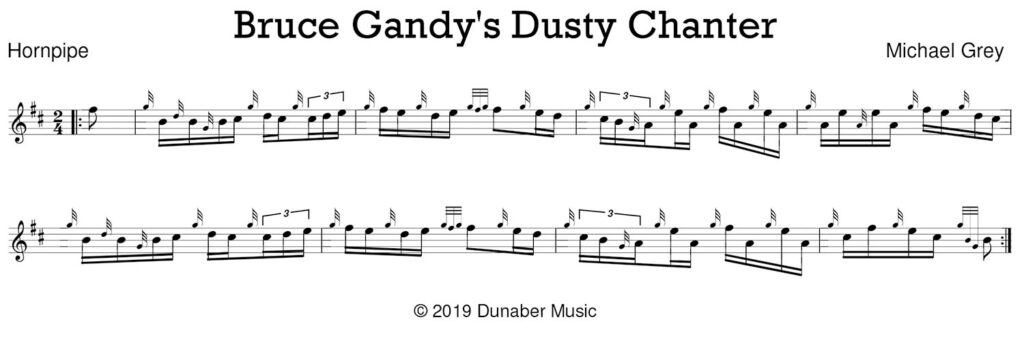
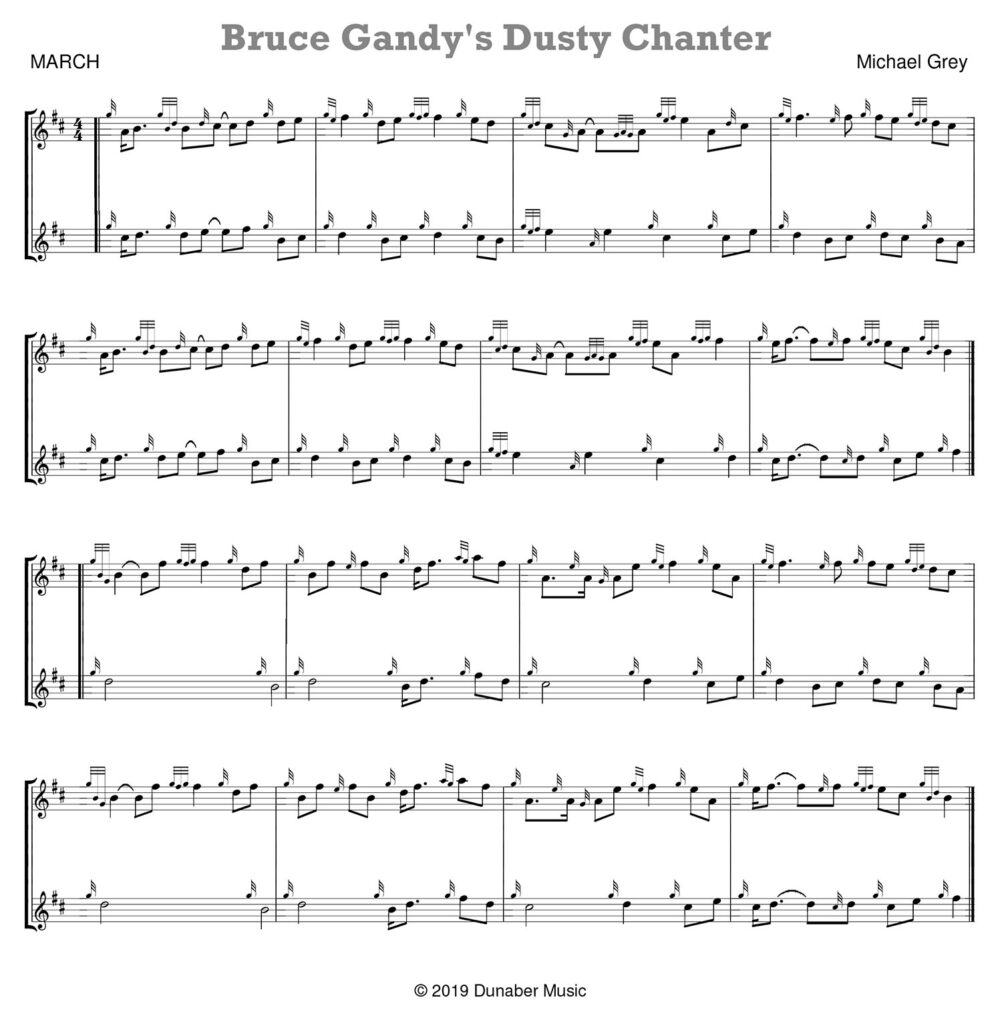
You will see here one view of a pipe tune arrangement. Here is my hornpipe, Bruce Gandy’s Dusty Chanter, rejigged, if you will, as a common time march. Clearly the march was born of the hornpipe. But it is quite different: tempo and melodic paraphrasing are all part of the march arrangement – an echo of the hornpipe.
Now, should you want to record your funky, fresh compound time arrangement of George S McLennan’s The Little Cascade, you could fill your boots. McLennan’s music is now in the public domain. GS died in 1929 so his music became freely arrangeable in 1999 (i.e. 70 years after the composer’s death, the current European Union law related to copyright duration). Now, consider Donald MacLeod’s sizeable catalogue. Before performing – or recording – any reconceptualisation of any of his work permission would be needed from current copyright holders. MacLeod’s music doesn’t hit public domain until 2052.
While some do, I don’t know many in the water where we wade who follow the law. “Oh, it’s only a pipe tune. We aren’t in it for the money.” On the one hand, we diminish our music in thinking this dismissive way. On the other, I must admit, the common lawless piper’s view has been a boon to musical creation. Circumventing process – copyright laws – has given pipers unfettered rein over what, when and how music is shaped.
It’s largely up to us to align with common music world practice. Or not. To discount any law has risks. For pipers, generally, it is to slow the shift to a mark of professional musicianship. I suggest a robust professional element in the world of pipers goes a long way to keep our waters healthy – and carrying.
“Maker, ye maun sing them. …
Tomorrow, songs
Will flow free again, and new voices
Be borne on the carrying stream.”
Mike Grey is the pipe major of 78th Fraser Highlanders since September 2023, and he teaches, judges, writes and publishes bagpipe music. His Grey’s Notes series ran in Piping Today magazine for ten years. His Grey’s Notes book is available here.