

By Dr. Sandy Geyer, July 2026.

For many of us, pipe bands are far more than musical organisations. They become extended families; places where we grow up, find mentors, learn discipline and discover what it means to work towards something bigger than ourselves. Many of the lessons I learnt standing in a pipe band circle have served me just as well in business, leadership and life, and over the years I have heard countless players say exactly the same thing.
That is why healthy pipe band cultures matter. They shape musicians, but they also shape people.

Like every close community, pipe bands develop unwritten rules. Most strengthen us. We encourage beginners, celebrate success, support one another through disappointment and rally together when life becomes difficult. We also develop traditions that are wonderfully familiar. Every band seems to have someone convinced there is only one correct way to fold hose, iron a kilt or pack the trailer after a competition. We smile because those quirks become part of band life.
Some unwritten rules, however, are far less visible.
One of the most powerful is silence.
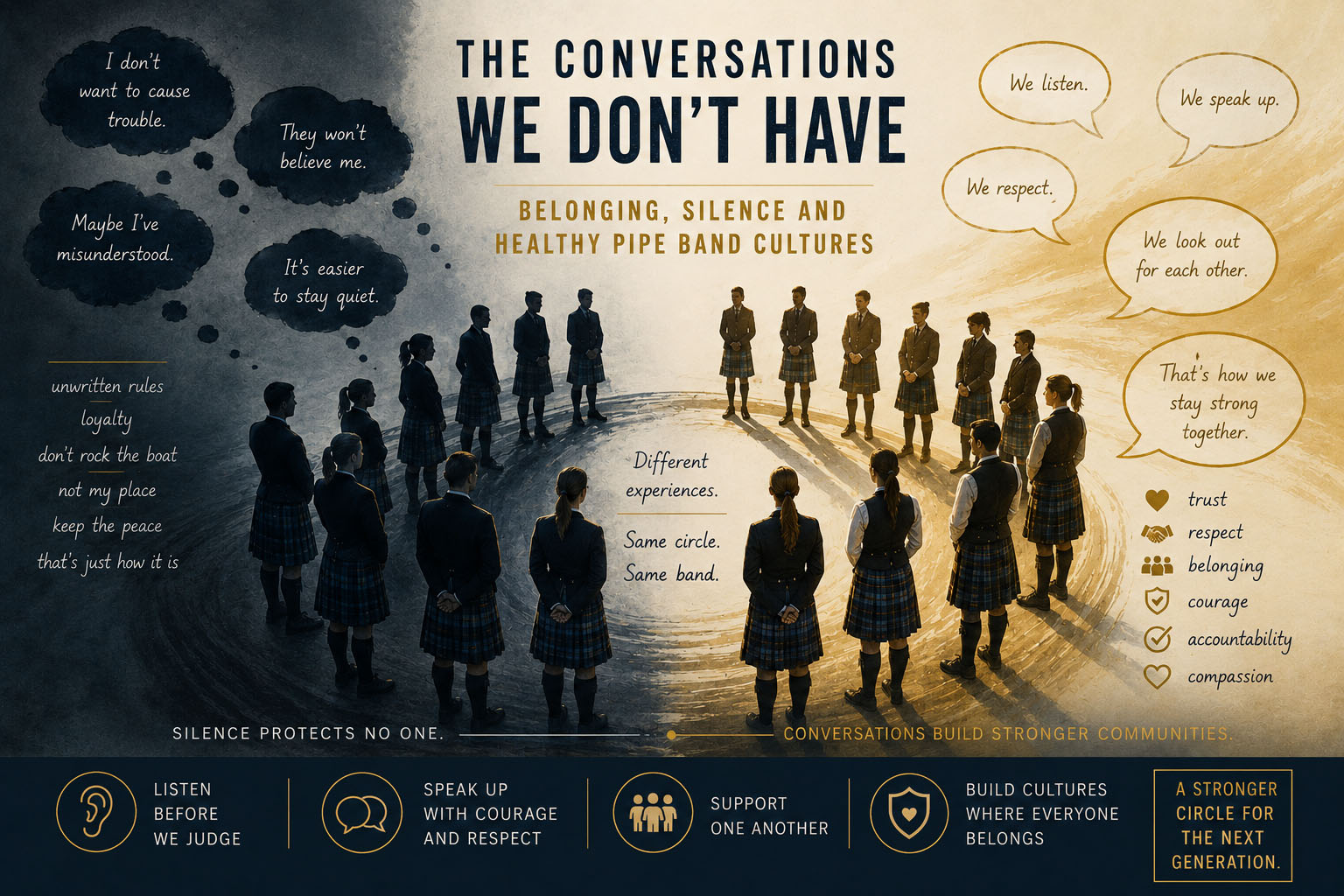
Imagine a young player joining a competitive pipe band. She practises diligently, slowly finds her place in the circle and begins to feel that she belongs. Over time an older member starts paying her more attention than feels comfortable. Nothing dramatic—just comments, messages and interactions that leave her increasingly uneasy.
She says nothing.
Not because she enjoys the situation, but because she worries she will create conflict. She wonders whether she has misunderstood. She worries that she might not be believed and convinces herself that quietly avoiding the situation is easier than risking her place in the band.
Months later she leaves.
When people ask where she has gone someone simply shrugs and says, “Perhaps piping just wasn’t for her.”
Nobody knows the real reason. Not because nobody cared, but because nobody knew.
After publishing articles about my own experiences and later sharing more of my story in Writing Myself Home, I received two very different responses. Many women quietly wrote, “Me too,” or “Thank you for saying it.” Many of the men who had stood beside me for years responded with four simple words: “I had no idea.”
I have thought about those conversations many times since because they forced me to ask a different question. How can people stand in the same circle and yet experience completely different realities?
Perhaps the answer is not that some people care and others do not. Perhaps communities can only respond to what people feel safe enough to tell them.
One of the things I find reassuring about leadership research is discovering that the challenges we experience inside pipe bands are rarely unique to pipe bands. Organisational psychologists have spent decades studying what they call cultures of silence across businesses, schools, sporting organisations, churches, universities and even the military. We sometimes like to think our little world is different. Usually, it isn’t.
Silence rarely begins with one person. It grows gradually. Someone worries they will not be believed. Someone else assumes another leader will deal with it. A friend hesitates because loyalty feels complicated. Leaders see no obvious concerns and reasonably conclude everything must be fine. Yet silence quietly grows between everyone acting with good intentions.
Silence is not loud, but it can be deafening. More importantly, it can be expensive. Organisations lose talented people; trust erodes and opportunities to strengthen culture quietly disappear.
We often describe pipe bands as families. Families can be wonderful places to belong, but they can also be places where difficult things remain hidden for years. Calling ourselves a family should never become a reason for avoiding difficult conversations. It should become the reason for having them well.
Now imagine a different situation. A player notices that one of his friends has a habit of making female members uncomfortable. He has never witnessed anything he would describe as serious. He likes his friend, respects the women in the band and feels caught between competing loyalties. Doing nothing feels easier than risking an awkward conversation.
Years later he discovers several talented players quietly left for similar reasons.
Researchers describe reactions like these through ideas such as the bystander effect and loyalty conflict. They are not evidence that people lack character; they remind us that protecting relationships in the short term can sometimes unintentionally damage communities in the long term.
One of the most influential ideas to emerge from leadership research over the past two decades is psychological safety. I first encountered the term during an animated discussion with one of my own children. Like many parents raised in the “because I said so” generation, my first instinct was probably less, “Tell me more,” and more, “Excuse me, I’m the parent here.” Thankfully the conversation continued because it challenged my understanding of what healthy disagreement really looks like.
Psychological safety does not mean avoiding difficult conversations. It means creating cultures where those conversations can happen without fear of humiliation, exclusion or retaliation. People can still disagree and accountability still matters. The difference is that belonging is not withdrawn simply because someone raises a concern.
The longer I have worked in leadership and leadership research, the more convinced I have become that healthy cultures are not built by avoiding difficult conversations. They are built by learning how to have them well.
This is not a conversation about women or about men. It is a conversation about culture. Most leaders genuinely care and most players want respectful, welcoming bands. Most would be deeply saddened to discover that someone had quietly carried an experience alone.
Which leaves us with an uncomfortable reality.
Leaders cannot respond to problems they do not know exist.
Healthy communities are not those where mistakes never happen; they are communities that know how to respond when mistakes do happen. Research consistently points in similar directions. We educate young players about respect, healthy boundaries and belonging. We provide safe ways for concerns to be raised. We equip leaders to listen before defending, and we encourage bystanders to see speaking up as protecting the community rather than betraying it.
I continue to believe these are conversations worth introducing into youth camps alongside musical instruction. The technical skills we teach are important, but so too are the leadership skills that shape the culture future generations will inherit.
Every pipe band speaks about family, but families are not defined by the absence of mistakes. They are defined by how they respond when mistakes occur. Silence often feels like the safest option. In reality, it can become the loneliest place for the person carrying the experience.
Perhaps the next conversation in piping is not about whether these issues exist.
Perhaps it is about whether we have created cultures where people feel safe enough to tell us when they do.
Continuing the Conversation
This article is the first in a series exploring healthy pipe band cultures.
In the next seminar, The Conversations We Don’t Have, (date and time to be confirmed) we will move beyond awareness to explore practical ways of strengthening our communities together.
Among the themes we will explore are:
- Why healthy communities sometimes become silent.
- Psychological safety and what it really means.
- The bystander effect and moral courage.
- How loyalty, belonging and identity influence our decisions.
- How different McPersonalities naturally respond to difficult conversations.
- Practical ideas for building stronger, healthier pipe band cultures.
My hope is that this conversation encourages all of us – leaders, tutors, players and families – to think not only about the bands we have inherited, but about the cultures we are creating for the next generation.
Dr. Sandy Geyer is an author, educator, business leader and competitive piper living in New Zealand. She holds a doctorate in entrepreneurial leadership preparation (DPP) and works internationally in leadership development for students, teachers, and business owners. www.sandygeyer.com