


By Dr. Sandy Geyer, August 2026.

At 4.30 on a recent Monday morning, my alarm signaled the start of my week.
As I made coffee and fed my somewhat time-confused pets, it struck me that this wasn’t really the beginning of Monday at all. Around the world, people were ending their Sunday. Some had just finished dinner. Others had settled into an evening with family.

Yet within the next hour, we would all find ourselves in the same virtual room, brought together by something that has fascinated me for many years: not simply leadership itself, but the conversations underneath it that we so often don’t have. Conversations about belonging, silence, culture, voice, and what happens when people experience the same band very differently.
By 5.30am, I opened my screen to find the first panel members already waiting. Joining me were Dr Carole Smith, Rory Bellingan, Corey Tillyer, Dr Patrick Regan, Meleana (Mel) Eade and Anna Smart – bringing perspectives from different generations, countries, leadership roles and experiences across the pipe band community. There were smiles, greetings, the inevitable comments about time zones and coffee, a few last-minute microphone checks, and that familiar mixture of anticipation and curiosity that comes before any live discussion. Although many of us had never met in person, it already felt like a conversation among colleagues.
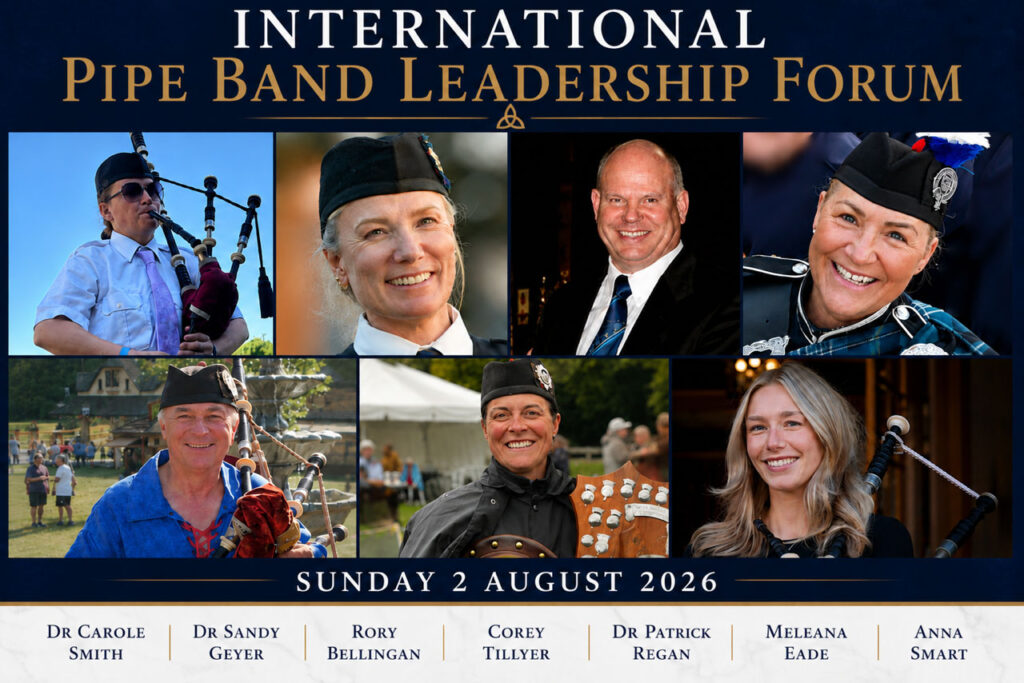
What made the morning particularly special was not simply that our panel represented several countries and different leadership experiences. It was that every one of us cared deeply about the future of the pipe band community and recognised that, while musical excellence has always been at the heart of our movement, the human side of our organisations deserves our attention too.
Our International Pipe Band Leadership Forum was called The Conversations We Don’t Have: Belonging, Silence and Healthy Pipe Band Cultures.
Not exactly the sort of title that promises ninety minutes discussing reeds, chanters and musicality.
Instead, we set ourselves a rather bigger challenge.
What is culture? Who creates it? Who maintains it? Who changes it? How does culture influence whether people feel they belong? Who decides whose opinions matter? When does silence represent agreement, and when does it mean someone has decided that speaking carries too great a cost?
And perhaps most importantly, how do we continue to pursue musical excellence without losing sight of the people who make that excellence possible?
As the discussion unfolded, it seemed to become less about finding definitive answers and increasingly about the quality of the questions themselves. These questions guided the conversation and it began to feel like many threads travelling across great distances and weaving themselves together: different countries, generations, personalities and experiences, occasionally agreeing, sometimes challenging, and often causing me to rethink the next question I had intended to ask.
Again and again, those threads returned us to one word.
Culture. Every band already has one
One of the first observations that changed the language of our discussion came from Dr Patrick Regan, who suggested that perhaps we might also think about culture as an atmosphere.
I liked that description, because atmosphere is something we understand instinctively as we can feel it within ten minutes of walking into a rehearsal room.
We feel in how the players greet one another. We feel it with what happens when someone makes a mistake. By simply watching we soon know who is allowed to joke with whom, who speaks out freely, and who gets interrupted. We see how the leadership responds when something goes wrong.
Patrick recalled playing in a very good band that played well but was, in his words, one of the “coldest” and least friendly bands he had known. There was musical quality, but very little fun. His reflection was simple: humour and kind-heartedness matter.
Dr Carole Smith brought another dimension to that idea by repeatedly drawing us back to the wellbeing of the people inside the organisation. A healthy culture, in her framing, isn’t simply one in which people get along or where obvious conflict is absent; it is one in which people have the opportunity to flourish, develop and feel supported both as musicians and as human beings.
The atmosphere we sense when we enter a band room is really the accumulated experience of all those small interactions. We feel the culture before anyone has explained it to us. So the question is not whether your band has a culture.
The question is who and what are driving it.
My presentation had described culture as being created through what we repeatedly reward, tolerate, celebrate, ignore, challenge and expect.
Those verbs matter because culture isn’t the values statement on a website or the words written into a constitution. It is the accumulation of behaviours that gradually teaches everybody: This is how we do things here.
And that led us to another important distinction.
Our values have to become verbs if we are going to “live” them and not just talk about them. In short, a definition we borrowed from Simon Sinek sums this up as:
“Culture = Values + Behaviour”
I would take that one step further in the pipe band environment:
Culture is our values demonstrated through our behaviour, particularly under pressure. Because values that cannot be translated into behaviour are very difficult to lead.
A band might say that one of its values is belonging, which is wonderful. But what does belonging look like – how do we do belonging?
Perhaps belonging means that we greet the new player by name. Perhaps it means that someone checks in when a member unexpectedly misses several practices. Perhaps it means that questions from a Grade Four player receive the same basic respect as questions from a Grade One player. Perhaps it means that the sixteen-year-old, the sixty-year-old, the neurodiverse thinker, the player from another culture and the only woman in the section do not have to become more like the dominant group before they are considered fully part of it.
If we cannot describe the behaviours attached to a value, we cannot claim to be living it.
Behaviour becomes particularly revealing under pressure. Before a major competition, after a disappointing result, when someone makes a costly mistake or when conflict enters the band, which values remain visible and which disappear through observable behaviour?
Everyone behaves reasonably well when things are easy.
Pressure reveals culture.
So perhaps one of the first questions worth taking back to our bands is this:
If somebody joined your band tomorrow and nobody told them what your values were, what would they conclude those values were simply by watching how you behave?
Who actually drives the culture?
This became one of the areas I found most interesting.
We naturally look towards formal leadership. Pipe Majors, Lead Drummers and committees create expectations, systems, standards and consequences. Their influence on culture is substantial.
But they are only one layer of influence.
Senior players, tutors, popular members and long-standing members hold enormous cultural power too. They may not have formal titles, but they communicate how things are really done here.
And then there are the players themselves.
Every person who laughs at a joke, welcomes a newcomer, ignores poor behaviour, encourages a struggling player, repeats a story about “how we’ve always done it”, challenges something respectfully or decides that something is safer left unsaid contributes to the culture.
This means culture is simultaneously led, inherited, reinforced and negotiated by behaviour.
Corey Tillyer gave us a lovely practical example from her own band. New members receive their music, are actively welcomed and are partnered with someone who can help them find their way into the group. Her band also creates deliberate space at the end of rehearsals for members to raise questions.
That is belonging turned into a verb.
It isn’t “we are a welcoming band.” It is “this is what we repeatedly do to make people welcome.”
Corey had also given me a phrase before the webinar that found its way into the presentation:
Traditions become powerful when they strengthen belonging rather than gatekeeping.
That distinction matters because tradition is itself one of the strongest carriers of culture. Tradition can tell us, you are part of something bigger than yourself. But without reflection it can just as easily communicate, we were here first; if you want to belong, learn to be like us.
Rory Bellingan brought an important stewardship perspective to this part of the conversation too. The challenge is not to discard tradition in the pursuit of something new, but to recognise our responsibility for what we inherit and what we pass on. Pipe bands are custodians of extraordinary traditions; leadership asks us to consider which parts continue to serve the people and the music, which need to evolve, and what our own generation will add before handing that culture to the next.
But does everybody experience the same culture?
This was where the McPersonalities gave us another lens.
My McPersonalities framework describes four broad ways people tend to engage and communicate: McBrave, McInspire, McAnalyse and McSteady. It is deliberately simple, and people can of course be blends, but its usefulness here is that it reminds us that the same rehearsal room is not necessarily the same experience for everyone.
A McBrave may be quite comfortable challenging an idea directly. A McInspire may readily contribute through relationships and conversation. A McAnalyse may notice a problem long before anyone else but want evidence, time and psychological safety before challenging the prevailing view. A McSteady may care deeply about the group and its relationships, but precisely because belonging matters, may be reluctant to risk those relationships by speaking.
In the presentation I posed the question this way:
If every McPersonality experiences the same band differently, are we unintentionally building cultures that work well for some personalities while silencing others?
Anna Smart provided one of my favourite “aha” moments of the morning when she spoke about recognising herself as a McAnalyse. She described having spent much of her earlier life sitting back and listening before eventually realising that she did know what she was talking about and had something worth contributing.
Her reflection also reminded us that developing the next generation of pipe band leaders isn’t simply about teaching them to play or eventually giving them a title. Somewhere along the way, we have to help them discover that their perspective has value and that they have permission to use their voice.
There is something important in that.
We often assess participation by who speaks.
Perhaps leaders also need to become curious about who doesn’t.
When silence isn’t agreement
This brought us to what was probably the most uncomfortable part of the conversation.
Silence.
Patrick identified several different kinds of silence. Sometimes a leader simply needs the room to listen because a decision has to be made or an instruction communicated. Sometimes the naturally talkative people fill the available space and somebody else is unintentionally excluded. And sometimes someone is deliberately silenced.
Mel Eade added an especially valuable leadership reflection. She described discovering that a former Drum Sergeant had disagreed with her but had said nothing. She had believed he agreed because she considered herself approachable.
That distinction is enormous.
Believing ourselves to be approachable does not necessarily mean other people experience us as approachable.
Mel’s response wasn’t that every rehearsal should become a ninety-minute democracy. She recognised that sometimes there simply isn’t time to explain every decision while trying to get a band musically prepared. Instead, she spoke about creating another time and place where questions can be asked and reasoning explained.
That is a much more useful leadership challenge than simply telling leaders to “listen more”.
Create the conditions in which listening can actually happen.
I also shared something that has stayed with me from my own writing. After publishing earlier articles about women in pipe bands, I received private messages from female players around the world telling me about their experiences, often followed by essentially the same request:
Please keep this confidential.
They had voices, they had experiences and they had opinions.
What they did not necessarily believe they had was permission.
That distinction matters, because silence is very easy to misread. It can be agreement, reflection, or timing – it can also be self -protection.
Which brought us back to musical excellence
There was another question sitting firmly underneath this whole discussion.
I have looked at countless photographs of leading Pipe Majors and Lead Drummers over the years. On the field, in the circle, before a performance, their faces often show extraordinary concentration. The shared responsibility and focus is obvious.
And rightly so.
Pipe bands pursue musical excellence. Standards matter. Discipline matters. Expertise matters.
But I found myself wondering:
Has our understandable focus on musical excellence unintentionally narrowed who we believe has permission to speak and to lead?
In many pipe band environments, musical credibility carries enormous influence. The best players become tutors. Tutors become section leaders. Excellent musicians become Pipe Majors and Lead Drummers.
But leadership is a completely different skill set.
Mel captured this beautifully when she reflected on becoming a Pipe Major herself. She knew she could play and teach tunes, but she wasn’t initially convinced that meant she possessed all the skills required to lead. Over the following years, she came to understand leadership as a continuing journey of self-awareness and, importantly, surrounded herself with people whose strengths complemented her own.
Patrick took the thought further: the Pipe Major does not need to be the best at everything. Leadership includes delegation and bringing out the best in other people. His example of involving others in tuning and other responsibilities led to a simple but powerful distinction: it isn’t my band because I am Pipe Major; it is our band.
That made me wonder whether we need to separate two questions more deliberately.
Does musical excellence qualify us to lead music?
And:
What qualifies us to lead people?
They might overlap, but they are not the same.
Musical ability might determine where we stand in the circle but it should not determine whether our humanity gives us a place in the conversation.
So who gets to be heard?
And this became the million-dollar question of the forum: Who decides who gets to be heard?
Our first instinct might once have been to answer: the leader, in reality… the culture decides.
And leaders influence culture.
That distinction matters because a leader may genuinely believe that everyone is welcome to speak while inheriting a culture that has spent years teaching certain people otherwise.
People like you don’t challenge here. You haven’t been around long enough. You’re not playing at a high enough level. That’s not how we do things.
No leader needs to say those words explicitly. Culture (by means of behaviour) is perfectly capable of saying them on our behalf.
So leadership intention isn’t enough.
We have to become curious about the culture people are actually experiencing.
By this point in the conversation, I was beginning to see why the different perspectives around the screen mattered so much. Rory kept us connected to stewardship and the responsibility that comes with tradition; Carole to healthy cultures in which people can flourish; Corey to the practical behaviours that turn leadership theory into everyday experience; Patrick to participation, inclusion and the conditions that enable people to speak; Mel to the reality of leading people while still pursuing demanding musical standards; and Anna to the experience of the next generation finding confidence, identity and voice.
From the leadership triangle to a leadership framework
The above perspectives from the discussion helped me progress something I introduced in my first Pipe Band Leadership Seminar.
My original Pipe Band Leadership Triangle identified three elements of a thriving band: Musical Excellence, Belonging and Leadership.
I still believe strongly in all three.
What I realised while preparing this forum was that the model described what mattered without adequately explaining how we create it.
So underneath those three elements, I have begun placing four leadership practices:
Healthy Conversations. Understanding People. Understanding Culture. Leading with Intention.
And then another question occurred to me.
Which way does the model run?
Do we begin at the top with musical excellence and eventually create leadership, belonging and culture around it?
Or could it also work from the bottom upwards?
Could healthy conversations allow us to understand people better? Could understanding people help us understand the culture they are experiencing? Could understanding culture enable us to lead more intentionally? And could all of that actually support, rather than compete with, musical excellence?
I suspect the answer isn’t perfectly linear. Human organisations rarely are.
But I increasingly believe these things strengthen rather than dilute one another.
Musical excellence earns credibility. Leadership creates direction. Culture determines whether people stay.
Ninety minutes disappeared remarkably quickly.
There were subjects we barely touched and questions I had prepared that we never reached. In many ways, that seems appropriate for a forum called The Conversations We Don’t Have.
Right at the end, as I was preparing to close the session, Rory stopped me.
There was one word, he said, that had appeared a few slides earlier and that he believed sat at the foundation of good leadership.
Humanity.
If humanity is being displayed, experienced and allowed, he suggested, we are probably on the right track.
It was an unexpectedly simple place to land after ninety minutes of theory, research, personalities, leadership models, culture, belonging and difficult conversations.
But perhaps that was the point.
Our pipe bands exist to make music, and musical excellence deserves the extraordinary commitment we give it.
The question isn’t whether we should lower those standards in order to care more about people.
It is whether we are prepared to raise our leadership standards to match our musical ones.
The framework I presented at the end of the forum therefore leaves us with four connected leadership practices: create healthy conversations; understand people; understand the culture they are experiencing; and lead with intention. The premise underneath them is simple: the strongest bands don’t choose between excellence and belonging. They intentionally build both.
And so, rather than ending this article with answers, I would like to leave you where our conversation ultimately left me.
Imagine somebody walked into your band next week.
What would they say your band values, based not on what you tell them, but on what they see you do?
What happens to those values when the band is under pressure?
Who really drives the culture in your band?
Who has permission to challenge it?
Whose voices are heard most easily, and whose do you have to deliberately seek?
What behaviours are you rewarding, tolerating, celebrating or quietly ignoring?
Does musical ability influence whose opinion is considered valuable?
Would your newest, quietest or least experienced player feel able to raise a concern?
What does belonging actually look like as a behaviour in your band?
And perhaps the most confronting question of all:
If you weren’t one of the leaders, would you want to belong to the culture you are helping to create?
Those questions don’t require every band to arrive at the same answers. They simply require us to keep having the conversations.
Because every band already has a culture. The question is not whether one exists.
The question is whether we understand the one we are creating, and whether we are creating it intentionally.
Dr. Sandy Geyer is an author, educator, business leader and competitive piper living in New Zealand. She holds a doctorate in entrepreneurial leadership preparation (DPP) and works internationally in leadership development for students, teachers, and business owners. www.sandygeyer.com