

• PART 70 •
BY JEANNIE CAMPBELL MBE.

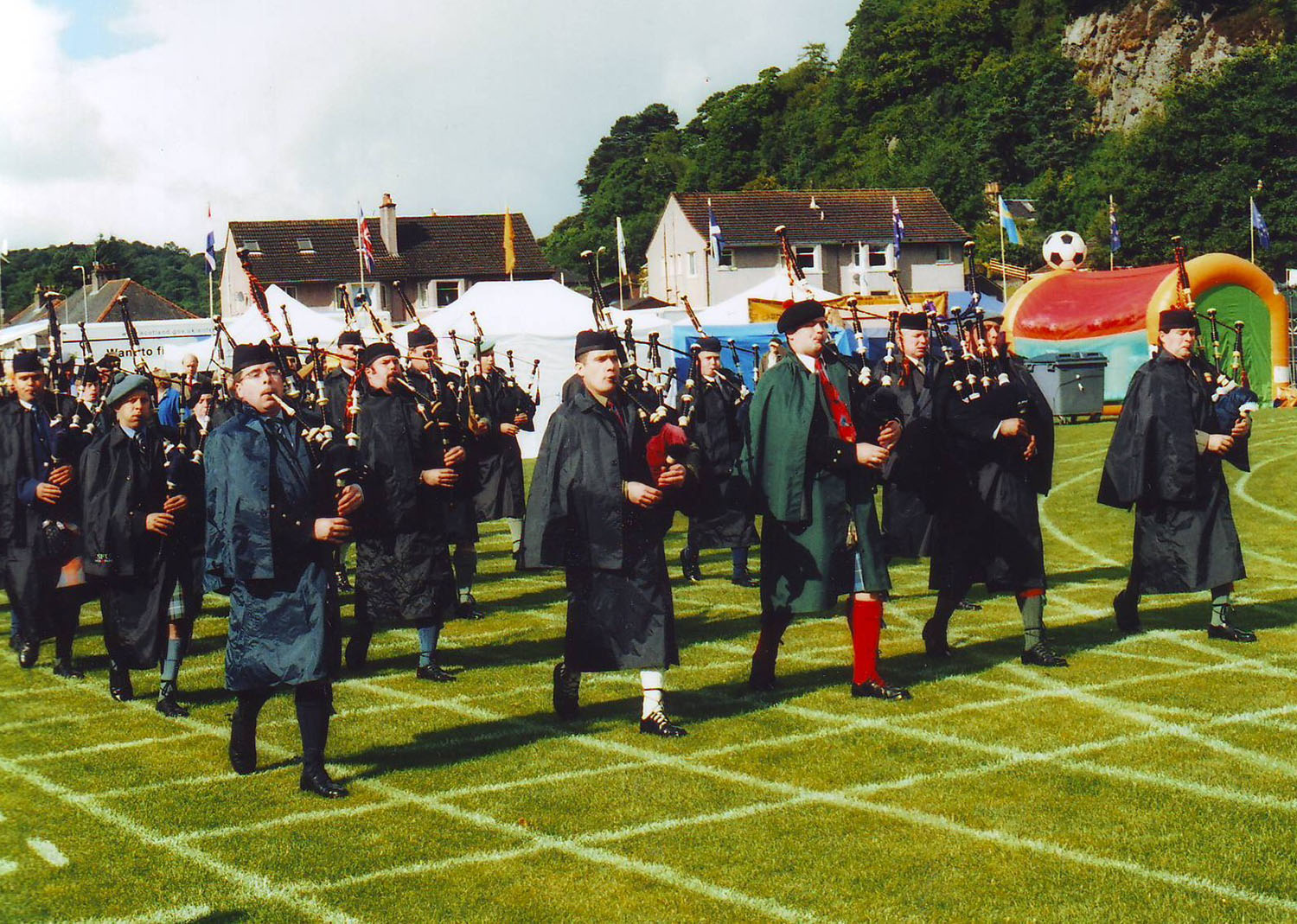
The Argyllshire Gathering in 2005 took place on 24th and 25th August. Three events all started at 9am, the Gold Medal in the Great Western Hotel, The Silver Medal in the Corran Halls and the MacGregor Memorial in the Regent Hotel. An hour later the Senior Piobaireachd began in the Royal Hotel.

The set tunes for the Gold Medal were MacDonald of Kinlochmoidart’s Lament No 2, Clanranald’s Salute, The Gathering of the MacNabs, Lament for Captain MacDougall, MacLeod of MacLeod’s Lament, The Young Laird of Dungallon’s Salute. Four tunes were required and there were 30 names in the programme, with one more added on the day.
The set tunes for the Silver Medal were Lament for the Little Supper, March for a Beginner, Lady Doyle’s Salute, Cluny MacPherson’s Salute, The Boat Tune, MacKay’s Short Tune. Again four tunes were required. There were 30 competitors.
For the Senior event four tunes were to be chosen from Lament for the Union, Lament for the Earl of Antrim, Earl of Ross’s March, Mrs MacLeod of Talisker’s Salute, Beinn a’Ghriain, Nameless-cherede darieva. There were 18 competitors.
The Former Winners MSR started at 5pm in the Corran Halls. There were 20 competitors and the judges were Iain MacFadyen, Bob Worrall and Jimmy Banks.
Angus MacLellan reported on the Senior Piobaireachd for the Piping Times
“After an absence of five years it was nice to be invited to judge at this year’s Argyllshire Gathering piping events. My assignments were the Senior Piobaireachd on Wednesday 24th and Junior MSR and Open Jigs on Thursday 25th August. Before I discuss in detail the individual performances in the Senior Piobaireachd some thoughts occur: ‘What caused so many competitors to have unsteady bagpipes?’ Well there certainly was a draught coming from the part of the dining room that was cut off. ‘What was the distance between tuning rooms and the competing area?’ There was certainly something causing it. I would also ask the Music Committee of the Piobaireachd Society to set a slightly longer list of tunes to give more variety to the audience. Hearing the same tune four times on the same day is a bit much for anyone. Finally, is there a solution to the tuning lights? A number of competitors appear to get upset with them, watching for the amber and red light and getting caught out.
“Owing to the fact that the Senior Piobaireachd was being held in the Royal Hotel, I took advantage of staying in the hotel and consequently it was no problem arriving at the venue, the hotel dining room, in good time to meet my fellow adjudicators, John MacDougall and James McGillivray who had stepped in to replace the unwell William MacDonald.
“Despite what it said in the programme, first to play was Robert Wallace who was asked for the Nameless Cherede Darievea. Robert never quite got the bagpipe settled because he was nursing the high G, this note being rather inconsistent throughout the tune. Nevertheless he had some lovely phrasing bur the whole performance was marred by the drone balance drifting from early in the tune and the odd taorluath and crunluath movement being untidy, especially on D.
“Second to play was Stuart Shedden with Mrs MacLeod of Talisker’s Salute. Stuart got off to a nice bright start but as the tune progressed he showed little change of pace between the singlings and doublings of the variations and got a bit untidy/careless in his execution.
“Willie McCallum followed with the Lament for the Earl of Antrim but this was one of those very rare occasions when he never got the drones locked in at the start and they became very unsteady, causing Willie to push the tune rather fast spoiling any good phrasing or playing.
“Fourth to play was Gordon Walker playing Beinn a’Ghriain. Gordon got the bagpipe nicely settled and had a good performance phrasing the urlar and variation one well. A little bit of tension crept in during the crunluath variations, especially the a mach but he completed the tune without any mishap.
“The Nameless tune was chosen for Iain Speirs who had a competent performance on a good bagpipe which held throughout. Maybe variation one (S & D) could have had a little more life but overall a good tune.
“No 6 was John Cairns from Canada playing Mrs MacLeod of Talisker’s Salute. He never got the drones settled on the low A from the start and the urlar was rather on the slow side for me. John picked up the tempo in variation 1 but by the time he got to the tripling the drone balance was well out and the GDEs were very tight. The taorluath and crunluath variations were very straight losing him the melodic line.
“No 7 was Niall Matheson who was another competitor unfortunate to have bagpipe problems with the top hand being rather sharp, especially F and high A and his performance of the Lament for the Earl of Antrim suffered as a result.
“The Earl of Ross’s March was chosen for Greg Wilson from New Zealand and he began in a confident manner with a nice bright tempo. However throughout the performance he appeared to have trouble executing the hiharin movement and unfortunately this tune is full of that movement. I also thought the doublings of variation 2, taorluath and crunluath were rather too brisk.
“No 9 was Bruce Gandy from Canada playing the long and technically demanding Lament for the Union. Bruce was rather guilty of snatching in the urlar especially phrase three of line 2. The variations of this tune do not relate to the urlar and are difficult to get music from. Being rather straight, and a little untidy fingering, did not help Bruce’s case.
“At No 10 was Stuart Liddell playing Beinn a’ Ghriain. I felt Stuart never really settled into the tune and with the drones getting rather unsteady from variation 1 onwards this was not to be his day.
“A little disappointing was Jack Lee, Canada playing Mrs MacLeod of Talisker’s Salute. The urlar was on the slow side for me and though he picked up the tempo in variation 1, the D and F notes became a little distracting and most unusually there was the odd lapse of technique in the taorluath and crunluath movements
“Next was Murray Henderson playing The Earl of Ross’s March and getting the bagpipe nicely settled he set off with lovely phrasing and a nice bright tempo. Overall this was a good performance though I personally thought Murray pushed the taorluath and crunluath variations a little hard.
“Dr. Angus MacDonald followed at No. 13 playing The Lament for the Union, but once again never really got the bagpipe settled from the start and failed to impress having a little bit of untidy fingering and some chokes in his performance.
“Local man Angus MacColl came in at No. 14 and gave a very good musical performance of the Nameless tune on a fine steady bagpipe throughout. In variation 1 the odd high A to low A was not always 100% clean but overall his was a very solid performance.
“Roddy MacLeod at No 15 playing The Lament for the Earl of Antrim was another competitor who unfortunately suffered with drone balance drifting. This may well have been the cause of his failure to bring out the theme notes in the taorluath and crunluath variations being rather square at this point in the tune.
“The penultimate competitor was Colin MacLellan playing the Earl of Ross’s March. For me Colin played the tune in far too brisk a manner being rather severe on the short notes throughout and the tripling and crunluath movements being rather tight and untidy.
“The competition was brought to an end by Brian Donaldson playing Beinn a’ Ghriain. Having got the bagpipe settled Brian set off, but was rather slow throughout the tune and unfortunately was rather weak technically at time especially in the a mach. After a short discussion with my fellow judges we had no hesitation in agreeing the result as shown in the results column at the end of this feature.”
Dugald MacNeill reported on the Gold Medal
“One of Willie Ross’s sayings was that you would not fall asleep listening to a poorly played piobaireachd. I was aware of a few nodding heads among the few of the audience remaining after nine hours of this competition. The player was Euan MacCrimmon playing MacLeod of MacLeod’s Lament. His performance fully deserved the medal: a melodious tune smoothly played with excellent fingering. This is a tune which would be better without both the tripling and the taorluath as it is too long at over 15 minutes. I was disappointed that no one played a grip on A instead of a hiharin (Angus MacKay and Binneas is Boreraig) as it fits better with the tune. I was also disappointed in the execution of the edre by some of the others who played this tune where there was not a strong low A which makes it so much more effective.
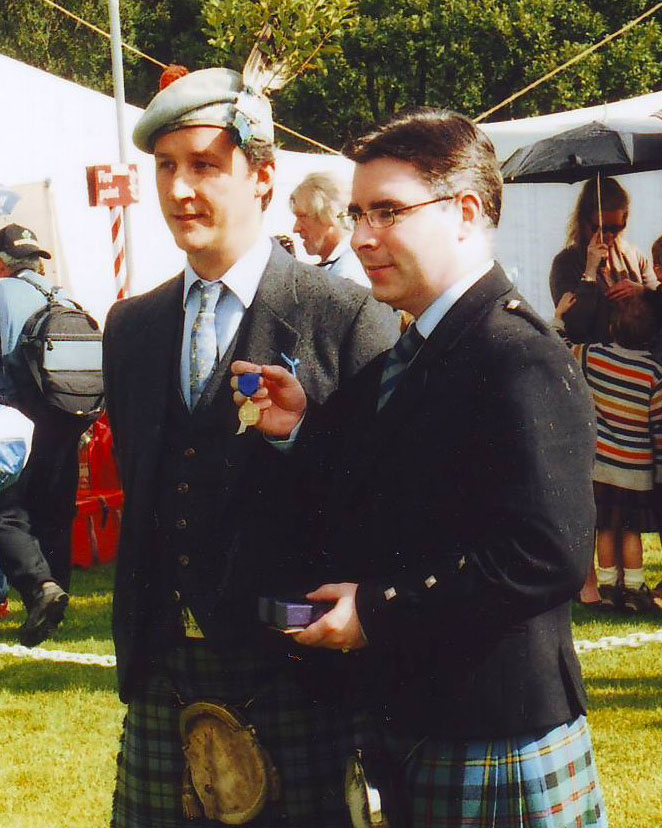
“The six tunes set for the Gold Medals this year were three laments and three salutes or gatherings but the variations of both types were generally played too slowly without the theme being apparent. The first player to impress with a tune which was sustained and flowed throughout the variations was Allan Russell with The Gathering of the MacNabs. Unfortunately he finished with some poor execution in the crunluath a mach and so would be ruled out. Greg Wilson (third prize) played Kinlochmoidart No 2 with good execution and no mistakes but was rather mechanical in the variations. However his drones were superb and certainly made easy listening. Chris Armstrong played Clanranald’s Salute perhaps a little slow in the middle but very well executed and I believe he would have been in the prize list had he not missed a line of the crunluath a mach. Richard Hawkes was given 4th place for a competent MacLeod of MacLeod’s Lament on an excellent instrument and it was good that he wasn’t punished for a minor blip in his taorluath doubling. Simon McKerrell played a very correct MacLeod of MacLeod on a good instrument and as is the fashion now played a crunluath a mach. A very solid performance which deserved his second place.
“I think that the Piobaireachd Society in setting the tunes should indicate where an a mach ought not to be played. John Angus Smith also played this tune but took a different approach to the phrasing of the ground. I thought that he played an extra line in his tripling. Several played the Lament for Captain MacDougall and some appeared to be sight reading it straight from the PS book. Jenny Hazzard however played a beautiful ground and variation. She then elected to play the crunluath breabach with a long second note in the breabach. This works well with this tune but somehow it did not work for Jenny. Gordon McCready also played Captain MacDougall and it certainly did flow right through. He cut out the extra controversial beat in the third line of the ground. Donald MacPhee, with Clanranald’s Salute, was perhaps a little sluggish in his variation one but in his usual style from then on it was a good salute. Unfortunately he had a note error in the third variation. Other players to be commended include Michael Gray (Kinlochmoidart No 2), Niall Stewart (Clanranald), Innes Smith (Dungallon). Judges: Tom Speirs, John Wilson and Malcolm McRae.”
Angus MacLellan reported on The Games
“Thursday 25th August was a rather blustery day with some heavy rain showers and at times a strong window. However the piping competitions went ahead as usual and Iain MacFadyen and I began the day judging the Junior March, Strathspey and Reel Competition. As is usual with this grade of competition the playing ranged from very good to some competitors being a little bit out of their depth and tackling tunes that were a bit too much for them at the stage they had reached.
“However considering the conditions the standard was very good with the prize winners in particular performing very well. Craig Killen from Strachur was a clear winner playing Charles Edward Hope de Vere, Arniston Castle and The Grey Bob.
“Ian McKerral from Campbeltown must be congratulated for the time he spent tuning so many of the competitors’ pipes and the standard of the pupils he put forward.”
The Jig
“With 59 entered for this competition it looked like Malcolm McRae and myself were in for a long hard day but in the end only 43 came forward and so we were able to finish just after 4pm. However it has to be said this was indeed a very poor competition with only about six or seven competitors being considered for the prize list. Why must so many of the competitors in this competition think the faster they play the better the tune will be? Really I have never heard so many pipers going like the hammers only to fumble, lose control, make mistakes and break down.
“The sooner some of the modern day players realise that a jig is also a dance rhythm that should be played at a tempo suitable for the Irish Jig to be danced to the better.
“Thank goodness for Angus MacColl who played The Kitchenmaid in fine style to win the competition. Also keeping things under control and getting music from their tunes were Jenny Hazzard, Gordon MacLean and Andrea Boyd who were 2nd, 3rd and 4th respectively.”
At the games there were 38 entries for the A March and 40 for the S&R. The B Grade events had 37 entries, the local events had four and the junior MSR had seven. Strathclyde Police band played during the day. Although the judges for each event were listed in the programme there were several changes on both days.”
Full results from the competitions at the Argyllshire Gathering 2005:
Senior Piobaireachd
1. Angus MacColl
2. Murray Henderson
3. Gordon Walker
4. Iain Speirs
Gold Medal
l. Euan MacCrimmon
2. Simon McKerrell
3. Greg Wilson
4. Richard Hawke
5. James MacHattie
Silver Medal
1. William Geddes (March for a Beginner)
2. Finlay Johnston
3. Andrew Douglas
4.Ross McCrindle
5. Donald MacKay
MacGregor Memorial
1. Gavin Stewart
2. Alex Gandy
3. Eric Oullette
3. Fraser Wylie.
FW MSR
1. Gordon Walker
2. Colin Clansey
3. Roddy Macleod
4. Angus MacColl.
A March
1. Niall Stewart
2. Jack Lee
3. Margaret Houlihan
4. Alastair Dunn
5. James MacHattie.
A S&R
l. Neil Smith
2. Alexis Meunier
3. Alastair Dunn
4. Jori Chisholm.
B March
1. Roderick Weir
2. Gareth Rudolph
3. Finlay Johnston
4. Fiona MacKay
5. Andrew Carlisle.
B S&R
1. Andrew Carlisle
2. Callum Beaumont
3. Andrea Boyd
4. Fiona Manson
5. Bernard Bouhadana.
Jig
1. Angus MacCol
2. Jenny Hazzard
3. Gordon MacLean
4. Andrea Boyd.
Local March
1. Daniel Johnstone
2. Alasdair Henderson
3. Jamie Forrester.
Local S&R
1. Jamie Forrester
2. Struan Thorpe
3. Fraser Wylie.
Best Local Piper: Jamie Forrester
Junior MSR
1. Craig Killen
2. David Muir
3. Fiona Mitchell.