

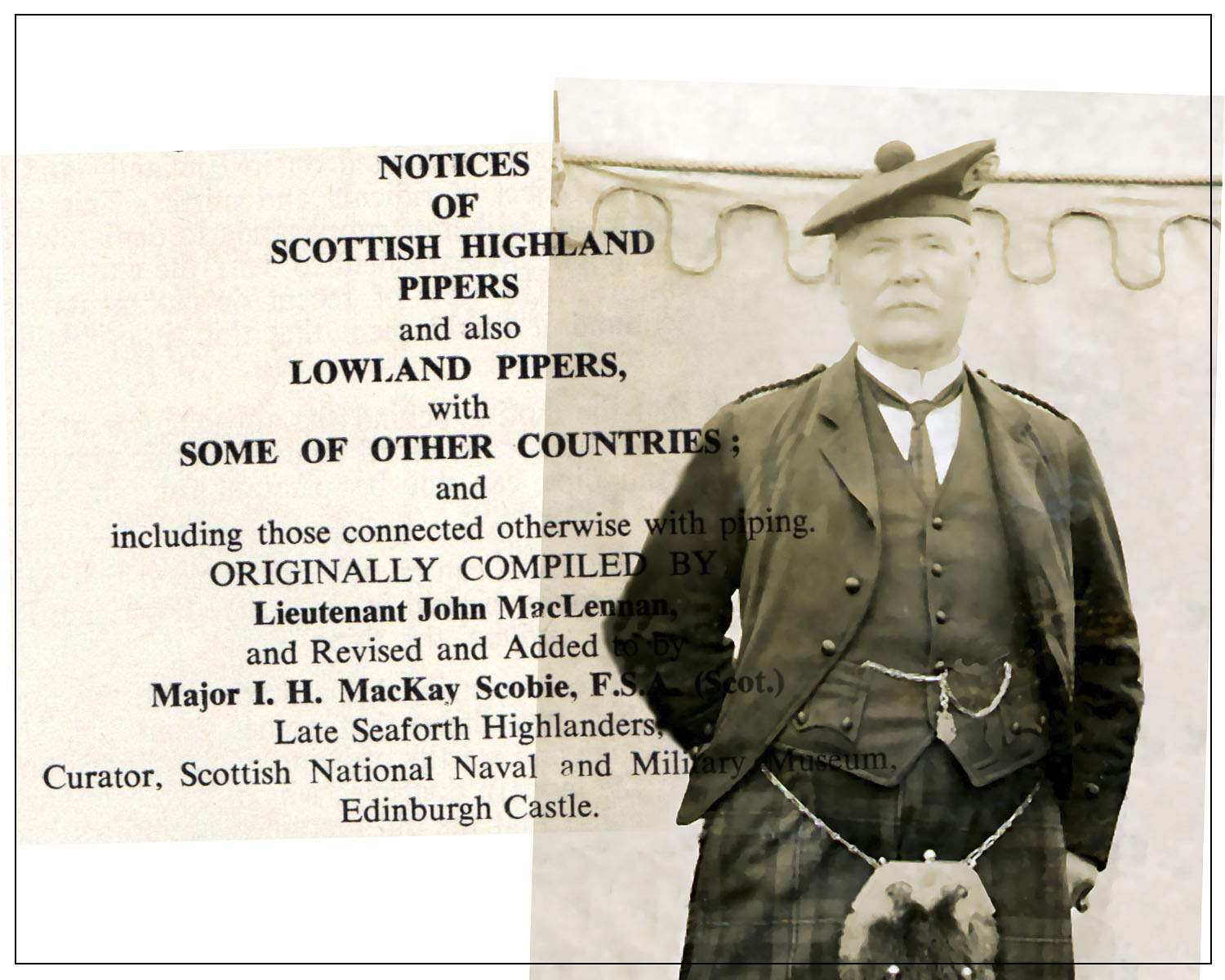
BY JEANNIE CAMPBELL MBE.

The Oban Times on 7th February 1914 had news of a forthcoming publication by Lieutenant John MacLennan:
‘History of the Pipe and its Music by Lieut. John MacLennan. Lieut. MacLennan has been steeped in the atmosphere of piping during the whole of his life, and probably there are very few who can write with such precise and intimate knowledge of the craft of piping and of pipers of present and past generations. It will, therefore, cause no surprise to his friends of the craft – and they are legion – to learn that he intends to publish before the end of this year a work dealing in a thorough manner with the history of the bagpipe and its music. The book will comprise, in the first place, the history of the bagpipe generally, and with particular reference to Scotland, the development of Highland music leading up to the pibroch in relation to music in general, the history of pibroch and composers of pibroch. The rest of the book will consist of a large number of short biographies of ancient and modern pipers – a section which will prove of rare interest to all interested in piping. Mr MacLennan has been engaged on the book for a number of years and has amassed a considerable amount of information of a unique character. He is now engaged in the work of revision, and expects to have the book published before the end of the year. It is worthy of remark that a similar service to Irish piping has been rendered by Captain O’Neill, Chief of Police, Chicago; while Mr MacLennan is a veteran of Edinburgh City Police service.’

John McLennan was born in 1843 at Kilcoy, son of Duncan MacLennan, 1781-1869. The MacLennan ancestry went back to Murdoch Maclennan, town piper of Inverness in the 16th century and the family included many champion pipers. John McLennan was a policeman in Dundee from 1865 to 1878 and in Edinburgh from 1878 until his retiral in 1906. In 1870 he married Elizabeth Stewart, sister of PM John Stewart of the Black Watch. They had several children including George Stewart McLennan 1883-1929. She died in 1889 and in 1891 John married Mary Cameron, nee Ross, a widow with two young children. She was the mother of more children, including Donald R MacLennan 1901-1984. John and his son George used the spelling McLennan, although D R MacLennan and other family members used the spelling Maclennan.
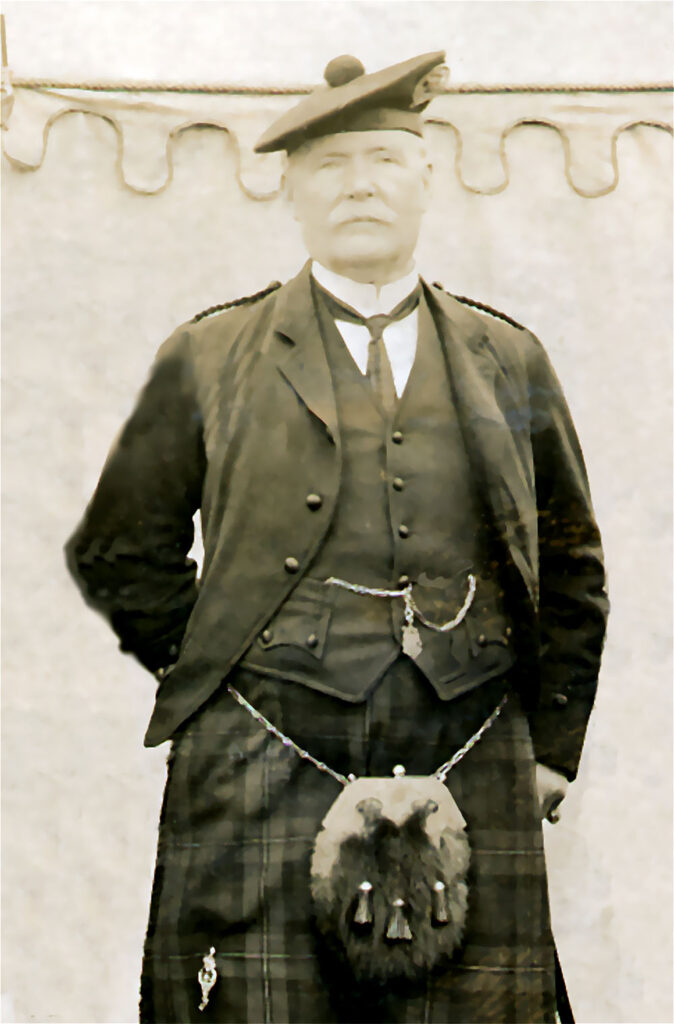
The piobaireachd as MacCrimmon played it
John McLennan published The piobaireachd as MacCrimmon played it with instructions how to read and understand music, in 1907. The instructional part of the book is in the form of a letter from the author to his son George S McLennan. This starts with some good advice which is just as valid today:
‘Dear George,
The rudiments of any art are the fundamental parts necessary to acquire proficiency. It is therefore obvious that if you aspire to be a tolerable performer on the Bagpipe, you must thoroughly study the Scale, not only the nature and character of each note, but the method of holding the Chanter, the manner of placing the fingers and their position in changing from one note to another, which note is to be left open and which closed, Agreeable performance on any instrument depends upon accuracy in tunefully playing the Scale. Your whole future depends entirely on your being properly trained at the beginning of your career, and always recollect that excellence of any sort is beyond the reach of indolence.
‘If you allow yourself to believe that it is impossible for you to do what you see others perform, your despair will not allow you to succeed, but if you let a reasonable assurance animate your endeavours, with a determined resolution, good tuition, and careful practice during a severe course of training, you will overcome all difficulties. Repeat again and again; facility will always come with diligence and labour. Endeavour to be the first man in your profession, never, however, allow yourself to become vain through success or discouraged by ill fortune.’
The Piper in Peace and War
In The Piper in Peace and War, by C A Malcolm, published in 1927, the author writes that ‘the book created much controversy among pibroch enthusiasts who did not share the ideas formulated by this able and life-long student of the bagpipe and its lore. It is characterised by unusual Gaelic nomenclature, and also various unorthodox beats for the crunluath a mach (here called ceither-lugh-a-mach).For the first time the leumluath, taorluath and crunluath are printed without the intermediate low A note.’
The newspaper report above from 1914 indicates that the book described as History of the Pipe and its Music was to be published later in 1914, but perhaps the outbreak of war that summer put a stop to those plans. Although he was over 70 at the time John served as a recruiting officer with the honorary rank of lieutenant.
According to his obituary, after the war Lt McLennan returned to his musical studies. ‘He had in view the publication of a work dealing with the historic events that had been mainly responsible for many of the famous old pipe melodies. For that he had to search the archives of several libraries in Edinburgh, and notably the Signet, the Solicitors, and the Public Library. That task, involving much labour, remains, we believe, unfinished, but another less exacting, and possibly more to the taste of those pipers not disposed to history, he has lived to complete. This is a Collection of Piobaireachds, Marches and two Reels, with a glossary of technical terms relating to pipe music. This book will shortly be in the hands of the music sellers and the public.’
The piobaireachd as performed in the Highlands for ages, till about the year 1808
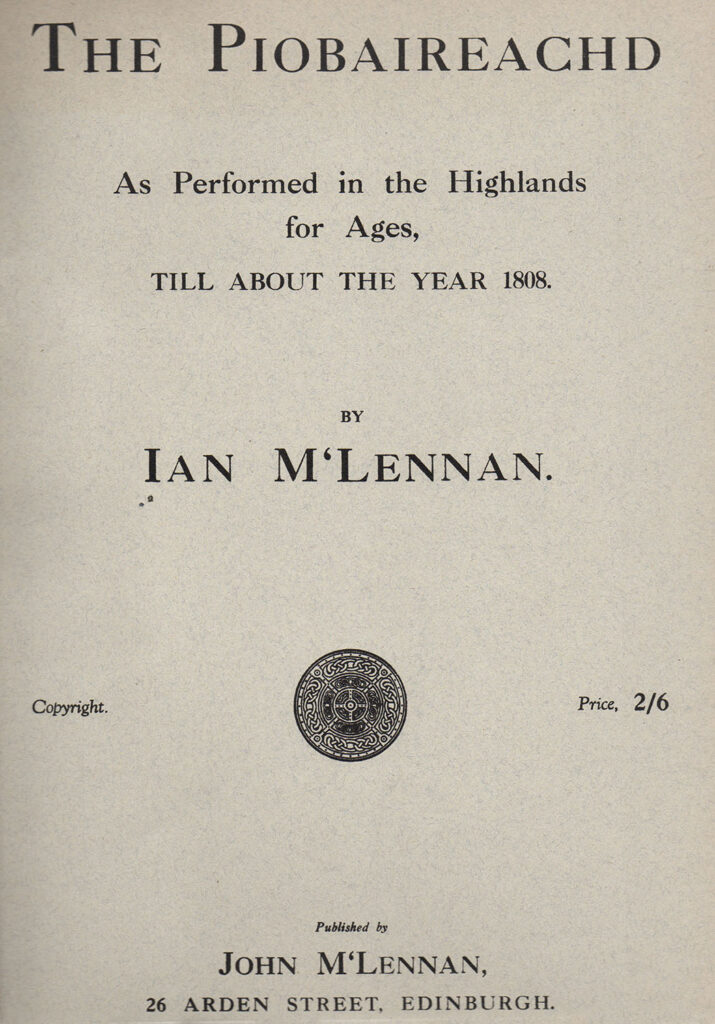
John McLennan died on 25th December 1923 and this last book, The piobaireachd as performed in the Highlands for ages, till about the year 1808 By Ian M‘Lennan, was published in 1924. The Oban Times on Saturday 31st May had a review, ‘An event of high importance in the piping world is the publication of the late Lieutenant Ian McLennan’s splendid work on The Piobaireachd. Mr McLennan, whose recent death is widely deplored, was a man of mark, and an authority in all matters relating to piping. Piobaireachd represents a classic branch of the art, and here the genius of Mr McLennan is masterly and expressive. Mr McLennan aimed at giving Ceol Mor as MacCrimmon played it. After years of study in his leisure hours he produced a system which yielded up easily, beautifully and effectively the treasure notes of the MacCrimmons. He saw the proof sheets of his great work now published by his son, and his instructions and desires have been carried out as faithfully as possible. Some 18 airs are here set down under the system of which Mr McLennan is the exponent.’
John McLennan has been commemorated in two tunes, the march Lieut. McLennan’s Farewell to the Edinburgh Police was composed by PM A M Findlay and Lieut. J. MacLennan’s (Edin.) March was composed by A R MacLeod.
The Notices of Pipers
So what happened to the History of the Pipe and its Music planned for publication in 1914 and the uncompleted work on the historic events responsible for famous old pipe melodies?
It is very possible that the section described as ‘a large number of short biographies of ancient and modern pipers’ plus some of the other historical content, has survived as what we now know as The Notices of Pipers.
These notices were introduced as follows in the Piping Times Vol 19 issue 7, April 1967:
‘A Dictionary of Pipers and Piping. Through the good offices of Captain D. R. MacLennan we are able to present from now onwards this most valuable and fascinating series.
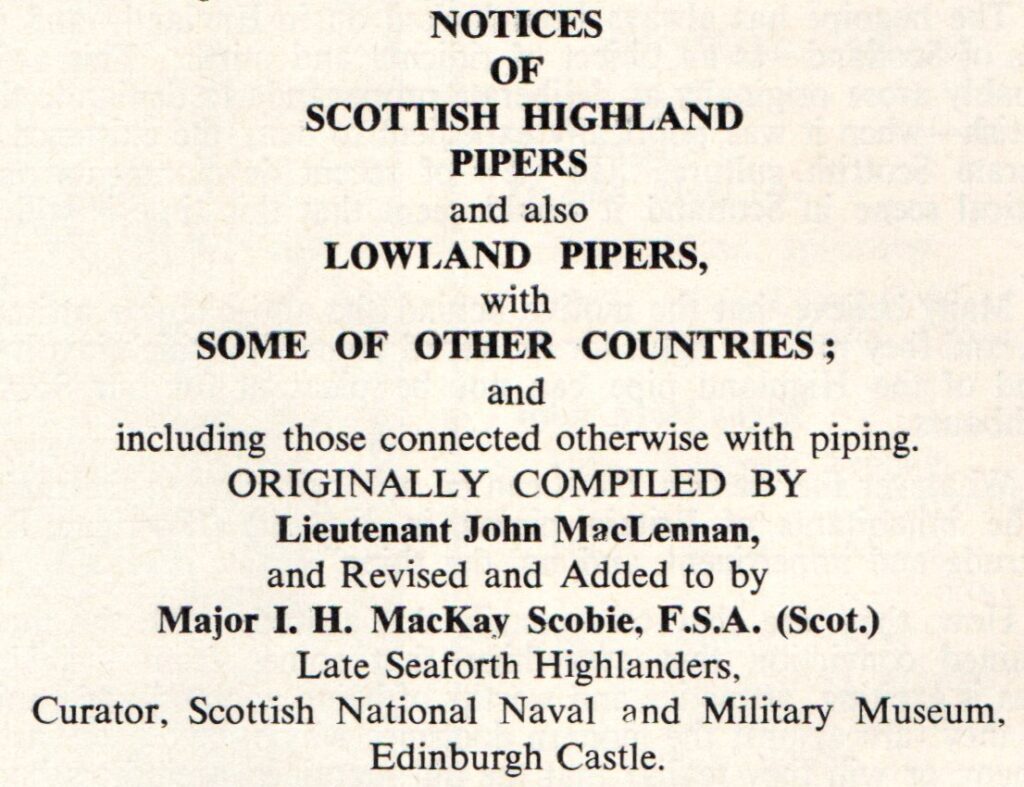
The frontispiece is given as we received it, but in fact the “Notices” have been further amended and added to by the late Archibald Campbell, Kilberry.
NOTICES
OF
SCOTTISH HIGHLAND
PIPERS
and also
LOWLAND PIPERS,
with
SOME OF OTHER COUNTRIES;
and
including those connected otherwise with piping.
ORIGINALLY COMPILED BY
Lieutenant John MacLennan,
and Revised and Added to by
Major I. H. MacKay Scobie, F.S.A. (Scot.)
Late Seaforth Highlanders,
Curator, Scottish National Naval and Military Museum,
Edinburgh Castle.
INTRODUCTION.
These “NOTICES of PIPERS” – originally compiled by Lieutenant John MacLennan, a notable enthusiast on piping matters towards the end of the 19th and early 20th centuries – were presented to the writer by his son, Captain and Quartermaster (formerly Pipe-Major) Donald Ross MacLennan, Seaforth Highlanders, in 1944. These notices have been revised where necessary, amplified, and considerably added to.
They do not profess to be an exhaustive survey of the subject, but at least include the names of the great majority of the more eminent pipers (professional and amateur), the pipe-makers, and those distinguished in some way in connection with piping, from early times onwards. In the case of many of them the necessary details have not been easy to procure, whether they belong to the distant or more immediate past, or even recent times. Lowland Scottish pipers and some of those of other countries (especially Ireland) have been included. Full definitions are given of the various kinds of pipe music, etc.’
The pages following the introduction mention the changes following the Jacobite rising, the period of depression, the revival, the Falkirk Tryst, the Edinburgh competitions, the Northern Meeting, the Argyllshire Gathering, the Highland bagpipe with two or three drones, reel size pipes, bellows blown Border, Lowland or Northumbrian, Irish Union or Uilleann pipes, Irish war pipes, English and Welsh pipes, different types of pipe music, emigration, the Army, publications, Hereditary pipers, family pipers, Burgh and Border pipers and Canntaireachd. The introduction is signed I.H. McK. S.
Many of these topics are covered in more detail in the alphabetical section which begins in the Piping Times Vol 19 issue 11, August 1967 and continues until Vol 27 issue 12, September 1975. An index to the notices can be seen in Vol 44 issue 7, April 1992. Although roughly in alphabetical order, this is not always the case as some sections appear out of order. The Notices cover an eclectic mix of pipers, from those fined for playing on a Sunday or causing a disturbance, angelic pipers in church carvings, ancient Greeks and Romans, and pipers of other countries to the famous hereditary pipers and champions of former years. While it is all interesting, some of the information included should be checked before being accepted as fact. Dates and places of birth and death are often not accurate but the difficulty of obtaining such information was mentioned in the introduction. In those days there was no easy access to registers of birth, marriage and death and no census records were available. However these Notices do form a valuable source and a basis for further research. There is no indication of how much of the text was the work of John McLennan and how much was added or amended by I H MacKay Scobie and Archibald Campbell, Kilberry.
Ian Hamilton Mackay Scobie was born in 1883 into a Reay country family with a very long running military background, with several serving officers from the 18th and 19th century. His father Col. Mackay J. Scobie fought in the Ashanti Expedition of 1875. Ian joined the Essex regiment in 1904 and served in Bangalore in 1906 and other posts around the Empire. In 1910 he was made a fellow of the Society of Antiquities of Scotland. A few years after this he published An old Highland Fencible Corps in 1914 as the first of his many books and writings. As a Captain Ian Hamilton Mackay-Scobie he accompanied the 1st Battalion Essex Regiment to Gallipoli in April 1915, where he led men in the initial landings and took part in some heavy fighting before being wounded in the hand. He then spent time recovering in Malta before transferring to the 1st Battalion Seaforth Highlanders, from mid-1915 onwards.
He was the Curator of the Scottish National Naval and Military Museum, Edinburgh Castle from its formation in 1930. He was an amateur piper and owned the Strathy pipes which had been in the family since 1783, inherited from the MacKays of Strathy, a three droned instrument of indigenous wood, said to have been played in the Scots-Dutch Brigade 1698. The rosewood chanter was of a later date c1780. He published the book Pipers and Pipe Music in a Highland Regiment in 1924 and added to and edited the Notices of Pipers. He died in Edinburgh in 1947. He composed the quickstep The 1st Battalion (72nd) Seaforth Highlanders Entry into Baghdad, March 1917.
Archibald Campbell born in 1877 was the third son of John Campbell of Kilberry. He was a lawyer by profession and was with the Indian Civil Service from 1901 to 1928 so he was away much of the time. He had piping tuition from Angus MacRae, John MacColl, John MacDougall Gillies, John MacDonald Inverness, William Ross and Alick Cameron. Archibald Campbell was one of the main figures in the early years of the Piobaireachd Society and judged many times over the years. He published the Kilberry Book of Ceol Mor in 1948. He died in 1963.