

BY JEANNIE CAMPBELL MBE.

In 1926 the list of tunes required for the major competitions was published early in the year in the Oban Times and other papers. Competitors in the Senior Competitions, the Open at the Argyllshire Gathering and Clasp at the Northern Meeting, were required to submit six tunes, A Ghlas Mheur, The Fingerlock; An Daorach Mhor, The Big Spree; Cath Bhealach Chraoibhe, The Battle of the Pass of Crieff; Guileagag Moraig, In Praise of Morag; Cumha Chlaibhers, Lament for Viscount Dundee; Cumha Mhic Shuain a Roaig, Lament for MacSwan of Roaig. The tunes were all from the new Piobaireachd Society book, although the notice stated that other settings were acceptable. Competitors in the Junior Competitions, which were the third piobaireachd event at the Argyllshire Gathering and the Gold Medal at the Northern Meeting, were to submit any three from the twelve tunes in the book. These events were sponsored by the Piobaireachd Society, therefore it was entitled to make the rules and set the tunes. Gold Medal entrants at the Argyllshire Gathering were to submit a list of six tunes, the names to be given in Gaelic with English translations. The Argyllshire Gathering Gold Medal was not sponsored by the Piobaireachd Society so it did not set the tunes for this event. The new book had been published towards the end of the previous year and the preface was signed J P Grant November 1925.
This was not the first book to be published by the Society, nor was it the first time the Society had set tunes. Going back to the beginning, the Society had been founded at a meeting in Edinburgh on the 19th of January 1903, with the objectives, ‘The Encouragement, Study and Playing of Piobaireachd Music on the Highland Bagpipe. To collect Piobaireachd MSS and Legends, and publish tunes which have never before been published, and to correct, when possible, tunes already in print and which are known to be wrong.’ In the early years controversies over the setting of tunes very nearly led to the failure of the Society.

1903
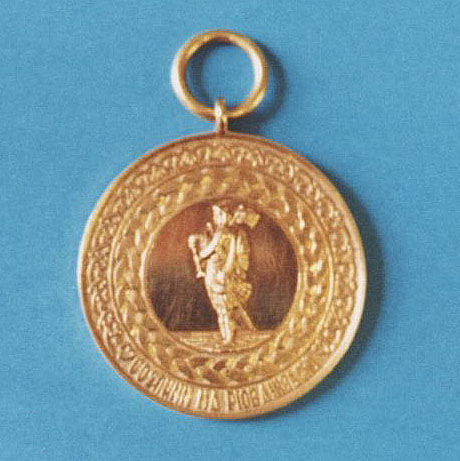
On September 19th 1903 the Oban Times announced, ‘The Society is to hold a competition next year for piobaireachd playing at which they will give £30 in prizes. The first prize shall be £20 and the Society’s Gold Medal, second prize £5, third prize £3, fourth prize £2. The Society will set 6 tunes each year of equal length and has decided to adopt the settings in Ceol Mor. The 6 tunes chosen for the first year are The Desperate Battle Perth, The King’s Taxes, Lament for MacLeod of MacLeod, The Earl of Seaforth’s Salute, The Groat, Lament for the Earl of Antrim. The committee has decided to let pipers have these tunes free of charge this year, and they may be had on application to the secretary of the Society.’ As General Thomason was the President of the Piobaireachd Society and the author of Ceol Mor he would have been able to make the plates available for the tunes to be printed.
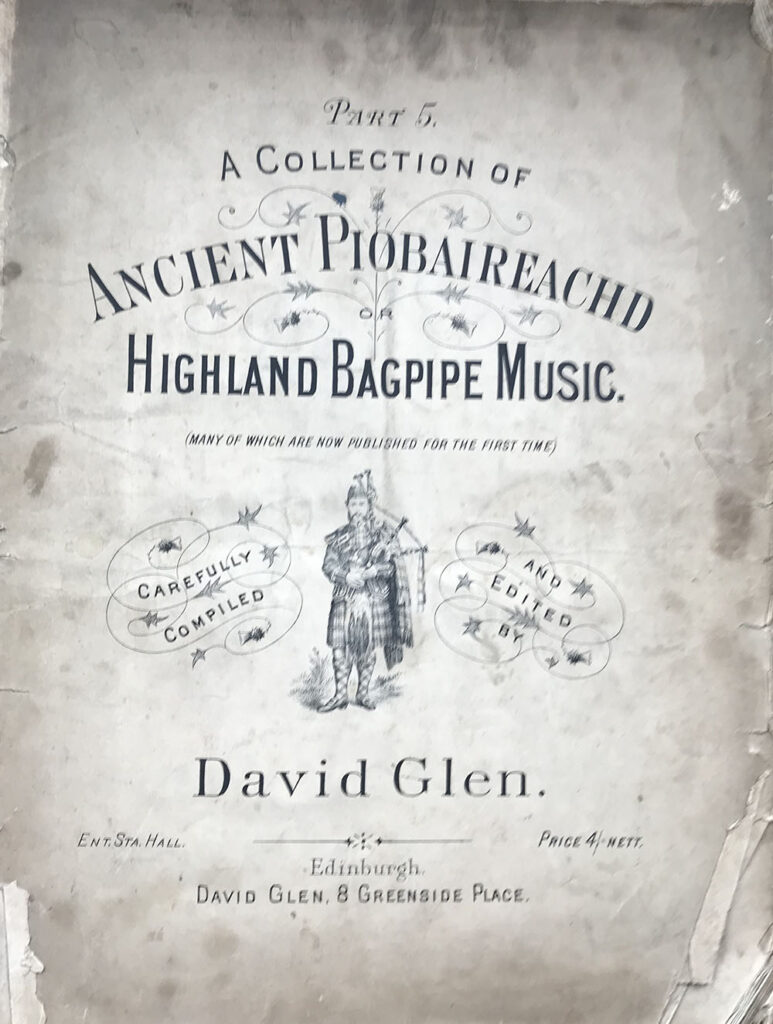
The following week the Oban Times has a letter from David Glen saying his book was better than Ceol Mor and offering to supply any tune from his Ancient Piobaireachd containing 70 tunes, at one shilling each or in book form 12 to 15 tunes for 4 shillings, and would supply quantities to the society at reduced prices for distribution to their competitors. This does not seem to have had the hoped for reaction from the Society as on October 3rd David Glen has another try, with the following advertisement: ‘The Piobaireachd Society of Scotland. Those intending to compete for the prizes to be offered for the correction of Ceol Mor should purchase David Glen’s Ancient Piobaireachd which will make their work easy. Contents and price on application. David Glen, 8 Greenside Place, Edinburgh.’
In December the Society decided to hold a second competition, open only to those who had never won a prize for piobaireachd playing at either the Argyllshire Gathering or the Northern Meeting or the Lochaber Gathering or the Portree Games. Entrants for this competition were to submit two tunes of their own choice.
1904
A preliminary notice for the Argyllshire Gathering and the new piobaireachd competitions appeared in the Oban Times in July 1904, followed by the full details in August. The Games were to be extended to two days due to the new events introduced by the Piobaireachd Society. On the first day there were to be three competitions:
- Piobaireachd – Open to all comers under the Rules of, and Prizes presented by The Piobaireachd Society, Gold Medal and £20, £5, £3, £2.
- Piobaireachd – The Highland Society of London’s Gold Medal and prizes given by the Argyllshire Gathering, open to all who have never won this medal before, £3, £2, £1.
- Piobaireachd – Confined to those who have never won a prize for such at the Argyllshire Gathering, Northern Meeting, or the Lochaber or Portree Games under the rules of, and prizes presented by, The Piobaireachd Society, Silver Medal and £3, £2, £1.10s.
On the second day there were to be competitions for marches, strathspeys and reels, local piping and piobaireachd playing by the winners of the previous day’s events.
The report stated, ‘The first prize a Gold Medal and £20 fell to Mr John MacDonald, Inverness, for The King’s Taxes. This is rather a hard tune, the proper getting up of which presents some difficulties, but MacDonald gave an excellent rendering of it. Pipe Corporal Geo Stewart MacLennan, 1st Gordon Highlanders, a young piper, carried off the second prize with the Lament for the Earl of Antrim which he played carefully and well. The third prize winner was Corporal Piper W Ross, 1st Scots Guards, who played The Desperate Battle with good effect. The fourth prize fell to James A Center, Edinburgh, who made a very promising appearance.
‘The second competition organised by the Society was a confined one. There were fourteen entries and some capital and promising pipers were heard. The Argyllshire Gathering piobaireachd competition also produced an interesting exhibition and the winners showed capabilities of which much greater things may be expected.
Gold Medal confined – 1. Pipe Corporal Geo Stewart MacLennan, 2. and 3. Corporal Piper W. Ross and James A Center, equal.
Piobaireachd confined – 1. Geo S Allan, Peterhead, 2. and 3. J. Gordon, Lunga, and PM Alick Matheson, Royal Scots, equal, 4. William MacNeill, Oban.’
The Piobaireachd Society judges were Lord Dunmore, Mr. Somerled MacDonald, Captain Stewart of Ensay, Mr Angus Campbell younger of Kilberry and Mr J McKillop jr of Polmont Park for the first competition and Captain Colin Macrae, Captain McNeill DSO, Captain MacLean of Pennycross and Captain Ian Forbes younger of Rothiemay for the second competition.
1905
As the competition had been deemed a success it was to be repeated the following year. A committee was appointed to issue music for the 1905 competition, and that music was to be issued in book form and in the so-called ordinary notation instead of General Thomason’s system.
The membership of the Society had increased greatly as the rule on admission had been relaxed to include those interested in piobaireachd playing. This increased the income from subscriptions but had the unfortunate effect of a number of less knowledgeable members, some of whom were gaining places on the committee. In 1904 Lord Dunmore was elected as President of the Piobaireachd Society in place of General Thomason. James McKillop resigned as secretary and was replaced by the less knowledgeable Stewart of Ensay.
Charles Adolphus Murray 7th Earl of Dunmore was born in 1841 and educated at Eton before serving in the Scots Fusilier Guards. He was credited, with the Duke of Atholl, for devising the eightsome reel in the 1870s. In 1890 he was officer commanding the 1st Volunteer Battalion of the Cameron Highlanders and appointed John MacDonald as Pipe Major of the Battalion. Although he judged regularly at the Northern Meeting from 1883 to 1906 and judged at the Argyllshire Gathering in 1904, 1905 and 1906 Lord Dunmore was not thought to be a great piper. Colonel Jock MacDonald said he remembered Lord Dunmore and he didn’t know one end of a chanter from the other, he used to blow into the wrong end sometimes. Kenneth MacDonald, the 1888 Argyllshire Gathering Gold Medal winner, was piper to the Earl of Dunmore at Rodel, Harris from about 1881 to1886, before becoming Piper to Panmure Gordon of Glenalleter Braemar.
Major William Stewart of Ensay, born 1847, was an officer in the Argyll and Sutherland Highlanders. He was said to be a good piper. His father, John Stewart of Ensay, a small island off the south coast of Harris, was born in Harris in 1825 and died in Edinburgh in 1899. Finlay Macrae was Piper to John Stewart of Ensay.
The first series of books were large, measuring 14 inches by 10.5 inches, although they did not have a large number of pages. The first book, priced at three shillings had ten pages of introductory notes and seventeen pages of music. The fifth book, priced at two shilling and six pence, had eight pages of introductory notes and eighteen pages of music. The tunes were written in full in all the books.
The first book appeared early in 1905 and was reviewed in the Oban Times on the 25th of March: ‘One of the special means whereby the Piobaireachd Society sought to carry out its laudable work was the promotion of competitions, at which valuable prizes were offered for the best playing of such music, and in this mode of propaganda the musical public was deeply interested. When it was announced, however, that the standard adopted by the Piobaireachd Society was General Thomason’s Ceol Mor, there was some astonishment that at the outset of its career the Society should adopt as its standard a modern system of writing piobaireachd, which was unknown to pipers, except as a name, and whose signs were new to them. Not a few addressed themselves to the task with splendid enthusiasm, expecting that the knowledge of this “standard” system, once acquired, would serve them for all future competitions. For reasons best known to itself, the Piobaireachd Society, after its first competition, abandoned the standard which it had set up, and set about preparing a collection of its own, which would be its standard, and out of which the test tunes would be annually selected. The first part of that Collection is now before us. It is printed in the orthodox notation, and contains the following six tunes: The Prince’s Salute, Lament for John Garve MacLeod of Raasay, Lament for Patrick Og MacCrimmon, Isabel MacKay, The Grants’ Gathering and The March of the Clan Macrae. It will be observed that with the exception of The Prince’s Salute, taken from Donald MacDonald’s Collection, the other five are from MacKay’s Collection. Beyond correcting obvious misprints, the tunes are reproduced very much the same as they are given in these two collections. Nor does the Society seem to have any standard for writing piobaireachd music, for MacDonald’s system is accepted when the tune is lifted from his Collection, while MacKay is allowed to write the same musical phrases in his own fashion in the tunes taken from his work. This want of uniformity is anything but satisfactory, and is not in keeping with the power claimed by the Society ‘to decide between the diverse renderings of conflicting authorities.’ There are some other irregularities in MacKay’s and MacDonald’s settings of certain tunes which experience, as well as science, has taught pipers to play in a manner different from what is written. The Piobaireachd Society has allowed these incongruities to remain, leaving it to the competitor to interpret them to the best of his knowledge, and by doing so have shirked the very work they were expected to perform. One wonders why, with so many unpublished MSS in its possession, the Society should have been content to reproduce six tunes which are already in the hands of every piper. One of the objects of the Society is “to collect piobaireachd MSS and publish tunes which have never before been published”. This, we maintain, it has failed to carry out.’
On 29th April Fionn wrote with a number of corrections to the historical notes then on 6th May there was a letter from Lord Dunmore, President of the Society: ‘Bagpipe Music. The Piobaireachd Society’s Collection. Carlton Club, London, 20th April, 1905, Sir, My attention has been recently called to an article under the above heading which appeared a little while ago in your newspaper. As many of the statements contained therein are somewhat wanting in accuracy, I trust you will permit me, as president of the Piobaireachd Society, to correct the same, the more so as I happen to know that our indefatigable secretary, Major Stewart of Ensay, who compiled that most able preface to the Society’s first publication, went out of his way to procure from the most reliable sources such conclusive information as would render incontrovertible and incontestable every statement made by him in the publication under discussion. I now propose therefore to take the different points of the article seriatim, expose its incongruities, and correct its inaccuracies.
‘First. The Piobaireachd Society did not “lift” its version of The Prince’s Salute from MacDonald’s collection, nor from anybody else’s collection.
‘Secondly. The Piobaireachd Society has not adopted MacDonald’s notation for this tune, in corroboration of which anyone with the most elementary knowledge of pipe music may satisfy himself by placing side by side the two versions and comparing them; in addition to which we have the MS authority of two of the most celebrated players of Ceol Mor of a past generation for the correctness of our version, each of whom was reputed to have been the best exponent of it since the days of the MacCrimmons.
‘Thirdly. The competition tunes were chosen and corrected by members of the Piobaireachd Society possessing a thorough practical as well as theoretical knowledge of Piobaireachd. Their work has been finally revised by some of the best and most successful prize-winning professional players of Piobaireachd of the present day. The settings given may consequently be accepted with every confidence as to their merits and correctness, not only for the Piobaireachd Society’s competitions, but also at the many other important competitions at which members of the Piohaireachd Society control the judging.
‘Fourthly. In the versions given, the Piobaireachd Society has most certainly not allowed any incongruities to remain.
‘Fifthly. The Society has not in any one instance left competitors to interpret points of difficulty. Major Stewart, writing to me on this subject, says: “In the note to The Prince’s Salute it is stated incidentally that some players prefer the alternative method of playing the first variation but the preponderance of the best professional evidence being in favour of the other method, it has been adopted. In so small a matter as the substitution of the single grace note for the couplet indicated in footnote the preferable method has been stated. In former times The Prince’s Salute was one of the most popular of Piobaireachd. Its decadence in the present time is mainly due to the fact that pipers could not get a good version of it. The one in MacDonald’s book is accessible to few, and it is only an expert who could evolve a good setting from its antiquated and complicated notation, superfluous grace notes and numerous errors. The correct and authentic version furnished by us (The Piobaireachd Society) will be shortly in the hands of every piper.”
‘Thus writes Major Stewart. It is perhaps, Sir, hardly necessary to point out that the “chief Reason” attributed to Major Stewart by the writer of your article for his disbelief in MacDonald’s statement relative to The Prince’s Salute does not appear in his (Major Stewart’s) remarks on that tune. MacDonald seems to have proved his ignorance by talking of King James as the “Prince of Wales,” which practically renders the statements of no historical value whatever. Highland popular belief and tradition assigns the origin of the Prince’s Salute to the Prince, which is a logical and reasonable surmise, be it right or wrong.
‘Sixthly. The Piobaireachd Society has never “shirked its work,” nor has it failed to carry out its objects, and it is not likely ever to do so. During the past month its effective strength and the influential support it has received has more than doubled. First and foremost, His Royal Highness the Prince of Wales K.G.’ etc., has graciously become the Patron of the Society. We have also received the support of ythe following Highland regiments and regiments possessing pipe bands, nemely the Scots Guards, Black Watch, Highland Light Infantry, Seaforths, Queen’s Own Cameron Highlanders, Gordons, Argyll and Sutherlands, King’s Own Scottish Borderers, Scottish Horse etc, etc, all of which make an annual contribution to the funds of our Society, as does also the Highland Society of London. The great majority of Highland and other Scottish proprietors and Highlanders interested in the preservation and correct transmission of their ancient music and in the revival of its playing have joined our society, and we are supported by the Highland press in almost every instance.
‘Allow me, therefore, in conclusion, Mr Editor, to express a hope that so important a paper as the Oban Times, a paper that has always been in sympathy and in touch with every movement which has for its object the safeguarding of old Highland traditions, will stretch forth to us the right hand of friendship, and support a society which has been formed for such a praiseworthy object as “the general advancement and diffusion of knowledge of the ancient Highland Piobaireachd.” I am, etc, Dunmore. President of the Piobaireachd Society.’
More criticism was to follow on 13th May, with three letters: ‘The Piobaireachd Society’s Collection of Bagpipe Music. Parliament Square, Edinburgh, 8th May 1905. Sir, I have read with interest the letter in your issue of the 6th inst on the above subject by the President of the Piobaireachd Society, and if I should submit the matter from a somewhat different point of view, I hope it will not be looked upon as an attempt, on my part, to throw cold water on the very laudable work of the Society. My only object is to see the martial music of my country, which has fallen into decay since Culloden, brought back to its original grandeur.
‘The President says the society did not lift The Prince’s Salute from MacDonald’s collection; that ‘MacDonald’s setting is antiquated, complicated with superfluous grace notes and numerous errors.’ The notes in both settings are the same. Some grace notes in MacDonald’s are turned into text notes in the Society’s book. Both are far from being correct, but MacDonald’s is much superior as regards melody. The Society’s setting is written in quadruple time with a few beats in simple duple time interspersed, but the second measure of the ground and the last measure of the three divisions of the ground are not written in any known time ancient or modern. The first variation is both written wrong and tied wrong. The notes of one beat are stuck to the notes of another, all by which a very pleasant melody is turned into monotonous nonsense, “the preponderance of the best professional evidence being in favour of this method” it would be gratifying to know who they are, what knowledge they have of music, and the reason they gave for adopting such an absurd method. There are a few syncopated notes in this tune, of which the Society appears to have no knowledge. There are no superfluous notes in MacDonald’s, but there is one superfluous text note in the Society’s setting.
‘John Garve MacLeod’s Lament is a conglomeration of meaningless notes copied from MacKay’s book with some of MacKay’s variation omitted and a new variation added. What is called the ground, or melody, is divided into seventy-two beats, while the new variation has only 48 beats in all. It is now divided into three parts of 16 beats each, and the piper is asked to play seven bars in the first part no less than four times before proceeding to the second part. Surely the man who propounded this theory must be a past master in the art of tautology.
‘Patrick Og MacCrimmon’s Lament. The Society’s setting of this beautiful melody is the same as in MacKay’s, and much inferior to that in MacDonald’s. The ground and first variation are given in 48 beats each, while the taorluath and crunluath have only 24 each. The notes are written so as to defy a Mozart to make any sense of them.
‘Isabel MacKay is from MacKay’s book. It is by no means correct, but upon the whole is the best written in the collection.
‘Craigellachie is the same as in MacKay’s. It may have been a good tune when composed, but what remains to us is simply rubbish. The ground contains 96 beats, the first variation 64 beats and the third variation no less than 128 beats. This tune is very much out of joint, and unless some good musician can be got to touch it up, should, along with a few others, be blotted out of existence for the honour of our country’s melodies.
‘The MacRae’s March is also from MacKay’s book, and any person who could believe this to be the original setting of the melody must be credulous, for, with the exception of the crunluath, every beat is written so as to make the performer a laughing stock to the audience. It and Isabel MacKay have the taorluath breabach but the Society writes the one quite contrary to the other; both cannot be correct. This pibroch contains a good melody when properly played. The President says: “We have the MS authority of two of the most celebrated players of Ceol Mor of the past generation for the correctness of our version, each of whom was reputed to have been the best exponent of it since the days of the MacCrimmons.” I have a MS written by Duncan Campbell, a contemporary of John Ban MacKenzie, Donald and Alexander Cameron etc. He died in 1861, and was reputed to be a player equal to any other piper. His MS, however, is full of errors, and quite untrustworthy in the hands of any person but himself, and should I get the opportunity I am quite prepared to show that the MSS of those celebrated players are much in the same condition as Duncan Campbell’s, and therefore unreliable They had no knowledge of music, unless we say that a man who can read the alphabet is an exponent of the English language.
‘The letter further states that the tunes were corrected by members of the Society “possessing a thorough practical as well as a theoretical knowledge of Piobaireachd.” No one will doubt the statement, coming, as it does, from so high an authority, but it is only fair to say that they have left no trace of such knowledge in the book.
‘Had the Piobaireachd Society submitted their music to such men as Dr MacKenzie, Hamish MacCunn, Malcolm MacFarlane, Henry Whyte, and a few others, instead of submitting it to itinerant pipers who have no knowledge of notation, and whose only argument is, “That’s the tune as I got it from Maoldonich Dubh, and he was a better piper than ever you were or ever will be,” I have every confidence the present production would have had quite a different appearance and the Society would not require to seek shelter behind the phrase in the introduction, “Art must not be tied by rules.” I am etc, J McLennan.’
John McLennan was born in 1843 at Kilcoy and came from a family of pipers. He was a policeman in Dundee 1865 to 1878 and in Edinburgh 1878 until his retiral in 1906. During World War One, although over 70 at the time he served as a recruiting officer with the honorary rank of lieutenant. He was the father of G S McLennan from his first marriage, and D R MacLennan from his second. He published two books of piobaireachd in 1907 and 1925. He died in Edinburgh in 1923.
The second letter said: ‘To the Editor Oban Times. May 6, 1905. Sir, In your issue of May 6th there appears a letter from Lord Dunmore, in which he attempts to confute the statements made in the able review of the Piobaireachd Society’s Collection, which you published some weeks ago. The noble Lord’s communication is made up wholly of unsupported statements, and with your permission I will deal with them categorically.
‘Your reviewer did not accuse the Society of “lifting” MacDonald’s version of The Prince’s Salute, but he did state that the Society’s collection is a hotch-potch of MacDonald and MacKay, including some of their errors, to which are superadded the errors and so-called corrections of the Society. Lord Dunmore’s letter has not disproved that statement. Nor did the article state that MacDonald’s notation had been adopted in toto, but that his system in part had. In proof of this I refer Lord Dunmore to a common error of MacDonald’s which is reproduced in The Prince’s Salute, published by the Piobaireachd Society. That error consists in doubling G in the taorluath by B, where D is the cadence or theme note; then opening one A and adding a second by E grace note. Now, in performance this gives a note too many, and in the very next tune, John Garbh’s Lament, the Society gives this movement correctly, with only one low A. Moreover, in the urlar of the tune we are now discussing the Society begins by printing “a starting E embellishment note” as if it were an important theme note, in addition to which the note is made even more ridiculous by printing a rest mark above it. The E note should have been written as an appoggiatura, a quaver, and its value subtracted from the next note, which should have been a dotted quaver.
‘Further, the Society had added an E to the end of the fifth bar of The Prince’s Salute, which destroys the melody, and for which there is no justification. Lord Dunmore states that the Society had the MS authority of two of the most celebrated players of Ceol Mor of a past generation. The present writer happens to know the two celebrated players referred to, and he can testify that one of them strongly objects to the Society’s “sett” of the Siubhal variation of The Prince’s Salute; and also to the Siubhal of John Garbh’s Lament, which is a slavish paraphrase of the taorluath and theoretically wrong.
‘In his third paragraph your correspondent states that “the competition tunes were chosen and corrected by members of the Piobaireachd Society, possessing a thorough practical, as well as theoretical knowledge of Piobaireachd,” and that their work was finally revised by some of the best and most successful prize winning professional players of the present day.” All this sounds very well, it were allowed to pass unchallenged. I have already pointed out a few very serious musical errors, which sadly reflect on both the practical and theoretical musical knowledge of the members of the Society who chose and “corrected” (?) the competition tunes, and I will now indicate a few more.
‘First let me say that to be “a successful prize winning professional player” is no criterion of ability to write, or correct scientifically, such music as we are discussing. The only first rank player (professional), who possesses a genuine scientific knowledge of musical theory resides not a hundred miles from Oban, and he was not consulted by the Society. Further, “practical men only reproduce the errors of their predecessors,” and judged from the standpoint of this apothegm, the Society’s collection is no failure. Let me ask the Society how it is possible (in view of the fact that the third grace note of a “beat group” is a semi-quaver), for the beat low G’s producing two A’s following a G, E D cadence A, to be only semi-quavers. Yet the Society prints the movements in that style every time they occur. Any piper knows that the beats of three B’s are not so rapid as those of three low A’s, and yet the Society prints them of a similar value. The same kind of error occurs when doubling low G by B to open A. Surely these facts form a curious commentary on the theoretical and practical ability of the members of the Scottish Piobaireachd Society, and can be justifiably classed as “incongruities that remain.” Regarding points of difficulty, I am afraid the Society is not competent to suggest solutions – its knowledge is of too superficial a type.
‘As to Major Stewart’s preface, no one can deny its interest, but its value is negatived by its statements being put forward without adequate proof. The Society might with advantage study the articles you published lately from the pen of one of our best known authorities on the history of Gaelic music of all kinds. A study of his methods would prove advantageous. It is my opinion that the Society has shirked the objects it primarily professed, one of the most important of which was “to correct the ‘setts’ of piobaireachd melodies, and produce the best piobaireachd book in existence,” These final words are from the Society’s prospectus.
‘Major Stewart, writing to Lord Dunmore, states, among other things, that “the decadence of The Prince’s Salute among modern players is due to the fact that pipers could not get a good version of it, etc.” This statement is gratuitous and erroneous, but is characteristic of the wisdom of the Society. One of the finest settings in existence of The Prince’s Salute is to be found in Donald MacPhee’s collection of piobaireachd, which is accessible to every piper from its modest price. MacPhee’s book should be more studied by piobaireachd players than it is. It is the product of a first-rate player, who was also a thoroughly scientific musician.
‘Major Stewart’s letter to Lord Dunmore states that “the “sett” of The Prince’s Salute in MacDonald’s book is accessible to few; only an expert could evolve a good setting from its antiquated and complicated notation, superfluous grace notes, and numerous errors.” This is strong talk, and is what we expect from members of the self-styled Angus MacKay school – the school of humbug and self-advertised MacCrimmons – but not what we expect from the secretary of a society whose avowed object is not to criticise the standards of other days, but to produce a modern standard. The fact that MacDonald’s book ran through three editions up to the appearance of MacKay’s in 1838, and several since, proves its value, and should save it from the strictures of “dilettante dabblers,”
‘The recent increase of strength of the Society proves nothing but its influence, which is quite distinct from its musical or pibroch knowledge. The judging performances of the Society’s members at the various important fixtures where they officiated fell far short of satisfying either games committees or professional players, and many of the finest players in the country refuse to perform where the judges are wholly Piobaireachd Society members. This is significant fact.
‘Like all members of the piping world, I am interested in the preservation and correct transmission of our ancient music, and I am heartily in accord with the Piobaireachd Society in its special object, “the general advancement and diffusion of knowledge of the ancient Highland Piobaireachd.” In the furtherance of that object the Society should eschew judging and music correcting, for which it has abundantly proved its unfitness. In any case, if its members will judge and edit, they should be stiffened and kept right by an outsider or two of recognised special ability. There are a good many such. Recently, a friend showed me a setting of The Prince’s Salute, corrected by Angus MacKay, and a few of John MacKay’s MSS. They proved that MacKay latterly corrected his mode of writing piobaireachd music, and produced it in the style now partly adopted by a well known piobaireachd publisher. That style is not the Piobaireachd Society’s. I am all in favour of the Society’s objects, and wish the members individually and collectively every success, but I consider it mistaken policy on their part to set up as “the authorities” and “the judges,” positions for which they are not qualified. With the funds at their command, let them appoint judges approved by the players, and let them employ the best talent available to assist them in musical editing. This would be better than trusting to their own judgement, and in addition, once they learn that ability as a player does not imply the possession of ability or judgement necessary to score, note down from playing, judge, and correct piobaireachd, the future of the Society and of Ceol Mor will be assured.
‘Before finishing, I would ask the Society why it did not correct the thumb variation of The MacRae’s March, instead of merely “lifting” MacKay’s preposterous and laughable style of writing it. The thumb notes in it are important theme notes, and not merely embellishment notes. If any player plays this variation as written it will be ridiculous. Its adoption by the Society proves a poverty of musical imagination and judgement. The collection also contains a number of clerical errors which are inexcusable, and the method adopted of writing the crunluath variations is an insult to ordinary musical intelligence, in addition to being rhythmically and theoretically wrong. It is not calculated, if performed as written, to increase outsider’s admiration for Ceol Mor. The first great musical adage in dealing with corrections is, “conserve the melody.” Moreover, musical time does not consist merely in getting so many notes, according to signature, into each bar. The second great musical adage is, “conserve the rhythm.” Ignorance of these two adages produced – firstly, MacDonald’s difficult music; secondly, MacKay’s difficult music; thirdly, the Piobaireachd Society’s difficult music; but there stands out in contrast to these – sensible easily read, rhythmical, and admirable – Donald MacPhee’s and David Glen’s great collections, forming the only modern standards.
‘In dealing with the strictures contained in your absolutely just review, and also in this letter, let Lord Dunmore and the Piobaireachd Society keep in mind the truism that “it is only friends who point out to us our faults and shortcomings.” I am etc., Niall Mor A’Chamais.’
Then the third letter: To the Editor Oban Times 9th May 1905. Sir, I am pleased that the Piobaireachd Society have come into the open to discuss our differences, as it is a much preferable course to sulking in their tents. I can assure Lord Dunmore that I am at one with his society in their desire to see Ceol Mor flourish, and that it was this that actuated me in making the strictures on the Piobaireachd Society and its publication, which his Lordship on behalf of that Society now seeks to controvert.
‘I observe that in his letter Lord Dunmore makes no reference to the gravamen of my complaint, the vacillating policy of the Piobaireachd Society. Last year that Society, doubtless after due consideration, in their manifold wisdom set up General Thomason’s system of writing piobaireachd, generally known as Ceol Mor, as the standard by which candidates were to be judged at the annual competition of the society. Not a few went to the trouble of mastering this system, with its puzzling signs and bewildering symbols, in order to qualify themselves for taking part in the competitions of the Piobaireachd Society in years to come. These enthusiasts now find that, so far as the Piobaireachd Society is concerned, their labour has been in vain for this year; the much lauded “standard” of last year has been abandoned for one which does not possess the rudimentary virtue of being consistent with itself. Who knows but a new standard may be set up next year, based on the ancient system of canntaireachd used by the MacCrimmons?
‘I maintain that two things at least are essential to the fostering of piobaireachd – a standard as near infallibility as human efforts can make it, and a set of judges who have proved their qualifications for the position, and therefore enjoy the confidence of the competitors. Now I maintain that the collection of piobaireachd published by the Piobaireachd Society falls miles short of being a standard; and those who are responsible for the compilation are unqualified to act as judges of piobaireachd. In my review of the society’s publication I gave several reasons for its rejection as a standard, and I thought these reasons would be patent to the members of the Piobaireachd Society. “There are none so blind as those who do not wish to see,” and so Lord Dunmore comes forward, denies every charge, and makes the following audacious statement: “The ‘competition tunes’ were chosen and corrected by members of the Piobaireachd Society possessing a thorough practical as well as theoretical knowledge of piobaireachd. Their work has been finally revised by some of the best and most successful prize winning professional players of piobaireachd of the present day. The settings given may consequently be accepted with every confidence as to their merits and correctness, not only for the Piobaireachd Society’s competitions, but also at the many other important competitions at which members of the Piobaireachd Society control the judging.”
‘In face of this pronouncement it will be necessary to go into a few details, which can be verified by such of your readers as possess this wonderful compilation of the Piobaireachd Society, which might well be described as a “Comedy of Errors.”
‘When I read the foregoing paragraph by Lord Dunmore I was reminded of a story I once heard of a visitor to some remote part of Ireland. He was passing a schoolhouse by the roadside, and was astonished at the noise that was coming from the building. Opening the door he was surprised to find no one in charge, so he enquired who taught the school, and was told in reply “None of us knows nothing and we all teach one another.”
‘I stated that the society left competitors to interpret points of difficulty. I still maintain so. I find that holds or pauses are placed over certain notes and it is left with the competitors to determine the time of the notes so marked. I say the book is not consistent with itself. In The Prince’s Salute these holds abound, and bar 3, first stave, should correspond with the first bar of the tune, which it does not. The grouping of the notes in bars 2 and 4, stave one, is inaccurate, and this blemish is carried through the whole of the first six staves. In this same tune the taorluath and crunluath starting from D are written in accordance with MacDonald’s system, while in the other tunes similar cuttings are given after MacKay’s method. This proves what I asserted – that the society has no fixed method of writing piobaireachd, and that it fails to apply the prerogative it claims of deciding between the “diverse renderings of conflicting authorities.”
‘Lord Dunmore, on behalf of the Piobaireachd Society, claims a proprietary right to this “correct and authentic” version of The Prince’s Salute, and as there seems to be “a reasonable surmise” that the tune has been wrongly designated, might I suggest that in future editions of the society’s collections it might be designated “Our own make?”
‘It is denied that any incongruities have been allowed to remain. There is an incongruity in The MacRae’s March, which I believe is the chief reason why it is seldom or never played. That incongruity remains.
‘In Patrick og MacCrimmon’s Lament the society has copied MacKay so faithfully that they have perpetuated an undoubted blunder, the second bar of the urlar doubling being a crotchet short. This incongruity still remains. In the siubhal of John Garve’s Lament I observe that the melody grace notes are tied to the notes in the melody by “binds.” This system is not used in any other tune in the collection, although it might have been used with advantage to the musicians.
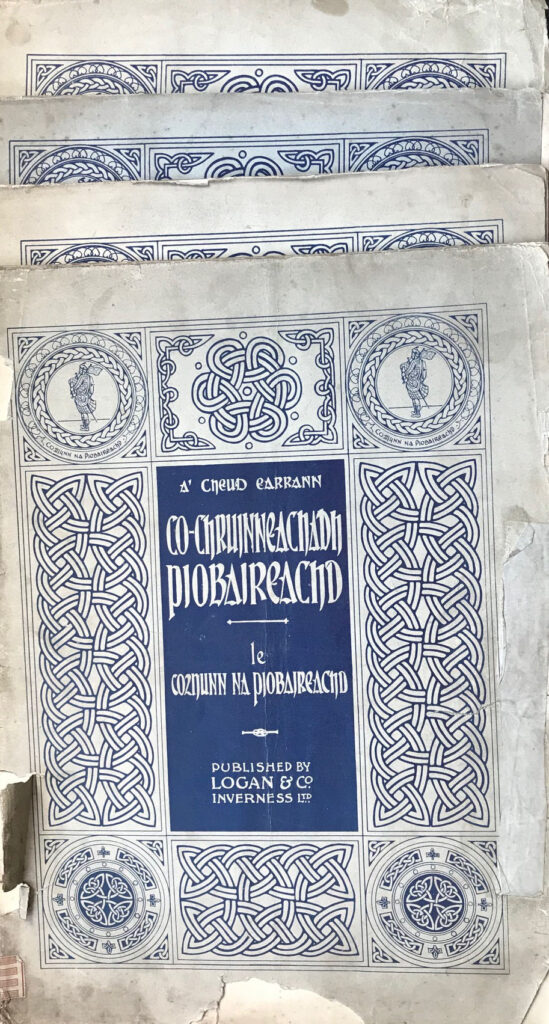
‘Mr Editor, I am not going to bore your readers with further details. John Garve’s Lament has over forty mistakes, consisting chiefly of grace notes to which over value has been given; while the tune Isabel MacKay suffers in like manner, but to a greater degree. In order to prove what I have written, and whereof I now affirm, I am prepared to make the following offer to Lord Dunmore as the president of the Piobaireachd Society: If he will send me, through you, a clean copy of the Society’s publication, I will return it to him through the same channel, with all the errors of “omission and commission” marked in red ink. These will exceed 150. The little Gaelic in the letterpress is little short of an insult to intelligent Gaels, the very first sentence on the outside of the cover “A’ Cheud Earrann,” being offensive to every Highland ear.
‘There is one remark I should like to make in conclusion, as it has much bearing on the future of piobaireachd. The compilers of this attempt at a standard work are anxious to “control the judging” at the various Highland gatherings, although incompetence to write piobaireachd stamps their only effort. As a premium will be placed on all who play from the Collection of the Piobaireachd Society, tunes taken from other standard collections will be boycotted, and the selection of tunes played will be limited to the three test tunes, or at most to the six contained in this collection compiled by those who “control the judging.” People biased in favour of any particular setting should never be allowed to act as adjudicators.
‘Lord Dunmore says that the Piobaireachd Society is “supported by the Highland Press in almost every instance.” I know what that means? It means a policy of closing your eyes and opening your mouth, and instead of reviewing the musical portion of such a work as that now published you may, as one contemporary did, to give the pedigree and the achievements (in a different field from music) of the leading members of the Piobaireachd Society, or deal with the cover of the publication and praise the Celtic character of its design, as was done by another contemporary. However flattering this mode of criticism may be to the members of the society, they know that it does not help them to set up a standard for piobaireachd playing that will command the respect of intelligent players. I am, etc., The Reviewer of The Piobaireachd Society’s Collection of Bagpipe Music.’
The Society’s competition again took place at the Argyllshire Gathering of 1905. The events were the same as in 1904 but the prize money was reduced greatly, with only £7 for the first prize instead of the £20 offered the previous year. There were three set tunes, The Prince’s Salute, The Lament for Patrick Og MacCrimmon and Lament for John Garve MacLeod.
The judges for the Society’s Medal were Lord Dunmore, Mr Archibald Campbell, Kilberry; Major Stewart of Ensay; Captain Colin Macrae, and Mr J MacKillop jnr. The other judges were Colonel Campbell of Inverneill, Captain C A H MacLean, Mr Somerled MacDonald, Captain MacNeill, Captain Forbes of Rothiemay and Major C Neill MacDonald. There were seven competitors for the Society’s Gold Medal but the day was very cold and wet and two, John MacDougall Gillies and John MacColl both broke down while playing Lament for John Garve MacLeod of Raasay. John MacDonald played the Lament for Patrick Og MacCrimmon and the other four pipers played The Prince’s Salute. James Center, William Ross and Roderick Campbell played it by the book but George Allan played the first variation differently. The result was announced on the first day as 1. John MacDonald, 2. James Center, 3. George Allan, 4. William Ross, 5. Roderick Campbell. The formal prize-giving ceremony was held at the end of the second day. Early on the second day, an official came up to Allan, congratulated him on his performance and said “Here is your prize”, and handed him £3. Allan thought that a little odd, as he expected to get his prize at the prize-giving ceremony later in the day. But at the prize giving the result was announced as 1. John MacDonald, 2. James Center, 3. William Ross, 4. Roderick Campbell. This was the prize list that appeared in the Oban Times. G S Allan did not appear in the list. Immediately after the competition Ensay had convened a meeting of the Committee of Management of the Piobaireachd Society, which decided that Allan was disqualified by the rules and over-ruled the judges whom they had themselves appointed. This led to the immediate resignation of some of the original members, and was followed by several more resignations. These included the three Kilberry brothers, their father John Campbell of Kilberry, James MacKillop, and most of the other knowledgeable members. General Thomason resigned his membership in July of the following year and died in 1911 without ever being reconciled with the Society.
1906
The remaining members continued the work of the Society and produced a second book of tunes in 1906. This too, got a poor reception. In a letter to the Oban Times, 14th July 1906, Lt John McLennan wrote, ‘The second part of this long-looked-for book has made its appearance at last, and we now have twelve tunes in two years for five shillings and sixpence. At this rate it will take fifty years to complete a book of three hundred tunes, and it will cost nearly seven pounds. Major General Thomason, after spending a life-time and a fortune collecting piobaireachds, published some three hundred of them in a neat concise form for the modest sum of two guineas. The Bible Society publish the Old and the New Testaments, the Psalms and the Paraphrases, for one shilling and sixpence. Why the Piobaireachd Society is issuing this book in such a piecemeal fashion, and so very expensively, especially when we find that there is nothing in it except what has already appeared in as good, if not better, form, is best known to the Committee.
‘So long as the Piobaireachd Society hands out plenty of gold, there will always be any amount of competitors, no matter what sort of stuff they are compelled to play. Let the Society cease from giving prizes and refrain from the practice of judging in one’s own cause, and then listen to how many of their settings of tunes are being played; or let another society get up other sets of the same tunes and double the prizes and the Piobaireachd Society would see their settings put in the shade.’
Another contribution from an anonymous writer appeared a month later. ‘It is to be regretted that a Society of this kind, started no doubt with the best intentions, should prove a hindrance instead of a help to pipers by issuing inaccurate and mangled versions of tunes, and great credit is due to Mr MacLennan for calling public attention to the matter. If the Society has really the interests of piping at heart it will best serve these interests by now withdrawing from circulation all their publications and handing them over to a competent authority on the theory and practice of pipe music, who will correct and issue them in an intelligible and proper form. Failing this, I see no course for the Society but to wind up and frankly acknowledge its failure to carry out successfully the work undertaken by it.’
The notice from the Piobaireachd Society listed the required tunes for the Society’s competitions at the Argyllshire Gathering, Northern Meeting and Lochaber. The notice stated: ‘Part II of the Society’s publication of piobaireachd containing the above six tunes is now ready, and may be obtained from Mr P Henderson, 100 Renfrew Street, Glasgow, price 2/6. No other versions will be eligible for prizes in competitions held under the Rules of the Society. William Stewart, Hon Secy, The Piobaireachd Society. Ensay, Obbe. 1st July 1906.’
The three events at the Argyllshire Gathering were as before, 1. The Piobaireachd Society Gold Medal, open to all comers, for which the three tunes were MacLeod of MacLeod’s Lament, the Bells of Perth and Lochnell’s Lament; 2. The Highland Society of London Gold Medal, restricted to those who had not already won it, for which a list of six tunes was to be submitted; and 3. The confined event for the Piobaireachd Society Silver Medal, with the same rules as before, which required the three tunes Lament for the Only Son, Corrienessan’s Salute and Clan Ronald’s Gathering. For the Piobaireachd at Lochaber and the Clasp at Northern Meeting the tunes were those for the Argyllshire Gathering Open event but for the Northern Meeting Gold Medal the tunes were those for the Argyllshire Gathering confined Silver Medal event.
It should be noted that the set tunes rule only applied to the competitions held under the rules of the Piobaireachd Society and for which the Society provided the prize money. The prize money for the Gold Medal at the Argyllshire Gathering was provided by the Argyllshire Gathering, hence the set tunes were not mandatory for this event and competitors could submit any six tunes of their own choice. The situation was different at the Northern Meeting where from 1905 in addition to the Highland Society of London Gold Medal and the Gold Clasp there was prize money from the Society.
1907
In 1907 the third book was published. In July Somerled MacDonald wrote, ‘The Piobaireachd Society in the preface of its publication, publishes an extract from an article in the Northern Chronicle which is most misleading. In the first place the newly instituted competitions of the Society are not the cause of the increasing number of competitors. It is also misleading to suppose that the pipers play the Society’s versions at other games for preference. They play them for the sake of practice. It requires a good deal of practice to play a tune without any music in it.
‘The music published this year by the Society is just as bad as usual. A few of the mistakes in the grounds of the tunes may be noted. This is not meant to be a full criticism of the book, but merely of a few of the mistakes which are at once apparent.
‘The Lament for the Children. The cadence G E D is written wrong in the ground, and wherever it occurs, right through the tune. The e should be written as it is played, a full note. The fourth bar of the ground is almost unplayable; the first B should be cut, and the second one given the time. The same mistake occurs right through the ground and its doubling. In the last bar of the first part of the ground, the grace note C is wrong; it should be a low G. The note as written is an easy way of getting out of it. The same note is wrong all through the tune. In the seventh bar of the second part of the ground, the G grace note should be left out before the E, and in the eighth bar there should be a G grace note before the F. In this bar the F should be cut, and the high A made long. The E should not be cut as written here.
‘The MacLeod’s Salute. The cadence G E D is, as usual, wrong, and it occurs so often that the tune is hopelessly ruined.
‘The Unjust Incarceration. I cannot understand why the most beautiful bar in the first part of the ground is missed out. (I mean in the repeat of the first part of the ground). Is it because it appears in General Thomason’s book, or perhaps it may be that it does not appear in the manuscript of some ancient amateur? The cadences are, of course, wrong. There is an obvious misprint in the first bar of the second part of the ground. Last year some of the pipers practised the misprint, but I think this one will be too much for them.
‘MacDonald of Morar’s Lament. The cadences are written wrong right through this tune as in the others, varied by a misprint in the very first bar of the tune, but I presume pipers will require to practise this note, as it is actually possible to play it. The time given to the first B in the first bar is wrong, as it is wherever this note occurs in the tune.
‘My King has Landed in Moidart. In the B grip throughout this tune the accent is on the wrong B. The tune has been mutilated almost beyond recognition.
‘The Lament for the Harp Tree. I understand this magnificent tune is not to be played this year, for which we ought to be thankful.
‘Of course it is well known that the cadences mentioned have been written in this way for years, but they have never been played as written until the new Piobaireachd Society insisted upon it. It they would only leave these notes to the discretion of the pipers, the tunes would not be quite as bad.’
Lord Dunmore died in August 1907 and was followed as President by Simon Fraser, Lord Lovat. He was born in1871 and succeeded to the title in 1887. He served in the 1st Life Guards before raising his own regiment, the Lovat Scouts, for the South African War. He became a Brigadier General and served again during the First World War. From 1926 to 1928 he was Parliamentary Under Secretary of State for Dominion Affairs. He died on the 13th February 1933.
At the Argyllshire Gathering in 1907 the three piobaireachd events were as before. The set tunes for event one, the Open competition for the Piobaireachd Society Gold Medal were, The Children’s Lament, The Unjust Incarceration, Ronald Macdonald of Morar’s Lament. For event 2 the Highland Society of London Gold Medal, six tunes were required and for event three, the Confined Silver Medal, the tunes were MacLeod’s Salute, Isobel MacKay. At the Northern Meeting the tunes for the Clasp were those for the Open but for the Gold Medal the tunes were Lochnell’s Lament, The Bells of Perth and Macleod of Macleod’s Lament. The rules stipulated that Piobaireachd Society settings must be played.
1908
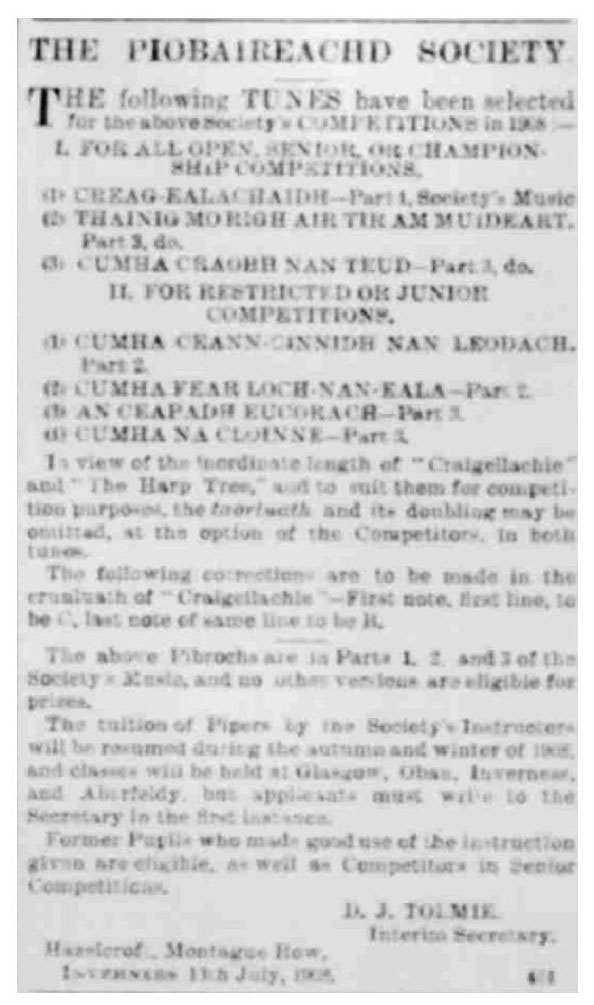
In 1908 the events were as before, but the notice for events 1 and 3 stated ‘under the rules of and prizes presented by the Piobaireachd Society, without the previous mention of the Gold and Silver medal. For the Open the tunes were Craigellachie, My King has Landed in Moidart and Lament for the Harp Tree. The rules stated, ‘Piobaireachd Society settings must be played. In view of the inordinate length of Craigellachie and The Harp Tree and to suit them for competition purposes, the Taorluath and its doubling may be omitted at the option of the competitor in both tunes. The following corrections are to be made in the Crunluath of Craigellachie – first note, first line to be C, last note of same line to be B.’ For the Gold Medal again six tunes were required and for the third event the tunes were MacLeod of MacLeod’s Lament, Lochnell’s Lament, The Unjust Incarceration and Lament for the Children. At the Northern Meeting the Gold Medal tunes were Lochnell’s Lament, Lament for the Children and The Unjust Incarceration; and for the Clasp, Craigellachie, My king has landed in Moidart, and Lament for the Harp Tree.
1909
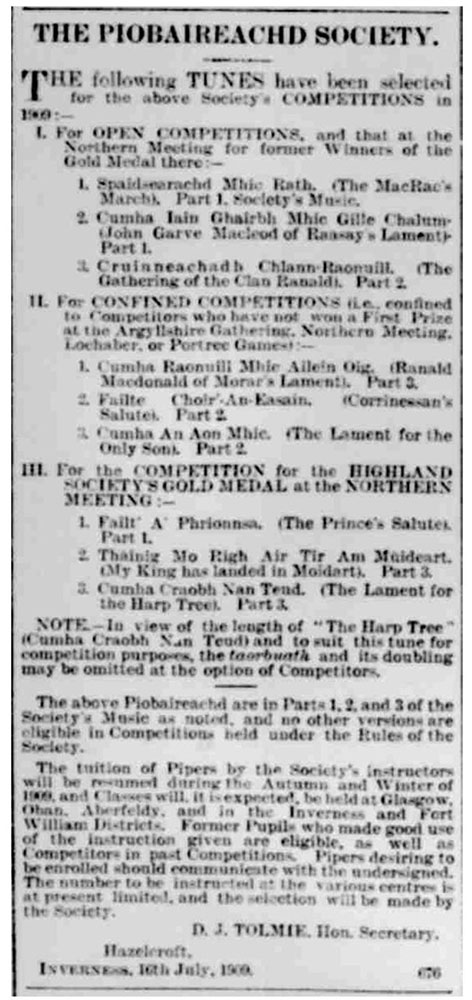
In 1909 the tunes for the Open competition at the Argyllshire Gathering and the Clasp at the Northern Meeting were The MacRaes’ March, from Book 1, John Garve MacLeod of Raasay’s Salute, from Book 1 and The Gathering of Clanranald from Book 2.
For the competitions confined to those who had never won a first prize at the Argyllshire Gathering, Northern Meeting, Lochaber or Portree Games the tunes were Ronald MacDonald of Morar’s Lament, Book 3, Corrienessan’s Salute, Book 2, and Lament for the Only Son, Book 2. For the Gold Medal at the Northern Meeting the tunes were The Prince’s Salute, Book 1, My King has Landed in Moidart, Book 3, and Lament for the Harp Tree, Book 3. Due to the length of The Harp Tree the Taorluath and its doubling could be omitted at the option of the competitor. The notice ended, ‘The above piobaireachd are in Parts 1, 2 and 3 of the Society’s Music as noted, and no other versions are eligible in competitions held under the Rules of the Society’ and was signed D J Tolmie, Hazelcroft, Inverness, 10th July 1909.
In 1909, instead of the Piobaireachd Society Gold Medal, the Dunstaffnage Cup was awarded and from then onwards this cup was awarded to the winner of the Open Piobaireachd, until it was lost in 1922.
1910
The fourth book, published in 1910, was heavily criticised. Lt John McLennan wrote ‘This fourth part of the Piobaireachd Society’s publication, just issued, is an insult to intelligence, and ought to be withdrawn in deference to the worldwide reputation of Celtic Music. It is got up in the most haphazard, ramstam method possible, without the slightest aim at design or form, and the simplest rules of scientific notation are entirely ignored.’ Dr Charles Bannatyne wrote ‘The present part of the Society’s music bristles with inaccuracies. Not one of the tunes published in this part is correctly noted.’
A correspondent with the pen name Padruig Og wrote: ‘In England, and among those uninitiated in the art of piobaireachd playing, it is a matter of common belief that if a man blows through a blowstick into a sheepskin bag (it is all one with them whether he plays well or can with difficulty stumble through Highland Laddie) then that man knows all there is to know about the great Highland bagpipe and its music. Like most popular beliefs founded on ignorance, this is a fiction. It would be as true to say that the player of a street piano-organ must be an authority on Beethoven. This unfathomable ignorance, combined with the small numerical proportion of practical amateur players, is the main factor which destroys all chance of success for a large Society, filled with the uninitiated. From the Society’s point of view, the situation must without doubt seem hopeless; for outside the Society they see a large number of amateur piobaireachd players, in and out of this country. And in the Society how many can be found who can themselves play even two piobaireachd? The number, I am told, is small. And yet this Society professes to dictate to the piping world what is correct and what is not correct; and their dogmatism does not end there. Unfortunately these dictates are carried into practice. The Society’s paid instructors are bound, willy nilly, to perpetuate the blunders originated or corroborated by this Society. Further, at the competitions held under the Society’s rules, the judges are selected from the ranks of the Society and the competence of the Society’s judges, with one or two honourable exceptions, must be a matter of grave doubt and it is manifestly improbable that these one or two exceptions can judge at Oban and Inverness and Lochaber and Portree. The Society is, indeed, in a bad way. Why is it that the Society, whose objects are in every way admirable and deserving of the support of all lovers of Ceol Mor, why is it that it has failed so lamentably? The answer has already been foreshadowed, I can almost see in my mind’s eye the various stages by which this state of affairs may have come about. The promoters of the scheme, anxious to obtain support, financial and moral, appealed to the uninitiated public. It became the fashion to join the Society, and in a short time its own mother would not have recognised it. In short, the men who asked for support got it – floods of it – and were drowned in the deluge. That is the only possible theory which seems to cover the lamentable facts.”
The Piobaireachd Society notice for the set tunes was published in the Oban Times in February. The tunes for the Open events were, Cumha Mhic Shimidh, Cumha Chaiptein Macdhghhaill, A Bhoilich; for the confined events Bodach Nam Briogais, Cumha Phrionns’ Tearlach, Failte Bhain Tighearn’ D’Oyley; and for the Gold Medal at the Northern Meeting, Tulach Ard, Bratach Bhan Nan Stiubhartach, Togail Bho Thir. The notice stated that the tunes were all in Part 4 of the Society’s Collection and ‘no other versions are eligible for competitions under the rules of the Society.’
1911
In 1911 the tunes set for the Open at the Argyllshire Gathering and the Clasp at the Northern Meeting were Craigellachie, Bells of Perth, John Garve MacLeod of Raasay’s Lament. For the Gold Medal at the Argyllshire Gathering, competitors were to submit six tunes of their choice. For event three at the Argyllshire Gathering and the Gold Medal at the Northern Meeting the set tunes were The Gathering of Clan Ranald, Lament for the Only Son, The MacRaes’ March. The set tunes were to be from the Piobaireachd Society books and no other versions were eligible.
1912
On 22nd June 1912 the Oban Times announced: ‘The Piobaireachd Society have just published Part V of their Collection. It contains the following eight tunes: The Battle of Sheriffmuir, The Battle of Auldearn, The Blind Piper’s Obstinacy, Lament for Catherine, Lament for Donald MacDonald of Glengarry, Lament for MacLeod of Colbeck, Kinlochmoidart’s Salute, andThe Rout of Glenfruin. The preface contains historical and traditional notes of some interest and value. The work is to be had from Mr Peter Henderson, 24 Renfrew Street, Glasgow.’
The Notice for the Argyllshire Gathering listed the tunes for each event. For the Open, the Dunstaffnage, Cup, the tunes were: Lament for MacLeod of Colbeck, The Battle of Auldearn, The Rout of Glenfruin. Piobaireachd Society’s Settings must be played. For the Gold Medal, open to all who have not won this medal before. A list of six tunes was to be sent to the secretary, any of which the competitor might be called upon to play. For the third event which was confined to those who had never won a first prize for such at the Argyllshire Gathering, Northern Meeting, Lochaber or Portree Games, the tunes were The Battle of Sheriffmuir, Lament for Catherine, Lament for MacDonald of Glengarry. Piobaireachd Society’s Settings must be played. For the Gold Medal at the Northern Meeting the three set tunes were The Battle of Sheriffmuir. The Blind Piper’s Obstinacy, Kinlochmoidart’s Salute. For the Clasp the tunes were Lament for Macleod of Colbeck, The Battle of Auldearn, The Rout of Glen Fruin.
The Oban Times on 27th July 1912 published a long letter from Lt John McLennan. He began: ‘26 Arden Street, Edinburgh 23rd July, 1912. Part V of the Piobaireachd Society’s publication has recently been issued, and I regret to note that it is as great a failure as its predecessors; indeed, if we take into consideration the “Historical Notes,” this volume may be looked upon as the greatest failure. An estimate of the care and research put on it can be obtained from statements made on the second page of the “Historical and Traditional Notes viz.: “John Macleod of Colbeck was an eminent Jamaica planter.’ He then gives details of the family and career of John MacLeod. Next he writes about the possible tuition of John MacKay, Raasay before going on to criticise the various tunes. As the replies cover all these points Lt McLennan’s letter is not given in its entirety here.
This letter was published in the Oban Times on 3rd August 1912: ‘The Piobaireachd Society’s New Collection. To the Editor of the Oban Times. Glenorchard, Torrance, 27th July 1912. ‘Sir, Lieut McLennan has now come forward with his usual hostile criticism of the Piobaireachd Society’s publication. As one of the editors, may I be permitted to make a few observations on it? I do not think that any useful purpose will be served by entering into a discussion on the correctness of the settings of the music. It is useful and interesting on the question of settings to have Lieut McLennan’s views, which are always worthy of consideration; but he will doubtless admit there are others whose views are also entitled to respect.
‘With regard, however, to the Historical Notes, it is somewhat of a relief after Lieut McLennan’s opening remarks to discover that he finds fault with the Note on one tune only. This Note is by no means so inaccurate as he indicates. He assumes that the tune was written as a Lament for Colonel John MacLeod who died in 1823. This is very possibly correct, and if Lieut McLennan will show that it must be so, a note will be taken for reference in the preparation of any future editions of the book. What the Note guardedly says is that the Lament seems to have been written for Colonel John MacLeod, who died in 1775. This may be so; it may have been written for his son; but, apart from that question, all the statements about him are correct. (See Mackenzie’s History of the MacLeods)
‘With regard to the question whether or not John MacKay was instructed in piping by John Dubh MacCrimmon, this statement, of which, as Lieut McLennan says, the Piobaireachd Society are not the originators, would appear now to be incapable of proof, and may or may not be correct. Lieut McLennan endeavours to disprove it. As regards the first part of his argument, assuming the statement that Professor MacArthur was the last pupil “taught by the ancient MacCrimmons of Skye,” to be correct, its weight depends on the answer to these questions:
- When was MacArthur taught by MacCrimmon?
- John Dubh being alive at the date of the competition, was he included in the phrase “the ancient MacCrimmons of Skye”?
‘The second part of the argument seems to amount to this suggestion: that John Dubh was not available as a teacher in Skye when John MacKay might be supposed to have been receiving instruction from him. Angus MacKay, however, indicates that with the exception of a visit to Greenock in 1795, made with the intention of going to America, an intention which he abandoned, he lived his life in Skye, where he died in 1822 at the age of 91.
‘In a lecture printed in the Celtic Monthly on Ceol Mor agus Clann Mhic Cruimein, the Rev Neil Ross, who from local and traditional knowledge is exceptionally qualified to speak of the history of the MacCrimmons, says that after 1770, when rent began to be exacted for Boreraig and John Dubh MacCrimmon left it, he remained as piper at Dunvegan. If Lieut McLennan, from the stores of his historical knowledge relating to the pipes, can throw any further light on these questions, I am sure your readers will be interested to have his remarks. I am etc, John Bartholomew.’
Sheriff John Bartholomew of Glenorchard was a prominent figure in piping for many years. He was hon secretary of the Scottish Pipers’ Society and a member of the music committee of the Piobaireachd Society. In 1909 he purchased two volumes of the Campbell Canntaireachd from Miss Anne Campbell, a granddaughter of Colin Campbell. Sheriff Bartholomew judged frequently at piping competitions. He died in 1937.
On August 10th the Oban Times published a reply from Fear Aig Am Bheil Fios, written on 3rd August. He says: ‘Mr McLennan’s desire to tear the Piobaireachd Society’s work to pieces has got such a hold on him that it has become chronic. His fifth effort to pick holes in a texture that is too tough for him, or his usual cry for war against a peace loving body like the noblemen and gentlemen of the Piobaireachd Society, is as great a failure as ever.’ He then goes on to reply to the criticisms of various tunes.
‘MacDonald of Glengarry’s Lament. Mr McLennan says: “This is a beautiful tune spoiled.” Yes – in his criticism. His main objections are as follows:
- That there are two gracenotes in the first and second bars turned into theme notes to fill in the time. –Not so.
- That there are seventeen syncopated beats cut up into two beats. –Nonsense!
- That the taorluath and crunluath are pointed and timed quite differently from the succeeding tune. –The one tune has got nothing whatever to do with the other, and if Mr McLennan cares to look, he will see that the two tunes are quite differently constructed.
‘My answers to his errors follow in each case, but to give him every opportunity of fair play, perhaps he will point out the notes referred to in No 1 and the beats referred to in No 2.
‘Kinlochmoidart’s Salute. Mr McLennan’s objections are: That in the urlar there are no less than 18 notes belonging to one beat stuck on to the next. – As a matter of fact this urlar is timed to perfection, each beat stands on itself alone; but perhaps Mr McLennan will be good enough to point out the notes he maintains are misplaced.
‘The Battle of Auldearn. The Objections are:
- That the urlar and its doubling have 64 beats each. – Quite correct.
- That the siubhal, its doubling, and the dara-siubhal, contain 32 beats each. – Quite correct.
- That the treas-siubhal goes back to 64 beats. – This might be given better in 6/8 time with 32 beats.
- That the taorluath and crunluath have 32 beats. – Quite correct.
- That there are some notes in one beat stuck on to the next. Not so, but perhaps Mr McLennan will point out these notes.
‘The Battle of Sheriffmuir. The points at issue are:
- That this tune sprang from, or is a variant of The Battle of Vaternish. – Mr McLennan and I sprang from Adam, but that is not to say that we are the same individual, or that I am a variant of Mr McLennan. All tunes spring or come from the scale, but in the eyes of broad minded men they all differ.
- That the second beat in each part of the ground and siubhal ordaig is A. – Quite correct, and certainly not B, as can be seen by anyone with eyes.
- For a wonder the beats are correct here, but some of the variations are badly tied, Mr McLennan says. – Where?
- That the treas-siubhal is written wrong. – Not so, but absolutely correct. Mr McLennan says it and the same variation in the Battle of Auldearn are both wrongly written, but he does not say what is the right way. Would he kindly do so?
‘The Blind Piper’s Obstinacy is apparently a tune too deep for Mr McLennan to understand, because he finds so many faults with it. It is a very fine setting, and agrees note for note with the MS setting which I possess. There is no need to get a setting from anyone.
‘McLeod of Colbeck’s Lament. The objections here are:
- That its composer stole it from other three tunes. – In imagination.
- That the beats are badly grouped. – Where?
- That the whole tune is badly timed. – Not so.
- That the urlar and variations do not agree. – To the extent of 90 per cent, they do agree, and where they do not that lay with the composer – not with Mr McLennan.
‘Catherine’s Lament and The Rout of Glenfruin have apparently escaped Mt McLennan’s notice.
‘Finally, your critic says that the Piobaireachd Society should get their music written by a man who has “a thorough knowledge of the Gaelic language, its songs, literature, and music, as well as the fingering of the chanter, and who has obtained the certificate of a college of music for having passed in the science of music, harmony, counterpoint, and instrumentation.” Where can such a man be found? The following questions may in the same way be asked of Mr McLennan. Is he a thorough Gaelic scholar, a fascinating singer, a professor of literature, a professor of music, a professional piper, has he passed in the science of music and the mastery of harmony, does he understand counterpoint, and how many instruments does he play?
‘In conclusion, if your critic possessed all those qualities above referred to, he would not have found so much fault with the Piobaireachd Society’s book. I am, etc, Fear Aig Am Bheil Fios.’
Another long letter from John McLennan was published in the Oban Times on August 17th.
He ends his letter by saying: ‘Let Fear aig am bheil fios come to the front, say who and what he is, and I shall then verify every word in dispute to the full satisfaction of all reasonable persons, and at the same time I will tear the statements of “One Who Knows” to shreds, and scatter them through Gaeldom, but to correspond with a man shooting from behind a hedge I will not. I am etc, Jno McLennan.’
The correspondence continued among other but John McLennan took no further part. One writer described the Part V as ‘One of the finest books of piobaireachd ever published.’ He went on to say, ‘Happily the Piobaireachd Society is in a flourishing condition, and their book meets with a very ready sale, which alone proves it correctness and popularity.’
Several other writers discussed Gesto’s book of Canntaireachd, querying whether he was a piper and if his settings and canntaireachd were correct. Another began his letter by saying ‘Writing as a competing piper, bored beyond expression by having to relearn and afterwards unlearn certain “wrong” versions, published in high places, I would like to urge, with your permission, from a performer’s point of view, the strong need of having Gesto’s book translated into ordinary notation by a practical piper…’
From around 1910 a new figure had appeared on the scene and he was to be an influential figure in the Society for many years to come. He was John Peter Grant, younger of Rothiemurchus, born in 1885 and an advocate by profession. When studying the law in Edinburgh he had his first piping lessons from Pipe Major James Sutherland ex-Seaforth Highlanders. Following this elementary instruction he became a pupil of John MacDonald, Inverness. In 1910 Rothiemurchus was a young man, aged only 24 and so was free of involvement in the controversies of the past. He had been gathering a private collection of material on piobaireachd together with Archibald Campbell, and in future years this would form the basis of the Society’s published collections. General Frank Richardson knew Rothiemurchus well in later years and was sure that he didn’t own a pair of trousers.
After two years of discussions and negotiations Rothiemurchus was enthusiastic, energetic, influential and knowledgeable and as an officer in the Lovat Scouts he had the ear of Lord Lovat, President of the Society. Rothiemurchus was able to bring together the members and former members of the Society. He had another ally among the members of the Society, John Graham-Campbell of Shirvan who had joined in 1908. In 1912, after a series of committee meetings and Extraordinary General Meetings the rift was eventually healed, several of the surviving original members including John and Archibald Campbell and James MacKillop, re-joined and Rothiemurchus was elected as a member of the Society. In 1913 a music committee was appointed with J P Grant as secretary and all the music issued by the Society was to be revised.
1913
In 1913 a list of ten set tunes was published in the papers on 8th February. ‘Competitors will be required to submit a list (a) for senior competitions, six or (b) for junior competitions, four, out of the following list: The King’s Taxes, Lament for the Duke of Hamilton, The Unjust Incarceration, War or Peace, The King’s Taxes, The MacKay’s White Banner, The Fraser’s Salute, The Bells of Perth, MacCrimmon will Never Return, Isabel MacKay. Competitors are at liberty to play any setting. J P Grant, Hon Secy, Music Committee.’
The last sentence of the notice made clear that competitors were no longer required to play the settings in the Piobaireachd Society’s books and this too instigated a number of letters to the Oban Times.
Firstly on the 15th of February: ‘Piobaireachd Society’s New Rules. 12th February 1913. Sir, I have always considered that the Piobaireachd Society were doing good work for our national music, and that the piping world owes them a debt of gratitude for their efforts to bring pipe music more prominently before the public; but there was one of their rules to which I had a strong objection, and I do not think I was the only one of the same mind. The Society always insisted on competitors playing the setting given out by them. Of course, they were perfectly within their rights in doing so; they gave the prize, and were entitled to make their own conditions, but was it judicious?
‘In my humble opinion, for the Society to meddle with those ancient settings, handed down from father to son, was little short of sacrilege, and I know for a fact that this prevented more than one good piobaireachd player from going forward to their competitions.
‘I am delighted to observe that now better counsels prevail, and that these Society settings are not in future to be insisted on. The effect of this, I am sure, will be an increased number of competitors coming forward, and better music heard. I think it is quite possible there may be some minor mistakes in these old settings (probably printer’s errors); by all means correct those, but leave the rest alone. They are the work of men who had the art of piobaireachd in their very blood, and I do not think there is a piper living today that can compose anything equal to them.
‘The present secretary of the Music Committee is a player, and a good judge – a man who, I really think, gives his decisions without fear or favour, and I confidently expect the Piobaireachd Society under his leadership will go on and flourish.
‘I should like this subject taken up and ventilated by an abler pen than mine, and there is no better paper in Scotland for the purpose than the Oban Times. Hoping you can find a corner for this letter in your valuable space, I am, etc, A Lover of Piobaireachd.’
In the same paper, David Glen and Sons, Bagpipe Makers, Greenside Place Edinburgh, took the opportunity to advertise, with this notice: ‘The Piobaireachd Society. All the Competition tunes for 1913. Price 1/- each, To Be Had From David Glen and Sons, Bagpipe Makers, Greenside Place Edinburgh.’
On the 8th March this letter was published: ‘Piobaireachd Society’s Competitions 1913. 48 India Street, Edinburgh March 1st 1913. Sir, As your piping readers perhaps have noticed, the official list of piobaireachd selected by the Piobaireachd Society for their competitions in 1913 was printed in your issue of February 8th. In succeeding issues an advertisement of Mr David Glen’s settings of these tunes has appeared under the heading “The Piobaireachd Society.” It has been brought to the notice of the Music Committee of the Piobaireachd Society that intending competitors have understood from the head-line of this advertisement that Mr Glen’s settings have been especially recommended by the Committee. I have been instructed by the Committee to deny this, and to state that the Committee are desirous that competitors in the 1913 competitions shall have complete freedom in their choice of settings of the tunes which they offer. I am, etc, J P Grant, Hon, Secretary, Music Committee, Piobaireachd Society.’
The Piobaireachd Society notice which had been published in February was repeated in the same paper.
Next in the Oban Times of March 29th this letter appeared, ‘The Piobaireachd Society’s New Rules. 20th March 1913. Sir, The work of the Piobaireachd Society has undergone severe criticism from its very infancy, and those who have found most fault with it have done nothing whatever to put matters straight, even if it has erred. There is nothing in existence in the shape of a pastime so dear to my heart as piobaireachd, and it is with much interest that I make my first attempt to express my views on the art while yet there is a chance.
‘“A Lover of Piobaireachd” in a recent issue, denounces the past management of the Society’s music, and suggests that competitors should be allowed to select their own settings. If your correspondent knows anything about piobaireachd at all, what will this suggestion mean? – only a side path to lead the Society and competitors, more especially the younger ones, astray.
‘“A Lover of Piobaireachd” goes on to say that “to meddle with those ancient settings, handed down from father to son, was little short of sacrilege.” To allow competitors to make their own choice of settings is only encouraging the destruction of piobaireachd. When the old piobaireachd which we have now handed down to us was created, they were each composed by one man. No tune had two different settings, and only one setting should exist. If in the past good tunes have been destroyed by ignorant men re-setting them, who had no right to do so, perhaps 50 to 100 years ago, there will only be more confusion to encourage different settings perpetually. In the past the gentlemen responsible for the music had only one setting. All the competitors were on the same footing, and the judges knew exactly what they were to hear played at the competitions. But now, under such rules as are suggested, what will the results be? That the judge is going to hear a setting never played before. That setting may be quite irregular in form, and yet get a prize. On the other hand, many a piper would get a prize if the settings were fixed who would be misplaced if he played a setting that did not meet the approval of the judge. There are many dangers in allowing pipers to select their own settings, some of which are, viz: Pipers would get prizes for settings which are wrong, and judges who are inexperienced in the construction of piobaireachd would be misled by strains new to the ear but false and irregular.
‘It must be remembered that to begin with every piobaireachd had only one setting as it left the hands of the composer, and only one should exist now. Who is directly responsible for so many settings of the same piobaireachd as we have today may be very hard to determine, but what was a stumbling block to men in the past should be no barrier in the way of those who today wish to see piobaireachd, once and for all, put on a proper and scientific basis.
‘I would humbly suggest that, first, the Piobaireachd Society’s new management should select the one perfect setting and let it be fixed once and for all time; print approved settings, and make all competitors play these only.
‘As a competitor, last year I got a book of the approved tunes from the Society, but this year no book is to be offered. Where am I to get the tunes for 1913? The old management of the Society in this way was perfect. I got nine tunes last year for 2s 6d, and I was perfectly satisfied that I was playing what was required of me. This year I am in danger of paying 10s, or £2. 2s, for a book which would contain them all, and even then I may be excluded from the prize list if I don’t play a setting to please the judge, though I did have a perfect performance.
‘In the past, the gentlemen who carried on the good work for piobaireachd were the pioneers of the Piobaireachd Society. I found no fault with their work. They kept the beacon burning for “Ceol Mor,” which guided the best competitors of our time to their rallying ground, and for this alone I give them the full praise they are most worthy of. Major William Stewart of Ensay, who edited and published their first collection of piobaireachd in full notation, though he left us the poorer by the loss of his undying love for piobaireachd, will be ever green in our minds while we scan the pages of his work, well begun, and now ended.
‘Captain Colin MacRae, whose enthusiasm and love for piobaireachd would be hard to beat, and himself a piobaireachd player, deserves the highest possible praise for his work in the field of music in connection with the Society’s competitions. Last year he broke all previous records for the choice selection of tunes and good settings, and it is with regret that I view his giving over the management of the Society’s music. I welcome the new secretary of the Music Committee, Mr J P Grant, yr. of Rothiemurchus, and hope he will keep the traditions of our national music ever near to his heart, and that my suggestions may receive his earnest consideration on their merit. I would not like to throw cold water on the enterprise he has just encountered, but would rather encourage him to adopt lines which would make piobaireachd more pure and simple, and preserve it in its original and perfect form.
‘I feel that it is my duty to give the gentlemen who had the management of the Society’s work in their hands, and nearest to their hearts, full credit for their good work. Unlike your correspondent, “A Lover of Piobaireachd,” I would not dare venture to extinguish in an instant the warm embers that have reflected the brightest rays of light that ever shone on piobaireachd till the new beacon id full ablaze.
In conclusion I wish the Piobaireachd Society, whoever may take up the work, every possible success, I am, etc, Competitor.’
The same paper had this letter: ’26 Arden Street, Edinburgh, 24th March 1913. Sir, After writing for over ten years against the settings of this Society, it is pleasant now to congratulate the Music Committee on the wise and thoughtful decision it has come to by giving the tune and allowing every man to play it as he thinks it should be. The Society and the public will thus get all that is best in the competitors, who will do their endeavour to give good music.
‘The only fear now is of the narrow-minded, one-eyed judge, who cannot move from the imperfect setting he has been accustomed with, and in this way retards a great forward movement. I am, etc, Jno McLennan.’
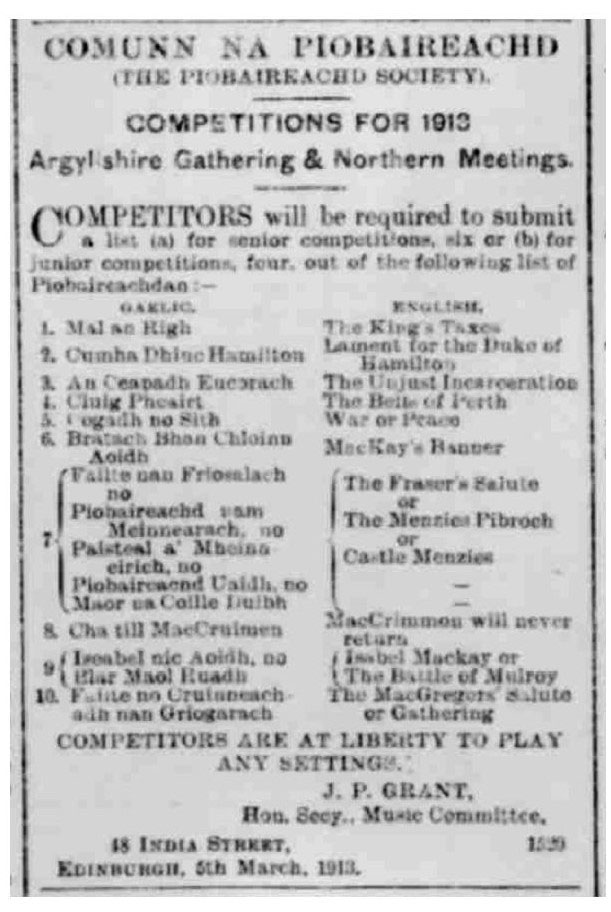
1914
The list of set tunes for 1914 was published in February 1914. ‘Competitors in the Senior Competitions will be required to submit a list of six tunes and competitors in the Junior Competitions a list of four tunes selected from the following: Lament for Donald Ban MacCrimmon, War or Peace, The King’s Taxes, Lament for the Duke of Hamilton, The Lament for the Children, Castle Menzies, Lament for the Laird of Gairloch, MacCrimmon will never Return, Salute to the Young Laird of Dungallon, Lament for the Old Sword’. The tune names were also listed in Gaelic. The notice continued, ‘The tunes will be accepted as correctly played if played according to the settings in the published collections of Angus MacKay, William Ross, David Glen, Donald MacPhee, the Piobaireachd Society or Ceol Mor. Competitor must, if asked, give the judges their authority for the settings to be played. Any setting other than those above mentioned may be played; but in this case if the judges do not think that the authority quoted is sufficient, they may take into consideration, in making their award, the merits of the setting adopted. J P Grant, Hon Scy Music Committee. 31 Northumberland St, Edinburgh. February 2nd 1914.’
The additional information given on the acceptability of different settings addressed the problem raised by a competitor in the letter published in the Oban Times on 29th March in the previous year.
With the war coming the Gatherings were abandoned and the work of the Society was interrupted. After the War a plan was made to replace the existing series of publications which had been put out before the war. The series was described as in many respects unsatisfactory. It was described as having consisted of five books which had been put together piecemeal, without any consistent format and with very little in the way of editorial notes.
1919
For the 1919 Argyllshire Gathering Gold Medal six tunes were to be submitted. Competitors in the Senior were required to submit five tunes and in the Junior three tunes from Lament for Donald Ban MacCrimmon, War or Peace, The King’s Taxes, Lament for the Duke of Hamilton, Castle Menzies, Lament for the Laird of Gairloch, MacCrimmon will never Return, My King has Landed in Moidart, MacGregors’ Gathering, I Got a Kiss of the King’s Hand, Clanranald’s Gathering, The Vaunting, Mary’s Praise, MacLeod of Raasay’s Salute. Settings from the published collections of Angus MacKay, William Ross, David Glen, Donald MacPhee, the Piobaireachd Society or Ceol Mor were acceptable. At the Northern Meeting six tunes were to be submitted for the Gold Medal and competitors in the Clasp were required to submit five tunes from the list given above. Again it was stated that any setting other than those above mentioned may be played; but in this case if the judges do not think that the authority quoted is sufficient, they may take into consideration, in making their award, merits of the setting adopted.
1920
In 1920 The Oban Times gave the full list of events and the rules for the piping competitions at the Argyllshire Gathering: ‘Competitors in the senior competition will be called upon to play from the following tunes: Cumha Chaisteal Dhun-Naomhaig, Lament for the Castle of Dunyveg; Cumha Mhic Shuain a Roaig, Lament for MacSwan of Roaig; Cath Bhealach Chrraoibhe, The Battle of the Pass of Crieff; Cumha na Peathar, The Sister’s Lament; Cumha Fhionnlaigh, Lament for Finlay; Blar Allt Eireann, The Battle of Auldearn. The tunes will be played according to the settings published in proof but the setting of The Battle of Auldearn printed in part 5, Piobd Soc Colln p8 may be played as an alternative. Competitors in the Junior competition will submit a list of any four of the following tunes: Mal an Righ, The King’s Taxes; Thainaig mor Righ air tir am Muidart; My King has Landed in Moidart; Fhuair mi pog do laimh an Righ, I Got a Kiss of the King’s Hand; Cruinneach Chlaun Raonuil, Clan Ranald’s Gathering to Sheriffmuir; Moladh Mairi, Mary’s Praise for her Gift; Failte Mhic Gille Chaluim, MacLeod of Raasay’s Salute. The tunes will be accepted as correctly played, if played according to the settings in the published collections of Angus MacKay, William Ross, David Glen, Donald MacPhee, The Piobaireachd Society, or in Ceol Mor. Any setting other than those above mentioned may be played; but in this case if the judges do not think that the authority quoted is sufficient, they may take into consideration, in making their award, the merits of the setting adopted. Competitors for the Gold Medal were to submit a list of six tunes, the names to be in Gaelic with English translations.
At the Northern Meeting the judges for the piobaireachd had been selected by the Piobaireachd Society under whose rules the competition was held. Competitors for the Gold Medal played the tunes set for the Junior competition.
1921
In 1921 competitors in the Senior competitions were required to submit these six tunes,Lament for MacSwan of Roaig, Lament for the Castle of Dunyveg, The Battle of Auldearn, The Battle of the Pass of Crieff, Lament for Finlay, The Vaunting. Competitors in the Junior competitions were required to submit a list of four tunes selected from,MacLeod of Raasay’s Salute, Mary’s Praise for her Gift, Lament for Donald MacDonald of Glengarry, Kinlochmoidart’s Salute, The Battle of Sheriffmuir, Lament for Catherine. Tunes would be accepted as correctly played, if played according to the settings in the published collections of Angus MacKay, William Ross, David Glen, Donald MacPhee, The Piobaireachd Society, or in Ceol Mor. Any setting other than those above mentioned may be played; but in this case if the judges do not think that the authority quoted is sufficient, they may take into consideration, in making their award, the merits of the setting adopted. For the Gold Medal at the Argyllshire Gathering a list of six tunes was to be submitted. At the Northern Meeting the Gold Medal tunes were those set for the junior event.
1922
The set tunes for the 1922 Senior Competitions were: Marion’s Wailing or Praise, The End of the Great Bridge and The Big Spree. Taorluath and Crunluath variations had been added to the Piobaireachd Society setting of The Big Spree and the notice stipulated that these must be played. The set tunes for the junior competition at the Argyllshire Gathering were The Battle of the Bridge of Perth, The Gathering of Clan Chattan and The Groat. The published settings of W Ross, David Glen, The Piobaireachd Society and Ceol Mor were acceptable. At the Northern Meeting the set tunes for the Gold Medal were those for the junior event at the Argyllshire Gathering.
1923
In 1923 the set tunes for the senior at the Argyllshire Gathering and the Clasp at the Northern Meeting were Lament for Donald Ban MacCrimmon, The Unjust Incarceration and Glengarry’s March. For the junior the set tunes were The Battle of Doirneag, (Campbells’ Gathering); The Company’s Lament and Hector MacLean’s Warning. Setting from the published collections of Angus MacKay, William Ross, David Glen, The Piobaireachd Society or Ceol Mor were acceptable and rules for other settings were as before. The setting of the Battle of Doirneag taught by PM MacDougall Gillies was also acceptable. Proofs of all these tunes now published by the Piobaireachd Society could be obtained from David Glen or Peter Henderson at 6d per tune plus postage. For the Gold Medal at the Argyllshire Gathering competitors were to submit six tunes. At the Northern Meeting competitors for the Gold Medal played the tunes set for the Junior events.
1924
In 1924 the list of set tunes had been published by the Piobaireachd Society in January. ‘Junior Competitions 1924. Competitors in the Junior Competitions will be required to submit the following tunes: Togail bho Tir, Weighing from Land; Blar Bhatairnis, The Battle of Waternish; Cumha Alasdair Dheirg Mhic Mhic Alasdair, Lament for Alasdair Dearg MacDonell of Glengarry. Senior Competitions 1924. Competitors in the Senior Competitions will be required to submit the following tunes: A’Ghlas Mheur, The Finger Lock; Failt’ a Phrionsa, The Prince’s Salute; Cumha Chlaibhers, Lament for the Viscount of Dundee. The above tunes may be obtained from Messrs D Glen & Sons, 8 Greenside Place, Edinburgh or from Mr Peter Henderson, 21 Renfrew Street, Glasgow (Price 6d per tune). Any other setting other than these published by the Society may be played, and the Competitors must, if asked, give the authority for the setting played; but in this case, if the Judges do not think that the authority quoted is sufficient, they may take into consideration, in making their award, the merits of the setting. The senior competitions were the Open at the Argyllshire Gathering and the Clasp at the Northern Meeting. The Junior competitions were the Junior piobaireachd competition at the Argyllshire Gathering and the Gold Medal at the Northern Meeting.
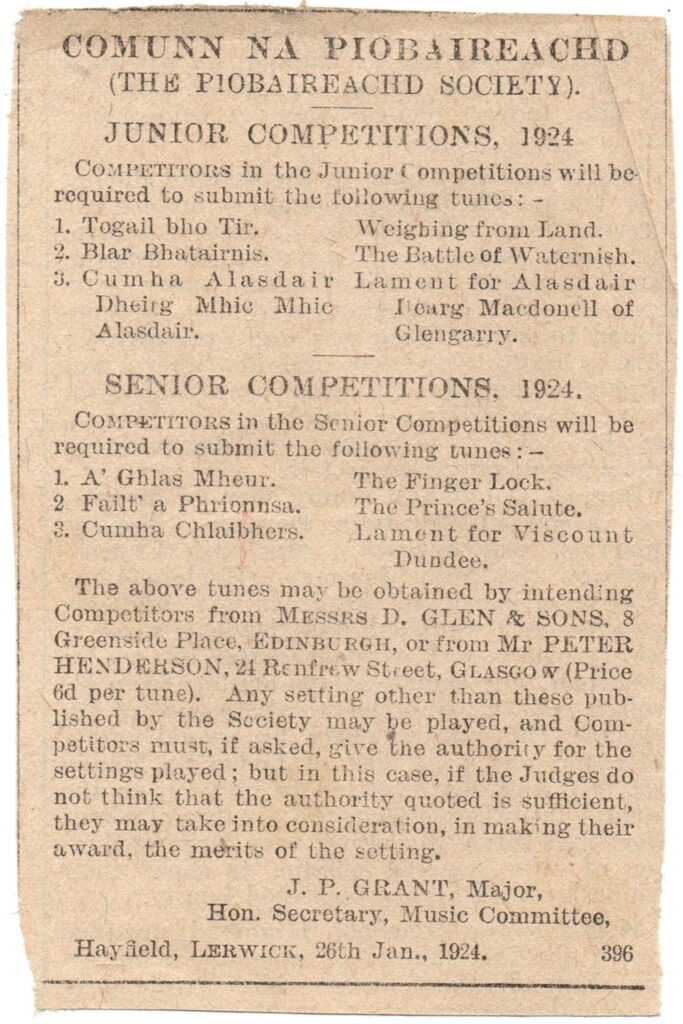
1925
In 1925 for the Junior competition at the Argyllshire Gathering and the Gold Medal at the Northern Meeting pipers were to submit Lament for Lady Macdonald, The MacGregors’ Salute, You’re welcome, Ewen Lochiel. For the Senior and the Clasp pipers were to submit The Bells of Perth, Donald Ghruamaich, Sir JasMacdonald of the Isles Salute. The notice stated, ‘The above Tunes may be obtained shortly by intending Competitors from Messrs D Glen & Sons, 8 Greenside Place, Edinburgh or from Mr Peter Henderson 24 Renfrew Street, Glasgow price 6d per tune. As before, any setting other than these published by the Society may be played, but the merit of the setting would be taken in to consideration.
Meanwhile the music committee was working on the proposed new series of publications. Archibald Campbell was still in India but was in regular correspondence with Grant of Rothiemurchus who was secretary of the music committee and the main influence in the Society. During the intervening years the set tunes for the competitions had been made available on single sheets but competitors were informed about other published settings and told that any other setting could be played but its merits, authority and authenticity would be taken into consideration.
The first book of the new series appeared in December 1925 and was advertised in the Oban Times on 12 December: ‘For Pipers, a Christmas Present. Piobaireachd. Twelve Tunes edited by the Piobaireachd Society, Price 1/6d. Patersons Publications Ltd., 152 Buchanan Street, Glasgow.’
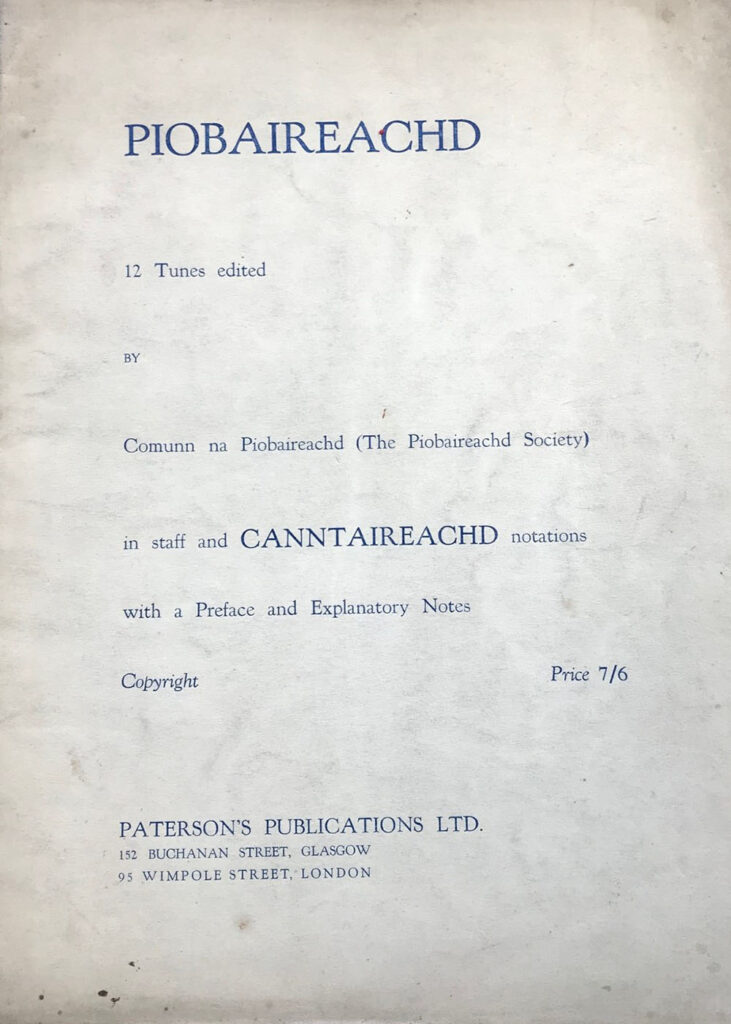
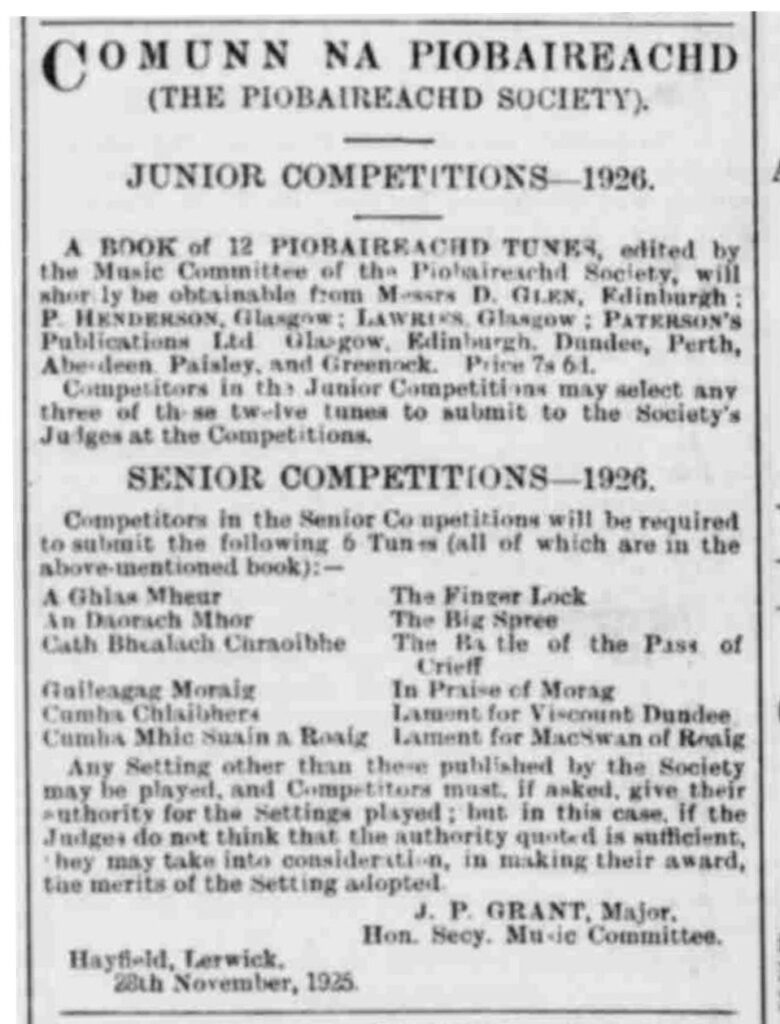
1926
The new book received a fairly good review in the Oban Times on 6th February 1926: ‘Piobaireachd. A New Publication. Issued by The Piobaireachd Society.
‘This book marks a new era in the editing of Piobaireachd. It is the first book of its kind to be furnished with a critical apparatus. Fifteen unpublished MSS are enumerated and described. The edition is founded on these unpublished MSS. Editors of former collections have generally fixed on settings that happened to appeal to themselves. But in this instance the Society, while printing some traditional setting of a tune, has also given the different versions that are to be found in their unpublished authorities. This method of editing is absolutely the correct one, for it gives all the information available, at the same time leaving it to every player to make his own choice. This method, by the way, is also the one adopted by scholars in dealing with any old or disputed text. In applying it systematically for the first time to ancient Piobaireachd, the Society has done good service to the cause which it has at heart. The critical and explanatory notes reveal a balanced judgement. They suggest to the reader how the most popular tunes, just because of their popularity, are the very pieces that are most liable to undergo change throughout the generations.
‘Following to some extent the example of General Thomason, in his “Ceol Mor,” the editors have saved much space by using abbreviations for Taorluath and Crunluath. The abbreviations are explained at the foot of each page of music. The result of this plan is that a whole tune can be contained on one page without any crowding or sacrifice of clearness. The reader can see at a glance the proportions of every tune, and also the relation between the different lines of the ground and the corresponding lines of the variations.
‘There are some printer’s errors – “An Daorach Mor” for “Mhor” pp 11, 13, and 14; on page 18 “Taoriuath” for “Taorluath”; and in par 1 of Preface “Nether Lord” for “Nether Lorn.” In the tunes The Groat, The Big Spree, and Lament for the Viscount of Dundee, we observe that the variations which are given as Crunluath a Mach do not contain the genuine movement of Crunluath a Mach at all. The part given as Crunluath a Mach in The Groat, for example is only the doubling of a Crunluath Fosgailte, and should be called by that name. Is there ancient authority for this departure? Thomason has access to several old MSS. But yet in his “Ceol Mor” he does not add a Crunluath a Mach to the three tunes mentioned.
‘A new and excellent feature of the volume is a Canntaireachd translation of the printed setting of each tune. The system of canntaireachd adopted is that of the Campbells of Nether Lorn. Fortunately, an old MS, of date 1791 survives, which contains no less than 168 tunes, and all in this particular notation. A key to the system can be got from this source alone. The notation is verbal, one word indicating a phrase, or sometimes a bar of music. Certain vowels represent the notes of the scale. Certain consonants coming before these vowels show the various beats and gracenotes.
‘As may be seen from a comparison of the verbal with the staff notation, a tune can be rendered quite correctly in Canntaireachd. The verbal system was undoubtedly the style used in the old schools of Ceol Mor; for it is only a century and a half since the staff notation was first used for the writing of piobaireachd. The verbal system had much to commend it. A tune could be put in actual words which could be dictated by the master and repeated by the pupil. Canntaireachd appealed to the ear as a spoken word, an advantage which the staff notation does not possess. The verbal system could not only be written and spoken as words, but it could be sung. If the present generation of pipers are desirous of acquiring the spirit of the old music, it is only reasonable to urge that they should at least be acquainted with the form in which the old music was taught.
‘The printing, paper and general appearance of the volume deserve high praise. The book is one which every piper might well possess.
‘Piobaireachd. Twelve Tunes edited by Comunn na Piobaireachd (The Piobaireachd Society), in Staff and Canntaireachd notations, with a preface and Explanatory Notes. Paterson Publications Ltd, Buchanan Street, Glasgow.’
Although the review of the book was on the whole positive, there were many letters criticising the settings and the way various movements had been written. This very soon became a discussion on the redundant A which continued throughout the year. Lt John McLennan had died in 1923 so was no longer able to give his opinion of the new book.
One writer, Angus Macpherson, referred instead to the matter of the Crunluath a Mach and Crunluath Fosgailte which had been raised in the review: ‘Inveran Hotel, Invershin, 10th February 1926. Sir, I have read with much interest the most excellent review given in your issue of 6th February, of the Piobaireachd Society’s new publication. It is quite evident that the writer knows his subject from A to Z, or, in other words, from Ground to Crunluadh a Mach. There is much in the new book to commend it to all pipers and lovers of piobaireachd, and I am sure it will have a wide circulation.
‘I am glad to note that the writer, in his review, has asked a direct question with regard to the Crunluadh a Mach variation given on three tunes, The Groat, The Big Spree, and The Viscount of Dundee’s Lament. He quite correctly says that this is not the genuine Crunluadh a Mach movement at all, but simply the doubling of a Crunluadh Fosgailte, and asks if there is any ancient authority for this departure.
‘More than once, Sir, I had the privilege, through your courtesy, to give my opinion in your valuable paper upon this same question, and I said then, as I say now, that there is absolutely no traditional authority for such a departure. This is a fact which cannot be confuted, and now that an abler pen than mine has taken up the subject, one would expect the Piobaireachd Society to have this gross infringement upon traditional piobaireachd removed and corrected in a book which most likely will be handed down as a standard work. The Piobaireachd Society, quite legitimately, may ask for my authority as proof of what I say. Well then, I do not think I could do better than refer them to their own publication, page 32, at the bottom of which it is noted that no symbol for such a variation can be found in Canntaireachd.
‘Could there be any more convincing proof, when for the Crunluadh a Mach proper, the symbol can be found and is given as for all other movements in piobaireachd? It must always be remembered that were it not for the Canntaireachd, a fact which the Piobaireachd Society has done well in publishing, we would not have the piobaireachd at all.
‘I noticed from the publication that this so called Crunluadh a Mach is put down to the credit of the late Donald Cameron. In doing so, I do not think that the Piobaireachd Society has paid a compliment to his memory and undoubted ability, for such a variation cannot be found even in Donald Cameron’s own manuscript book of piobaireachd, which I had the pleasure and privilege of consulting, nor in any other book ever written prior to the formation of the Piohaireachd Society. No doubt Donald Cameron, like all other learned pipers of his day, played the Crunluadh Fosgailte open or with the grip, according to his own taste or that which best appealed to his hearers; but to say that in competition he would play a Singling and Doubling with the grip and then tack on an open Doubling and call it a Crunluadh a Mach is not what I would expect nor care to believe of the man. According to traditional teaching, there is only one Crunluadh a Mach in piobaireachd, and to attempt to put it on a Crunluadh Fosgailte or a Crunluadh Breabach is attempting the impossible. Had the Piobaireachd Society noted that the Crunluadh Fosgailte would be accepted as correct if played with the grip or open, that was all that was required.
‘Let me assure your readers that I make these statements not in a spirit of arrogance but with the desire, as I am sure it is the desire of the Piobaireachd Society, that the piobaireachd be preserved and handed down in its traditional form. I am, etc, Angus MacPherson.’
Angus MacPherson was born at Badenoch in 1877, son of Calum Piobair MacPherson. He had been, a Railway Clerk, and part-time piper to Cluny, then spent three years in London 1894-97 teaching dancing. He was Piper to C Murray, Lochcarron in 1897 and Piper to Andrew Carnegie, Skibo Castle 1898-1905. Later he was an Estate Agent in Newtonmore then kept a hotel at Inveran, Invershin, from 1914 until the hotel burnt down in 1949. He won the Gold Medal at the Northern Meeting in 1923. He died at Bonar Bridge in 1976.
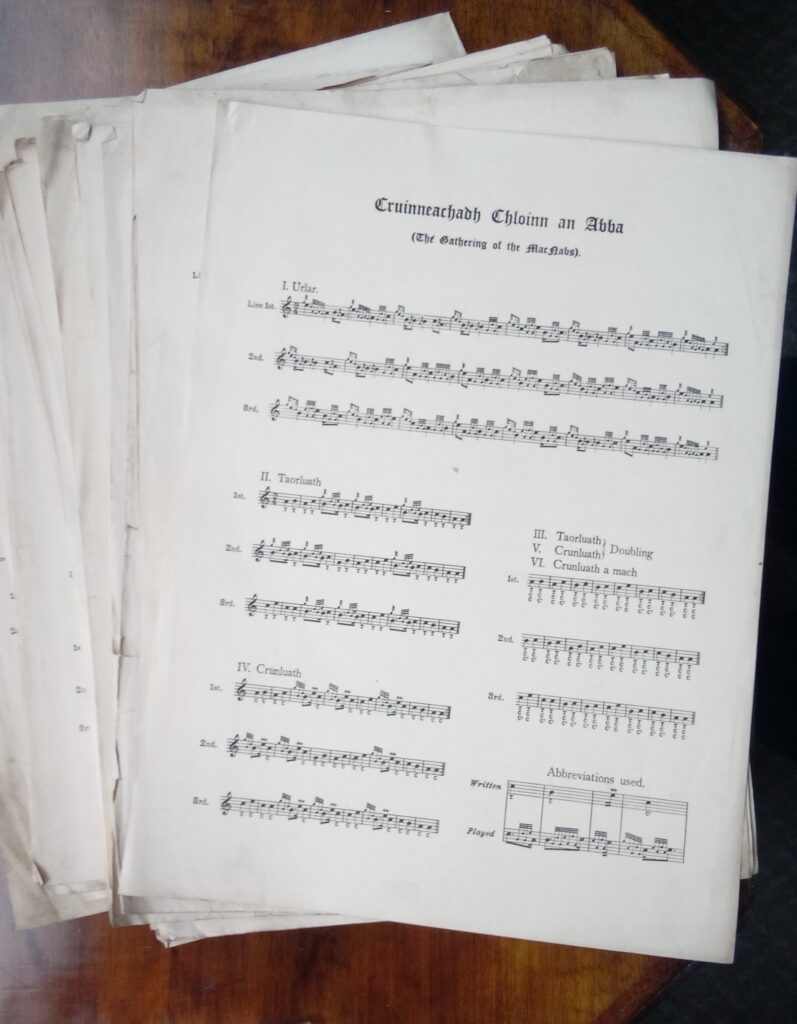
1927
In 1927 the notice for the set tunes was as follows: ‘Comunn Na Piobaireachd. The Piobaireachd Society 1927 Competitions. Competitors in the Senior Competitions will be required to submit the following tunes: 1. Cumha Dhomhnull Tuaghail Mhic Aodh. (Lord Reay’s Lament); 2. Cumha Dhuic Hamilton. (Lament for the Duke of Hamilton.) and 3. Siubhal Sheumais. (Lament for the Departure of King James); Competitors in the Junior Competitions will be required to submit the following tunes: 4. Cruinneachadh Chloin An Abba. (The Gathering of the Macnabs); 5. Cumha An T’Seana Chladheimh. (Lament for the Old Sword); 6. An Doill. (The Blind Piper’s Obstinacy.) Leaflets of the above tunes will shortly be on sale at Messrs D Glen, Edinburgh, and Peter Henderson, Glasgow- price 6d per tune. Conditions as to settings played will be as in previous years. J P Grant, Hon Secy, Music Committee. Rothiemurchus, Aviemore, 4th March, 1927.’
The notice from the Piobaireachd Society in 1928 was as follows: ‘Competitions 1928. The following tunes are prescribed: 1. An Ceapadh Eucorach. The Unjust Incarceration; 2. Blar Bhatairnish The Battle of Waternish; 3. Ceann Drochaidh Mhoir. The End of the Great Bridge; 4. Cill Chriosd. Glengarry’s March; 5. Cluig Pheairt. The Bells of Perth; 6. Spaidsearachd Dhomnuill Ghruamaich. Donald Gruamaich’s March; 7. Cumha Dhomhnuill Bhain MhicCruimein. Lament for Donald Ban MacCrimmon; 8. Blar Allt Auieann. The Battle of Auldearn; 9. Caismeachd Eachainn Mhic Ailean nan Sop. Hector MacLean’s Warning; 10. Cryuinneachadh Chloin Chatain .The Gathering of Clan Chattan: 11. ‘Se do bheatha Eoghain. You’re Welcome, Ewen Lochiel; 12. Togail bho Thir. Weighing from Land. Senior Competitions. Competitors in the Senior Competitions will be required to submit Nos. 1 to 6 in the above list, Six Tunes. Junior competitions. Competitors in the Junior Competitions will be required to submit a list of Three Tunes, selected from the twelve tunes on the above list. All of the above tunes have been set for competition previously, and settings have been printed by the Society. It is intended to re-publish them in a book within the next three or four months. Any setting other than those published by the Society can be played, and competitors must, if asked, give their authority for the settings played; but in this case, if the judges do not think that the authority quoted is sufficient, they may take into consideration, in making their award, the merits of the setting adopted. A Campbell Hon Secy, Music Committee. c/o Grindlay & Co, 54 Parliament Street, London, SW.’
1928
Book 2 came out in 1928 and containing the twelve tunes listed for the 1928 competitions. More books followed at roughly two yearly intervals until Book 8 in 1939 when again, the activities of the Society ceased for the duration. It became the custom that whenever a new book was issued the Society would set tunes from it.