

• PART 1 •
BY JEANNIE CAMPBELL MBE.

Although Dundee is never thought of as being one of the great centres of piping during the 19th century, there was quite considerable piping activity in the town at that time. There were two bagpipe makers, a pipe band was established by the Dundee Highland Volunteers, one of the earliest civilian bands was founded there and Highland Games were held over a number of years. These games experienced difficulties at times. The weather was often unfavourable, and sometimes there were financial problems. Even the large crowds attending could be a problem with reports of barriers and walls broken down, crushes of people in the park and even the collapse of an overloaded grandstand. Despite the newspapers reporting these problems the events were still described as successful. Events were usually Marches and Strathspeys and Reels, but at times there was piobaireachd as well. Many pipers also competed in the dancing which was all male, and the same judges would preside over both piping and dancing.
An historical account of the town of Dundee written in 1746 said: ‘The living were warned to bed by the sound of the bagpipe and the toll of the curfew, and the dead were carried to their graves by the tinkling of a handbell.’ This would refer to the town pipers who were employed in almost every town in Scotland. The main duty of the piper was to play around the town each morning and evening to signal the start and end of the day but they would also play at harvest times to entertain the workers in the fields and at any other local events or occasions. Sometimes they were accompanied by a town drummer. The earliest reference to the employment of a town piper is in 1497 and the latest in 1834. Surviving records show that pipers were employed in Edinburgh, Dumbarton, Biggar, Dumfries, Stirling, Lanark, Banff, Glasgow, Haddington, Linlithgow, Largs, Aberdeen, Jedburgh, Brechin, Dundee and Perth. The favoured bagpipe was the bellows blown instrument with a common stock. So residents of Dundee in these years would have been more likely to be familiar with the Lowland bagpipe than the Highland bagpipe.
The Scottish Parliament first formalised the position of ‘piper’ as a component of a Scottish Regiment in 1640, but the surviving muster rolls, from both before and after that date, show that the pipers were in fact all Lowlanders until almost the end of that century.
The pipe tune Bonnie Dundee and the song of the same name by Sir Walter Scott refer not to the town of Dundee but to John Graham of Claverhouse, Viscount of Dundee who was killed at the battle of Killiecrankie in 1689. Another well known Jacobite song is the Piper o’ Dundee in which the piper is named in the last line as Carnegie. One source suggests that Carnegie was with the Viscount of Dundee and raised funds and men, so got people to dance to his tune and was given the nickname Dundee’s piper. He survived Killiecrankie and went abroad. The words of the song refer to people and events in 1715 but this Carnegie who fought at Sheriffmuir could have been with Dundee earlier. A statement attached to one version of the song said a piper in Dundee named Antonie Court played subversive tunes but I can’t find the source for this. The tune appears in several early pipe music collections.
The 19th century was a time when many Highlanders moved south, some had to leave their homes due to the Highland clearances and others moved south looking for employment in the towns.
Interest in Highland piping in the city of Dundee was encouraged by several Highland Societies and Associations. The Dundee Highland Society was constituted 23rd September 1814 with the stated purpose of supporting poor Highlanders in Dundee. The 1834 Dundee directory for the Highland Society lists John Anderson, President; John Young, Vice-President; Rev C Macalister, Chaplain; Thomas Anderson. Treasurer; George Gauld, Secretary.
There is also an entry in the Masonic Lodges section for the Ancient Caledonian Society, Robert Pirie, Chieftain; John Sime, Vice-Chieftain; John Bogue, Treasurer; Alex Macdonald, Secretary.
The 1837-38 directory says that the Ancient Caledonian Society’s Piper was James Simpson. John Bogue appeared as Piper/Officer to the Dundee Highland Society in the directories of 1842-43, 1845, 1846-47, and 1850. The office of Piper was vacant from 1853 onward. Little is known of John Bogue for certain. He may be John Bogue, shoemaker, who appeared in the 1841 and 1851 census records for Dundee with his wife Christian and their family. Both John and Christian were born in Perthshire. He may be the son of John Bogue and Margaret Chalmers born in 1782. He married Christian Wilson in 1821 in Dundee and died in Dundee aged 71 in 1852.
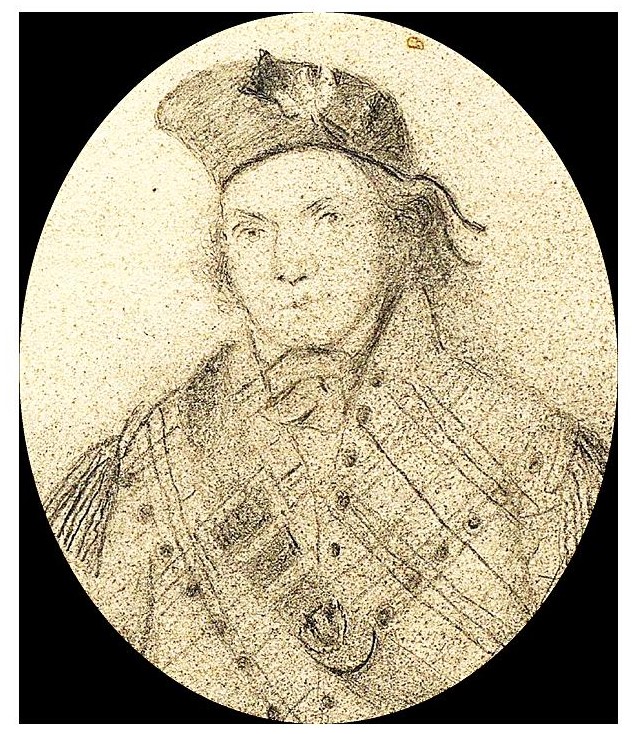
The Society commissioned a painting of Bogue which was reported in the Northern Warder and General Advertiser on 15th June 1841: ‘The Highland Society of Dundee. We understand the annual dinner of the Dundee Highland Society will take place on the 24th current, being the anniversary of the battle of Bannockburn, on which occasion the members will have the gratification of seeing a portrait of John Bogue, the Society’s piper, in full costume, painted expressly for them by Mr Caunter. We have had the pleasure of seeing the painting, a full length cabinet, and although yet unfinished, it promises to be a very masterly production. We shall have an opportunity of noticing this picture when it is completed.’ On 6th July there was further news: ‘Portrait of the Piper of the Dundee Highland Society. By R Caunter Esq. This picture is the work of a young talented artist, who has been resident amongst us for some months; and we have much pleasure in expressing our favourable opinion of his production. The picture was exhibited for the first time on Thursday week, on the occasion of the half-yearly meeting of the Highland Society; and although it was placed in a most wretched light, we were much struck by the merit of the work. It cannot be called a mere portrait, although the individual portrayed is given to the life, but is a picture containing many excellencies, and exceedingly creditable to the professional ability of Mr Caunter. The picture – a full length cabinet – represents John Bogue (en passant the bean ideal of a piper) in the centre, all plaided and plumed in tartan array, beside the lofty turret of an old baronial castle, cheering the solitude of the Highland hills with the music of his chanter. The attitude is easy and extremely natural, and the drawing good – we especially noticed the right knee and leg, which are strictly correct. The composition is diagonal, and the conception in excellent keeping with the subject. The tower is a happy idea; it adds not only character to the painting, but serves to break the straight line occasioned by the attitude of the piper, giving breadth to the whole, which would perhaps be meagre otherwise. The effect of the painting at first sight cannot be characterised as striking, possibly the bad light in which we saw it will explain this; but we are more inclined to think it arises from the harmony of the colours, which from their chaste toning, robs it of the harshness so apt at first glance to catch the eye. The minuteness of finish, on close inspection, shows the artist has a true eye to nature. We have been thus particular in noticing Mr Caunter’s painting, because we are glad to have an opportunity of introducing to public notice a young and promising artist, who, with that commendable modesty which is generally found in those who possess true merit, has always scrupled to obtain popularity by obtruding himself on public attention.’
The 1856-57 Dundee directory gives the aims of the Dundee Highland Society as “For general benevolent purposes and for relieving destitute Highlanders.” Another organisation the Dundee Highland Association was founded in 1856. Its first entry in the 1856-57 Directory, doesn’t state an organisational aim but from 1858 to 1862 the entry states: ‘For relieving destitute stranger Highlanders in Dundee, encouraging the dress, music and games of the Highlanders, and advocating and supporting the interests of Highlanders wherever or whenever at stake. Chief His Grace the Duke of Athole, President John McDonald, Vice President John Conacher, Secretary John Ross, Treasurer James Wilson, Chaplain Rev George Gilfillan A.M., Piper and Warder John Cameron. Committee meets in Thistle Hall Rooms on the first Wednesday of every month. Annual meeting 12th Jan. Annual Gathering in Barrack Park on 26th August, or Fair Day in Dundee.’
The Dundee Highland Society and the Dundee Highland Association both existed at the same time during the later years of the 1850s. Sometimes the two organisations and their events are confused in newspaper reports.
•John Charles Cameron was born in Brechin on 27th March 1796. In 1823 he was a gentleman’s servant then from 1824 a labourer then from 1838 to1859 a bagpipe maker. During this time he was also piper to the Earl of Mansfield for three years and in 1842 was described as such when he won a third prize at the Northern Meeting. From May 1843 to July 1945 he toured with a group named the Highland Pipers and Dancers, performing all over England, Scotland and Ireland. For the first two years Duncan MacKay was also a member of this group.
Cameron was involved with the Dundee Ancient Caledonian Society of which fellow piper John Bogue was also a member. The Society’s sixth rule contained the words: ‘no musical instrument shall be tolerated at the meetings of the Society, except the great Highland bagpipe; and, to encourage the keeping up of this instrument, every member capable of performing on it shall be allowed two votes in all matters decided by the Society.’
Bogue’s friendship with Cameron is demonstrated by the gift of a bagpipe composition called The Reel of the Mearns a copy of which is inscribed A New Year’s Gift from John Bogue to J. Cameron. He also composed a bagpipe tune called the Caledonian Mason’s Reel. John Bogue composed other original music and wrote variations, some of which are in Cameron’s books. In addition to his Caledonian Mason’s Reel, there are variations on Scots Wha Hae “by Eion McBhogue Phiper Commun Ghaidlealach Dundeadh” and Maggy Lauder, also credited to Eion McBhogue.
Various concerts and socials were organised in Dundee. In May 1856 a Grand Highland Concert at the Theatre Royal included among the performers Duncan MacKay formerly piper to the Duke of Leeds and Aeneas Rose Piper to the Duke of Atholl.
•Duncan MacKay was a native of Kintail but of Reay County stock. He was piper to Macpherson of Cluny from about 1828 to 1842 and during that time he made the Prize Pipe for the 1841 Northern Meeting. At the Edinburgh competition he was 4th in 1838 and 3rd in 1844. At the Northern Meeting he won first prize in 1852 after several second and third placings. In 1843 and 1844 he toured with the Highland Pipers and Dancers, a group which also included John Cameron. In 1845 he was piper to Mr Robertson of Foveran and from 1849 to 1856 piper to the Duke of Leeds. After this he lived in Glasgow where he was employed as a gentleman’s coachman before becoming piper to Captain Robertson Aikman of the Ross, Hamilton. He died at Ross Lodge, Hamilton in 1867 aged 63.
•Aeneas Rose was born in Kingussie in 1832 and was taught by John Macpherson, 1806-1880, who was the Pipe Major of the Atholl Highlanders and piper to the Duke of Atholl from 1826 for fifty-four years. Aeneas succeeded him and was piper to the Duke of Atholl for fifty years and Pipe Major of the Atholl Highlanders for forty years. He composed Lady Dorothea Stewart Murray’s Wedding Day. He died in 1905 at Blair Atholl.

From 1856 onwards there were Highland Games in Dundee. The first was under the auspices of the Dundee Highland Association and was held in the Barrack Park on Tuesday 26th August. A newspaper report described it as the first exhibition of the kind in Dundee.
Another paper reported: ‘Everything proved propitious for the occasion, the weather being delightful and the arrangements very complete. An arena about 300 feet long and 165 feet wide had been enclosed towards the north west corner of the Park and on the south side of this was a grandstand, decorated with flags, banners and evergreens, in which accommodation was provided for upwards of 1,200 people. In the centre was a raised seat for the Duke of Athole. About 30 feet in front of the stand was erected a large platform for the dancers etc. One o’clock was the time fixed for the commencement of the games; but long before that hour, the grandstand was nearly all occupied by a brilliant and fashionable assemblage, the greater proportion of whom were ladies; and several thousand spectators were congregated on the outside of the arena. The scene was a very gay and pleasant one; and we never remember seeing on any previous occasion such a large assemblage of well-dressed people in Dundee.’
The Duke accompanied by a large group of his followers in Highland dress arrived about noon and marched to the Royal Hotel for luncheon then marshalled in procession, followed by the members of the Highland Association went through the town to the Barrack Park, arriving shortly after one o’clock when they marched around the arena then took their seats in the stand and the games commenced.
Results were, Piobaireachds: First prize a Handsome Mounted Bagpipe, Duncan MacKay, late piper to the Duke of Leeds; second prize a Handsome Silver mounted Chanter, to Aeneas Rose, piper to the Duke of Athole. Playing Highland Reels first a Handsome Sporran, Aeneas Rose; second a Handsome Sgian Dubh, Duncan MacDougall. Best dressed, first a handsome silver medal, Duncan MacDougall; second a handsome silver sgian dubh, Duncan MacKay. There were the usual dancing and athletic events and some exhibitions of dancing from the Duke of Athole’s Highlanders.

Another concert was held in December, the proceeds of which were to go to the fund for erecting a National monument to the memory of Sir William Wallace. The pipers this time were Aeneas Rose and Charles Scott.
The second grand gathering was held on Wednesday 26th August 1857 in the Barrack Park. Encouraged by the success of the previous year the committee provided additional accommodation for visitors and this was fully occupied. About 8,000 were present when the games commenced. The absence of some illustrious visitors was regretted but in the absence of the Duke of Athole Sir John Ogilvy presented the prizes. The report described the gathering thus: ‘The scene altogether was animated and gladsome in the extreme. The display of flags and banners, the crowd of eager onlookers, the picturesque effect of the many Highland dresses worn, the wail and scream of the bagpipes, all contributed to the impression. The games were one and all contested with extraordinary keenness and skill. The dancing in particular was excellent, and the feats of strength might well vie with those usual at similar meetings.’ The results for piping were, Pibrochs on the Great Highland Bagpipe: first prize £5 and a handsome Silver Medal, Gilbert Gordon, piper to Lord Panmure; second prize £2.2s, Archibald Forbes Killechassie, Perthshire. For playing Highland Reels on the Highland Bagpipe, first prize a handsome timepiece presented by Mr Kelt, watchmaker, Murraygate, Duncan McDougall, Perth; second prize £1.10s. Gilbert Gordon piper to Lord Panmure. In the dancing events, Reels, Highland Fling and Reel of Tulloch John Forbes Notman from Edinburgh got three firsts. Duncan MacDougall, Perth was second for Reels and reel of Tulloch while Robert Will, Dundee was second for the Highland Fling. In order to encourage local talent in piping and dancing all Dancing Masters and persons going from place to place practising pipe playing and dancing as a means of livelihood were excluded.
•Gilbert Stewart Gordon was born in 1820 at Dull in Perthshire and was taught by his father John Gordon. In 1841 he was piper to Sir David Dundas of Dunira and in 1844 he was described as from Lude, Blair Atholl. In 1852 he was piper to Robertson of Foveran, in1853 piper to Malcolm of Poltalloch, from 1854 to 1859 he was piper to Lord Panmure then he kept the Black Bull Inn in Perth where he died in 1873 aged 53.
•Duncan MacDougall was born in Perth in 1837, when his father had a bagpipe making business there. On his father’s death in 1857 he took over the business but by 1862 he had left Perth and was Piper to Lord Elphinstone, brother in law to Lord Dunmore. Duncan returned to Perth briefly in 1865 but later that year was appointed Piper to the Prince of Wales. By 1867 he had settled in Edinburgh working first as an employee then on his own behalf as a bagpipe maker. During these years he was PM of the Edinburgh Volunteers. In about 1873 Duncan accepted the appointment as Piper to Lord Breadalbane at Taymouth Castle on condition that he was able to continue his bagpipe making business in Aberfeldy. For over twenty years he was the PM of the 5th VBRH Black Watch (Volunteers), only retiring a year before his death. He was also Pipe Major of the Breadalbane Pipe Band, which played on several important occasions at Taymouth. At the Northern Meeting he won the Prize Pipe in 1870, the Former Winners Gold Medal in 1873, Champion of Champions’ Gold Medal for Former Winners of the Gold Medal in 1876. At the Argyllshire Gathering he won the March in 1887. He died in Aberfeldy in 1898.